




Best Voice AI for Gastroenterology Practices: 4 Options Compared (2026)
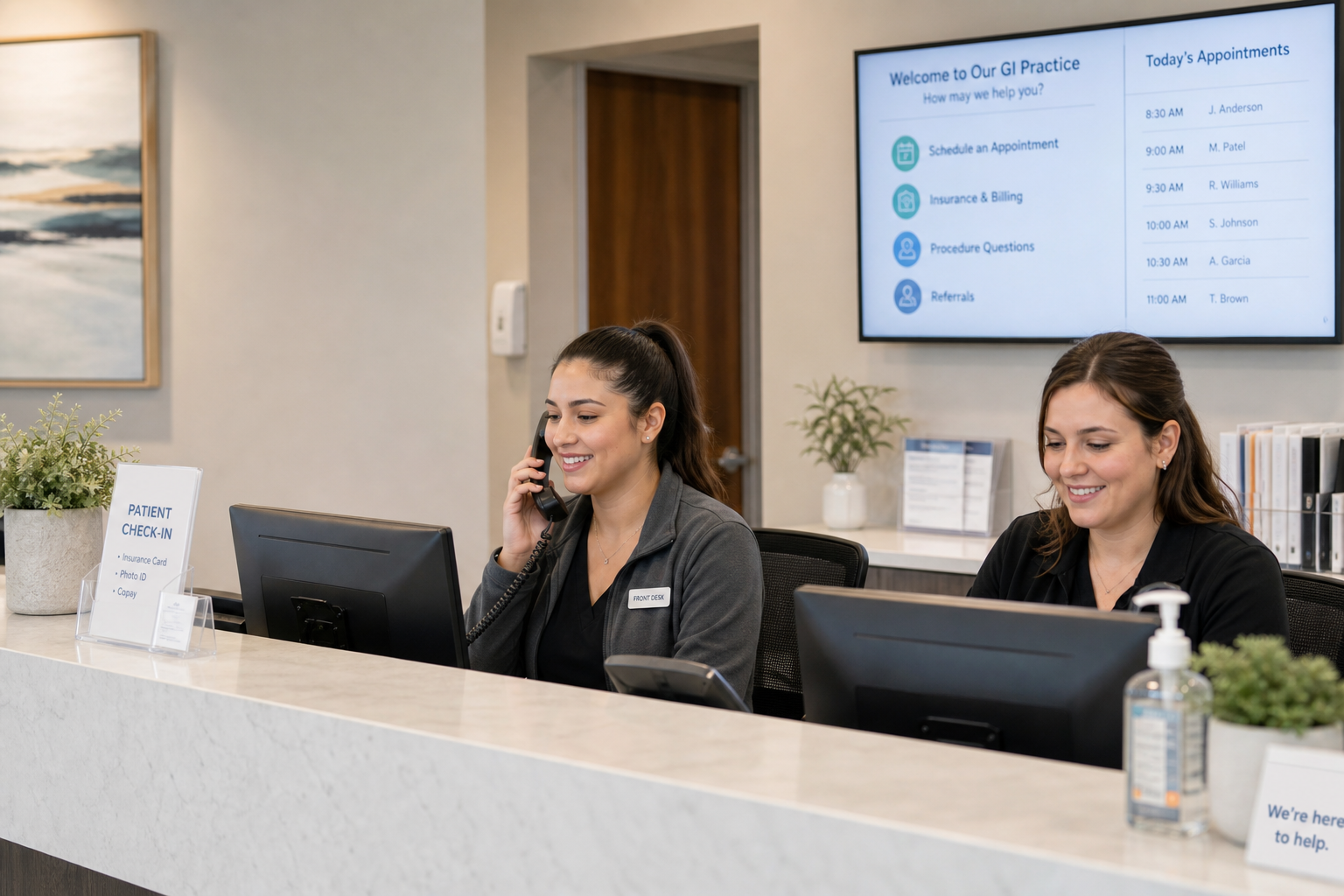
Compare 4 voice AI vendors for GI practices on colonoscopy scheduling, benefits verification, and prior auth calls. See which ones stop at booking.

One in five patients who calls a typical practice hangs up before anyone answers. If you're already mid-evaluation on an AI voice agent for healthcare, that number is probably why. What's harder to figure out is whether the tools you're looking at actually resolve calls end-to-end, or just move the handoff one step later in the workflow.
TLDR:
Healthcare call centers in ambulatory and specialty settings field a relentless mix of appointment requests, insurance questions, prescription callbacks, and referral coordination calls. Many practices still rely on front desk staff to manage that volume manually, and the math rarely works out. Call abandonment rates in healthcare often run 10% to 20%, meaning one in five patients who calls may simply hang up before anyone answers.
Staffing those lines fully is expensive. Fully-loaded labor costs for manually handled calls run roughly $18 to $22 per call by commonly cited industry estimates. And high-volume call environments drive turnover, which compounds the problem.
AI voice agents for healthcare are getting serious attention from practice leaders because they can absorb routine call types without adding headcount.
AI voice agents for healthcare are phone-based AI systems that speak with patients in real time, understand what they need, and complete the task without transferring to staff. Unlike older IVR systems that route callers through numbered menus, these agents hold actual back-and-forth conversations, verify insurance, schedule appointments, handle prescription refill requests, and write results back to the EHR automatically.
The category has matured past proof-of-concept. Several well-funded companies are now in production across ambulatory practices and health systems, and the field has moved from early pilots to live deployments with real call volume. Prosper AI operates in this space, focused on the front-office and revenue cycle call types that consume the most staff time.
What separates vendors is call coverage depth. Some handle scheduling only. Others cover prior auth, benefits verification, and billing inquiries within the same call. The architecture behind each system determines how many call types it can resolve without a human pickup.
Appointment scheduling and reminders are where most practices first deploy voice agents, and for good reason: scheduling calls often make up the largest share of inbound volume. But the use cases that deliver the most value extend well beyond the calendar.
Prior authorization AI targets one of the highest-friction points in the revenue cycle. AMA survey data indicates physicians manage roughly 40 prior authorizations per week, and many report care delays as a result. Voice agents can handle outbound auth status calls, gather payer information, and route exceptions to staff.
Many patient calls arrive outside staffed hours. Voice agents can take messages, confirm appointments, and answer common questions without sending patients to voicemail.
Balance questions and payment plan requests are high-volume, low-complexity calls that staff frequently handle manually. A voice agent can field these without clinical judgment.
The core components are straightforward.
What separates a capable voice agent from a basic one is call containment depth. Many systems can collect a name and appointment preference, then hand off. A more capable agent completes the full transaction, writing the appointment back to the EHR, running AI benefit verification, and closing the call without staff involvement.
For practice leaders vetting vendors, that distinction matters. A system that deflects 30% of calls still leaves 70% on staff plates.
Any AI voice agent operating in healthcare touches protected health information the moment it confirms an appointment, reads back insurance details, or logs a call note to the EHR. That means HIPAA-compliant AI appointment reminders and related workflows are non-negotiable, and the burden of verifying it falls on the buyer.
At minimum, every vendor should provide a signed Business Associate Agreement before go-live. Beyond that, there are several areas worth pressing on during due diligence.
A vendor that deflects on any of these questions mid-evaluation is a meaningful signal. Security architecture answers should be straightforward, not buried in legal fine print or deferred to an implementation call.
When assessing AI voice agents for healthcare, focus on a few criteria that separate genuinely capable systems from narrow tools that automate one workflow and leave the rest to staff.
Look for agents that can handle a wide call mix: appointment scheduling is the starting point, not the finish line. Reviewing AI voice agent use cases in healthcare shows that prior auth status checks, benefits verification, referral coordination, and after-hours triage all generate call volume. A system that covers scheduling but routes everything else back to the front desk has a hard ceiling on how much it can actually contain.
Ask vendors how their system handles EHR and PMS write-back. Real call resolution means data lands in the record without staff intervention. If the agent summarizes a call and hands off a task, that is assisted handling, not end-to-end resolution.
Coverage breadth times resolution rate is the number that matters. A system that handles 50% of call types at a 60% resolution rate is only resolving about 30% of total call volume.
| Evaluation dimension | Narrow-scope tool | Broad-scope agent (e.g., Prosper AI) |
|---|---|---|
| Call types covered | Scheduling only | Scheduling, prior auth, benefits verification, billing, after-hours |
| EHR / PMS write-back | Partial or staff-assisted | Real-time, no staff intervention required |
| End-to-end resolution rate | High within narrow scope (e.g., 60% of scheduling calls) | 60%+ across full call mix (based on Prosper AI's customer deployment data) |
| Effective total call containment | ~30% of total volume (50% coverage × 60% resolution) | 60%+ of total volume |
| Adding new call types | Requires vendor engineering | Self-configured as call mix expands |
| HIPAA / BAA coverage | Varies; verify full data-path coverage | BAA covers full stack including third-party LLM and speech providers |
Before any vendor conversation, practice leaders should map their actual call mix. A scheduling-only AI voice agent for healthcare leaves prior auth, benefits verification, and billing calls on staff plates. The coverage gap is what drives ROI, not the tech itself.
Three questions worth asking any vendor:
Press any vendor on what "contained" means. Ask for call-type breakdowns, not aggregate numbers. A 70% containment rate across scheduling-only calls is a very different result than 60%+ end-to-end resolution across scheduling, billing, and prior auth combined (based on Prosper AI's customer deployment data). Also ask whether "resolved" means the agent completed the transaction and wrote the result back to the EHR, or simply collected information and handed a task to staff. Those are different outcomes with different staffing implications. Architecture determines the ceiling: a system that handles scheduling but routes billing and insurance questions back to the front desk can only deflect what it was built to deflect, regardless of how the headline number is framed.
Free AI voice agent for healthcare offers are worth a close look too. Freemium tiers typically cap call volume, exclude EHR write-back, and leave the most complex call types to staff anyway.
Prosper AI handles the full inbound call surface that most voice agents leave partially staffed. Healthcare call center automation across scheduling, prior auth status checks, benefits verification, referral intake, prescription refill requests, and post-visit billing questions are all covered within a single deployment, not parceled across point solutions.
The call containment rate runs at 60%+ end-to-end resolution in production, based on Prosper AI's customer deployment data. That figure reflects real call mix, including the messy, multi-step calls that narrow-scope tools route back to staff the moment a patient asks something outside a narrow script.
Where Prosper AI does transfer to a staff member, it passes structured context so the agent picks up mid-conversation instead of starting over.
A few specifics worth noting for evaluators:
The best way to cut through vendor claims is to ask what percentage of your actual call mix gets resolved without staff touching it. Scheduling deflection alone won't move the needle if billing, prior auth, and after-hours calls still land on your front desk. See Prosper AI's full call coverage.
The architectural difference that matters most for multi-site groups is whether the system expands through self-configuration or requires vendor engineering for each new call type. Scripted, state-machine-style tools mean every new call type added after go-live goes back to the vendor. Prosper AI uses a generative, LLM-driven architecture that covers scheduling, billing, prior auth, and benefits verification within a single deployment and expands through configuration as your call mix changes. For multi-site groups with complex payer mixes or RCM-heavy workflows, that architectural difference sets the coverage ceiling on day one.
Yes, capable voice agents handle both, though most narrow-scope tools stop at the calendar. Prosper AI, for example, runs insurance eligibility checks against payer rules before the appointment, places outbound calls directly to payers for the cases payer APIs cannot resolve, and automates prior authorization status checks end-to-end, including waiting on payer hold times.
Prosper AI covers both patient-facing and payer-facing calls within a single workflow: scheduling, benefits verification, prior auth, billing inquiries, and outbound payer calls. Most healthcare AI agents, including narrower RCM-focused tools, handle one side of that equation and leave the other to staff. If your priority is reducing total call volume touching staff across the full patient journey, the relevant number to ask any vendor is end-to-end resolution rate across your actual call mix, not containment rate on scheduling alone.
Ask vendors to break out resolution rates by call type, not by aggregate containment alone. A 70% containment rate across scheduling-only calls is a different result than 60%+ end-to-end resolution across scheduling, billing, prior auth, and benefits verification combined. Also confirm whether "resolved" means the agent completed the transaction and wrote back to the EHR, or simply collected information and handed off a task to staff. Those are different outcomes.
Free tiers typically cap call volume, exclude EHR write-back, and route complex call types like prior auth and billing inquiries back to staff. Beyond that, verify that the vendor signs a Business Associate Agreement covering the full data path, including any third-party speech or LLM providers in the stack, and that call audio retention, data storage location, and access controls are documented before go-live.
Discover how healthcare teams are transforming patient access with Prosper.
Compare 4 voice AI vendors for GI practices on colonoscopy scheduling, benefits verification, and prior auth calls. See which ones stop at booking.

Compare 5 AI voice agents for ENT and allergy practices. See which handle scheduling and the payer calls for prior auth and benefits checks.

Best AI agents for orthopedic practices compared on prior auth, outbound payer calling, and billing. Only 1 vendor resolves 60%+ of calls end-to-end.


