




Best Voice AI for Gastroenterology Practices: 4 Options Compared (2026)
Compare 4 voice AI vendors for GI practices on colonoscopy scheduling, benefits verification, and prior auth calls. See which ones stop at booking.
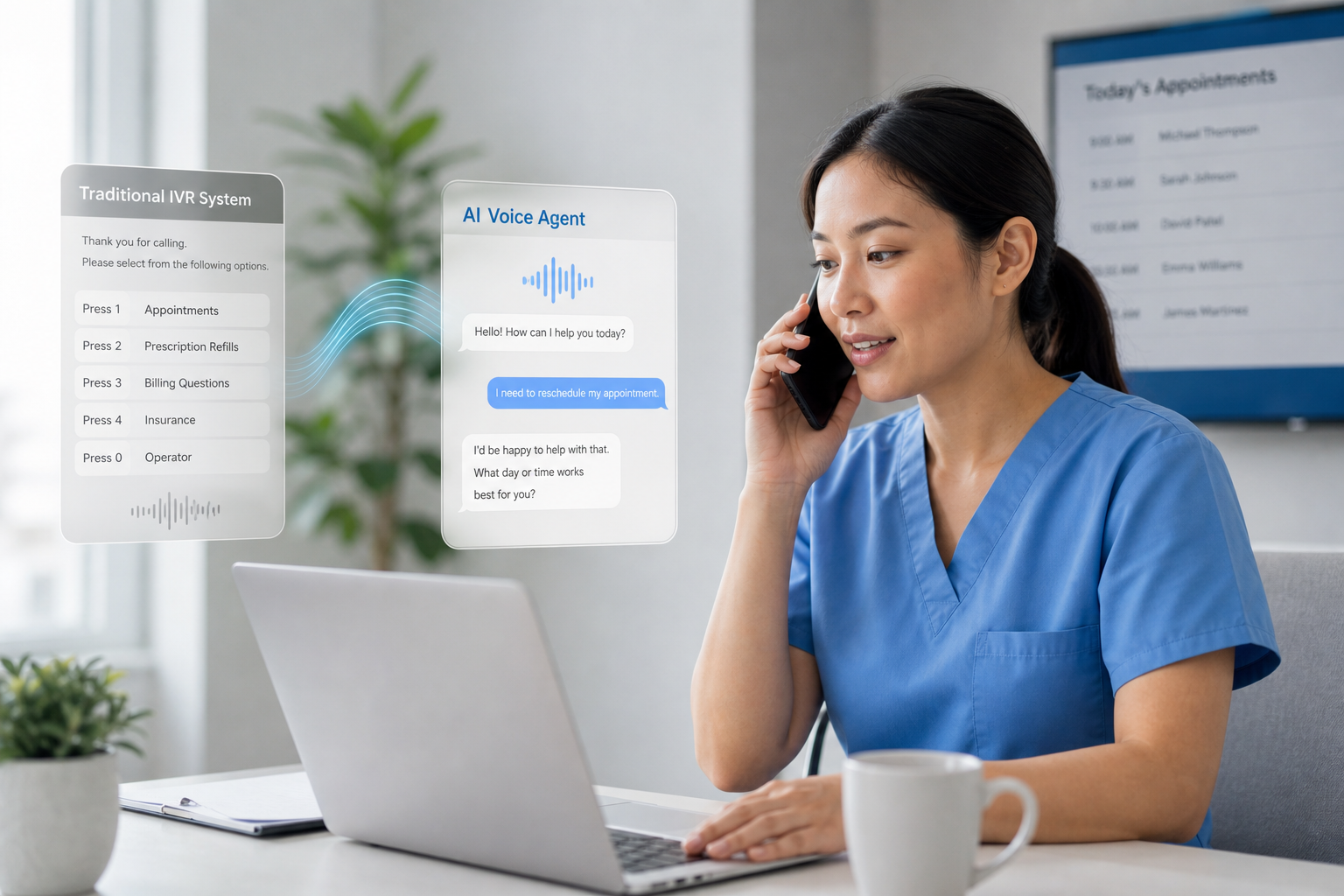
When was the last time a patient called your practice and didn't hit a menu or a hold queue? If your answer is never, you're watching revenue walk out the door every time someone hangs up before getting through. AI voice agents work differently because they don't route calls, they resolve them. No menus, no hold times, no abandonment at minute three when your front desk is already on another line handling the last caller who made it through.
TLDR:
Interactive voice response systems have been a fixture in medical offices for decades. They answer calls automatically, play pre-recorded audio menus, and route patients based on keypad input: "press 1 for appointments, press 2 for billing."
The core limitation is that IVR systems follow scripts. Every possible caller need must be anticipated in advance and mapped to a menu option. Anything outside that map either gets routed to a staff member or dead-ends.
IVR does reduce the number of calls that reach a live person. That has real value. But the calls it deflects tend to be the simplest ones. Complex requests, like prescription refills, prior auth status, or insurance questions, still land at the front desk.
Patient satisfaction with IVR in healthcare settings runs consistently low. The core reason is structural: menu-driven systems force callers to pick the closest option from a fixed list, and when the actual need falls between categories, the call dead-ends or escalates to staff. The result: high abandonment rates and staff still fielding the calls that matter most.
AI voice agents work on a fundamentally different model. Instead of routing callers through a fixed menu, they interpret what a patient actually says, infer the intent behind it, and respond conversationally without requiring the caller to pick a numbered option.
That difference matters more than it sounds. A caller who says "I need to know if my insurance covers my upcoming procedure" gets an answer, not a menu. If that same caller pivots mid-call to ask about a bill, the conversation continues without starting over. The dialog adapts to the patient, not the other way around.
Where IVR requires every scenario to be scripted in advance, AI voice agents handle scheduling and verification autonomously using natural language processing (NLP), which is the same technology that allows the agent to understand spoken intent without needing the caller to select from a preset menu. They pull live data from the EHR and return a structured outcome, with no staff intervention required for the calls they resolve.
| Capability | Traditional IVR | AI Voice Agents |
|---|---|---|
| Call handling approach | Routes calls through fixed menus based on keypad input; requires every scenario scripted in advance | Interprets natural speech and responds conversationally; adapts to patient needs without preset menu options |
| Complex request handling | Breaks down on multi-part requests like prior auth status plus billing questions; forces callers to work through multiple menus or escalate to staff | Handles multi-topic conversations in a single call; can pivot from scheduling to insurance verification without starting over |
| Availability and hold times | Limited by staff availability; creates hold queues during peak hours that drive high abandonment rates | Answers every call immediately across all hours with no hold queue or abandonment window |
| EHR and payor interaction | Cannot pull live data or make outbound calls; purely a routing and message-taking system | Pulls live data from 80+ EHR integrations and makes outbound calls to insurance companies for benefits verification and prior auth follow-up |
| Patient satisfaction | Studies show consistently low satisfaction due to menu frustration and inability to handle questions outside preset options | Higher satisfaction from conversational interactions that feel like speaking with a knowledgeable staff member |
Patients who reach a menu of eight options rarely find exactly what they need. They pick the closest match, get routed somewhere wrong, hear another menu, and hang up. That's IVR fatigue: the cumulative effect of a system that treats every caller as a routing problem.

In healthcare, the consequences go beyond a poor experience. A patient who abandons a call about a referral or prior auth may delay care. One who hangs up trying to confirm insurance coverage before an appointment can become a billing problem. That confusion creates real downstream consequences for care continuity and practice revenue that rarely show up in average call handle time metrics.
When a patient calls and can't get through, they don't always call back. A 2025 RXNT survey found that 66% of patients face access challenges, including difficulty getting appointments and reaching their provider, and many simply move on to another provider. That lost call becomes lost revenue, sometimes permanently.
Call abandonment is one of the quieter cost drivers in ambulatory care. Front desks miss calls during peak hours, lunch breaks, and after hours. Each missed call can represent a missed appointment, a lapsed patient relationship, or an unfilled slot that never gets rescheduled.
For high-volume specialties, the math adds up fast. A practice fielding several hundred calls a day can lose meaningful appointment volume just from the calls that never connect.
This is the gap that separates how IVR systems and AI voice agents actually perform in practice. IVR routes and deflects. AI voice agents answer, engage, and resolve, which means fewer abandoned calls and more appointments that actually make it onto the schedule.
Primary care practices face high call variance and a steady stream of off-script questions - prescription questions, referral coordination, insurance checks - that exceed IVR's scripted ceiling. The call mix is too unpredictable for a menu-driven system to contain, and the volume is too high for staff to absorb what IVR cannot handle. An AI voice agent that covers the full range of inbound questions end-to-end changes the math on front-desk capacity.
OB-GYN practices deal with insurance-dependent visit types where each appointment may require different eligibility checks depending on the patient's plan. Dynamic eligibility handling needs to be built into every scheduling call - IVR cannot perform that conditional logic, so insurance-dependent scheduling either stalls or falls to staff regardless of how the call was routed.
Cardiology carries one of the highest prior authorization burdens in outpatient care. Procedures like cath lab work, stress tests, echos, and EP studies require outbound payor calls that IVR cannot make. An AI voice agent that calls the insurance company directly, waits on payer hold times up to 45-60 minutes, and returns a structured outcome without staff involvement is a structural upgrade for cardiology operations - not an incremental one.
Behavioral health requires adaptive conversation handling that IVR cannot provide. Patient interactions are often sensitive, call content can signal distress or crisis, and the payer mix is complex. Voice tone calibrated for sensitive interactions, crisis call detection, and real-time routing to clinical staff when the conversation warrants it need to be built into the call handling layer - not added afterward.
MSOs managing multiple locations face a compounding version of all of the above. A centralized contact center handling calls across multiple EHRs and specialties needs one system that works across every site without per-site re-engineering. IVR requires separate configuration for each location's workflows; an AI voice agent with 80+ EHR integrations and a no-code configuration layer runs the same logic across the entire portfolio from one deployment.
Traditional IVR systems were built for volume, not complexity. They route calls. They collect callback numbers. They read office hours. That works fine for a utility company. It falls short fast in a medical practice.
The core problem is that healthcare calls rarely fit a clean decision tree. A patient calling about a referral may also have a billing question. Someone verifying insurance may need to reschedule. IVR forces those conversations into rigid menus that frustrate callers and push overflow to staff anyway.
IVR cannot initiate outbound calls to payors, creating a manual staff bottleneck for every benefits verification case that payer APIs cannot resolve - roughly 20% of all eligibility checks.
Research confirms it: patient satisfaction drops when call experiences feel impersonal or obstructive. IVR often feels like both.
Long hold times and missed calls are a known cost. Call abandonment rates in medical practices can exceed 30% during peak hours, with each missed call representing a patient who may not call back.
AI voice agents handle this differently than traditional IVR. Where IVR routes calls to staff who may already be overwhelmed, an AI voice agent picks up immediately, handles the reason for the call, and resolves it without a queue.
The mechanics behind that are worth understanding.
An AI voice agent operates across all hours without staffing constraints. Calls that would have gone to voicemail at 7 AM or abandoned at hold minute three get answered and resolved. Patients who can't reach their provider same-day often turn to walk-in clinics or switch providers entirely.
Prosper AI sits in a different category from both traditional IVR and most AI scheduling tools. Where IVR handles routing and most AI voice tools stop at appointments, Prosper AI handles the full call surface: scheduling, rescheduling, cancellations, insurance benefits verification, prior authorization status, referral questions, billing inquiries, and more.
That coverage matters because the majority of inbound call volume at most practices is not appointment scheduling. It's the other calls (the ones about benefits, prior auths, and billing) that consume the most staff time and are least likely to be handled by point solutions.
cuts calls by 60%, with staff redirecting that time toward in-office patient care.
Before signing a contract, call the vendor's live customer number and run these three tests. You do not need a demo environment or a formal evaluation to get a clear signal - you need 15 minutes.
Call any vendor's live customer number and run these three tests. The architecture gap is clear within 60 seconds. For a deeper breakdown, read our Gen 2 vs Gen 3 comparison and our 15-minute voice AI call quality test.
Yes. Prosper AI supports multilingual call opening from the first greeting, with no need for mid-call language switching. The system delivers service in the patient's preferred language from the moment the call connects, covering non-English-speaking patient populations without requiring callers to request a language change.
Press Ganey 2025 data shows 80% of healthcare consumers say scheduling convenience influences provider choice, and 46% would reconsider booking if they struggle to reach the main office. The deciding factor in patient acceptance is voice quality. Prosper AI's agents are built to sound like a knowledgeable staff member, not a phone tree. In production, patients interact naturally and complete calls without requesting a transfer. Those who escalate get a warm handoff with full conversation context - no repeat explanations needed.
At minimum: a HIPAA Business Associate Agreement (BAA), PHI handling with appropriate access and encryption controls, PCI-compliant payment processing for calls that include payment collection, and verbatim delivery of regulated disclosures rather than AI-generated paraphrases. Prosper AI meets all four. Any vendor you evaluate should confirm each standard explicitly - a blanket "HIPAA compliant" claim is not the same as a signed BAA and documented PHI controls.
IVR abandonment rates can exceed 30% during peak hours, per call center industry benchmarks. AI voice agents remove the abandonment window entirely by answering every call immediately with no hold queue. At Northeast OB/GYN, call abandonment dropped from 12% to 2% after deploying Prosper AI - an 89% reduction.
Yes. Prosper AI calls payers directly for the roughly 20% of eligibility cases that payer APIs cannot resolve automatically. No IVR system offers this, and few AI voice vendors do. Prosper AI's agents can wait on payer hold times up to 45-60 minutes to reach a live representative and return a structured verification result - all without staff involvement. For a closer look at how this works for prior authorizations, see our guide to automated prior authorization software.
AI voice agents vs traditional IVR isn't really a comparison anymore. One routes calls and hopes for the best, the other picks up, understands what the patient needs, and handles it. If your practice is still relying on menus and hold queues, you're leaving appointments on the table and burning out your staff in the process. Prosper AI goes live in 3 weeks and starts resolving calls on day one. Get started with Prosper AI and see what 60% fewer calls to your front desk actually does for your practice.
Discover how healthcare teams are transforming patient access with Prosper.
Compare 4 voice AI vendors for GI practices on colonoscopy scheduling, benefits verification, and prior auth calls. See which ones stop at booking.

Compare 5 AI voice agents for ENT and allergy practices. See which handle scheduling and the payer calls for prior auth and benefits checks.

Best AI agents for orthopedic practices compared on prior auth, outbound payer calling, and billing. Only 1 vendor resolves 60%+ of calls end-to-end.


