




The Best AI Voice Agents for Ophthalmology Practices in 2026
The 7 best AI voice agents for ophthalmology practices. Find platforms with ModMed & Nextech integrations, prior auth support, and patient automation.
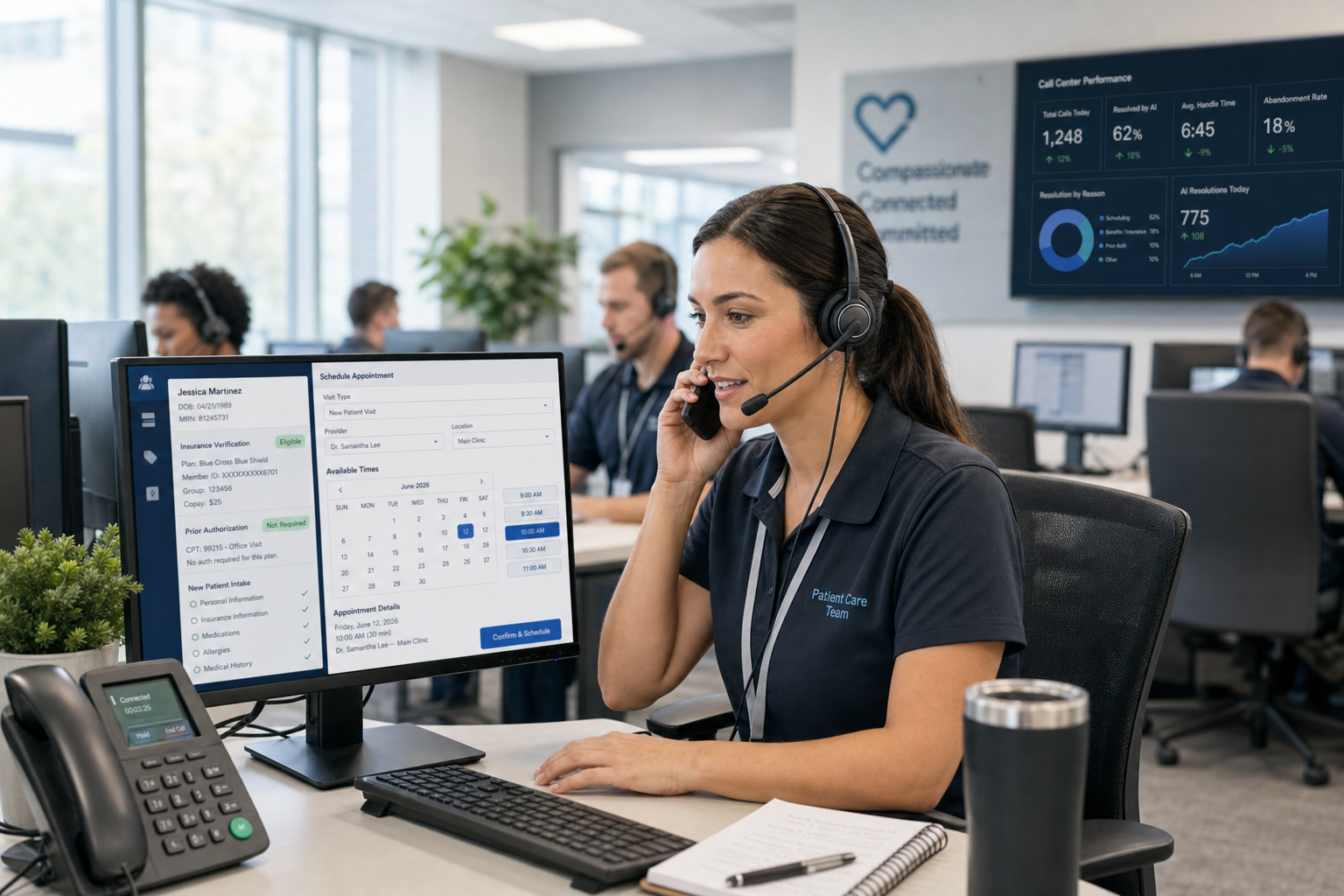
Most AI scheduling tools can tell a patient when your practice has availability. What separates tools with narrow coverage from ones that actually reduce call volume is whether they can verify insurance, check prior auth status, collect new patient intake details, and write the appointment back to your EHR without requiring staff to touch the call again. That's the difference between healthcare call center scheduling automation that shifts 30% of your workload and automation that resolves 60%+ of calls end-to-end. This guide breaks down what end-to-end resolution actually requires, where narrow-scope tools leave gaps, and which scheduling capabilities matter most when you're evaluating vendors mid-cycle. The goal is to give you a framework for comparing what different systems can handle before the demo starts.
TLDR:
Healthcare call centers field far more than appointment requests. A typical scheduling queue includes referral coordination, prior auth status checks, benefits verification, prescription refill routing, and post-visit follow-up calls. Many of these interactions require accessing the EHR, confirming insurance eligibility, and sometimes looping in clinical staff before anything gets resolved.
The result is that even a "simple" scheduling call can take 6 to 8 minutes when staff have to verify coverage, check provider availability, and document the encounter. At high-volume practices fielding hundreds of calls daily, that adds up fast.
AI can reliably handle appointment booking, confirmation, rescheduling, and basic eligibility lookups when connected to the EHR and payer data through healthcare call center automation. What it cannot do is exercise clinical judgment, triage urgent symptoms, or navigate exceptions that fall outside defined rules. The strongest implementations are clear about that boundary, routing complex or ambiguous calls to staff rather than forcing a resolution.
High call abandonment is one of the most direct signals that a healthcare call center's scheduling process is breaking down. When patients can't get through, they don't just wait — many leave and don't call back.
The numbers reflect this clearly. According to call center industry benchmarks, average abandonment rates run 8–12%, with some high-volume practices reporting rates above 20% during peak hours. Each abandoned call often represents a lost appointment, and lost appointments compound into measurable revenue gaps over time.

The downstream effects go beyond the missed booking:
Poor healthcare call center scheduling doesn't just frustrate patients. It creates a cycle where overloaded staff handle fewer calls well, which drives more abandonment, which increases callbacks, which overloads staff further.
Healthcare call centers face a specific set of scheduling problems that repeat across nearly every practice type and size.
These aren't isolated inefficiencies. They reflect a structural mismatch between call volume and available staff capacity. AI scheduling tools enter this gap, but how well they actually perform depends heavily on what they can handle end-to-end, beyond simply finding an open slot on a calendar.
Real-time EHR integration tops the list of requirements for most evaluators. Scheduling AI that cannot read and write back to your EHR or PMS creates a reconciliation burden that often exceeds whatever time the automation saves.
After that, call containment rate matters more than raw speed. A tool that resolves 60% of scheduling calls end-to-end outperforms one that answers faster but hands off constantly.
When a patient calls to book an appointment, AI voice agents can handle the entire interaction end-to-end: checking provider availability, collecting insurance information, confirming the slot, and writing the appointment back to the EHR without any staff involvement.
Most scheduling tools stop at the calendar. They confirm an open slot but hand off anything more complex to staff. That leaves a large share of scheduling calls still requiring human handling, particularly for new patients with insurance verification needs or multi-step intake requirements.
A few capabilities separate tools with broader call coverage from those with narrow scope:
| Capability | Narrow-Scope Scheduling Tools | End-to-End Automation (Prosper AI) |
|---|---|---|
| Calendar booking | Matches open slots and confirms availability with patients | Books appointments with real-time EHR write-back and no staff reconciliation |
| Insurance verification | Collects insurance details but hands off verification to staff for callback | Verifies benefits in real time during the call through payer APIs |
| New patient intake | Requires follow-up form or staff callback to collect demographics | Collects demographics and insurance details conversationally during the initial call |
| Prior authorization | Cannot check prior auth requirements, pushing work back to staff | Checks prior auth requirements against current payer rules before booking |
| End-to-end resolution rate | Resolves 20 to 30 percent of scheduling calls without staff involvement | Reaches 60 percent or higher first-call resolution in production deployments |
Healthcare call centers spend a significant portion of their operating budgets on labor, and staffing costs often scale directly with call volume. When AI handles routine scheduling calls, the math shifts: fewer calls require live agents, which means lower cost-per-interaction and more contained headcount growth even as patient volumes rise.
The ROI case tends to be clearest in three areas:
The caveat worth naming: ROI timelines vary based on call mix, integration depth, and what percentage of calls the AI can fully resolve end-to-end. Vendors claiming universal cost savings without accounting for those variables are overpromising.
Scheduling AI that can't write back to your EHR is scheduling AI that creates more work, not less. Any system worth evaluating should support bidirectional EHR integration so appointments booked during a call appear in your schedule without staff re-entry.

The key questions to ask any vendor:
Most narrow-scope scheduling tools support one or two EHR connections. A tool that covers your current EHR but not your PMS, or that writes appointments but can't pull insurance data for benefits verification, leaves staff filling gaps manually. For more on evaluating AI-powered healthcare contact center options, understanding these integration requirements is critical. That's coverage that looks good in a demo and falls short in production.
Healthcare call center scheduling performance lives or dies by a handful of metrics that most teams track inconsistently. The KPIs below give operations leaders a clear baseline for evaluating whether AI scheduling is actually working, aligned with industry benchmarks for healthcare call centers.
Tracking these numbers in isolation tells you little. The more useful question is whether resolution rates are climbing while abandonment falls, and whether staff are spending less time on routine bookings and more time on exceptions that actually require judgment.
Prosper AI handles the full call cycle, not just the moment a patient books an appointment. When a patient calls to schedule, the AI confirms eligibility and benefits in real time, checks prior auth requirements against the payer's current rules, and writes the appointment directly into the EHR. No callback. No staff handoff for routine cases.
Most scheduling tools stop at the calendar. Prosper's architecture covers the surrounding workflows that typically push calls back to staff: insurance verification, referral checks, and appointment prep instructions.
In production, Prosper reaches 60%+ end-to-end call resolution. Staff handle exceptions, clinical judgment calls, and complex cases where human context matters.
Call center scheduling tools that only match open slots leave the hardest parts of the job to staff. Benefits verification, prior auth checks, and EHR documentation still require manual follow-up when the AI stops at calendar booking. Your patients need confirmation the first time they call, not a callback two days later. If your current setup pushes most scheduling work back to staff after the initial interaction, Prosper AI resolves the full call so your team handles exceptions, not routine appointments.
Yes. AI voice agents can collect insurance information during the call, verify benefits in real time through payer APIs, and for cases where automated verification fails (~20%), the AI can call the insurance company directly to complete the verification before booking the appointment. This end-to-end capability means new patients get confirmed appointments without staff callbacks.
Traditional IVR systems use rigid menu trees that break when callers deviate from scripted paths and cannot handle tasks like insurance verification or EHR write-back. AI voice agents built on generative architecture handle multi-turn conversations, adapt to changing caller needs mid-call, and complete scheduling workflows end-to-end including eligibility checks and appointment documentation. The difference is 60%+ end-to-end resolution versus 20–30% with legacy IVR.
Industry estimates put the fully loaded cost of a manually handled scheduling call between $3 and $6 when you factor in labor, hold time, callbacks, and EHR documentation. AI-resolved calls run substantially lower per interaction. The ROI case strengthens when you account for overnight and weekend coverage, which no longer requires on-call staffing.
Track first-call resolution rate (the percentage of scheduling requests completed without callback or transfer), call abandonment rate, and average handle time. In production deployments, strong performance looks like 60%+ first-call resolution, abandonment rates dropping below 5%, and staff handle time concentrating on complex exceptions rather than routine bookings. The key signal is whether resolution rates climb while abandonment falls.
AI should escalate calls requiring clinical judgment, symptom triage, or exceptions that fall outside defined scheduling rules. Examples include patients describing urgent symptoms, requests involving complex multi-appointment coordination across specialties, or HMO new patient bookings requiring referral verification before scheduling. The best implementations route these to staff automatically rather than forcing the AI to resolve every call.
Discover how healthcare teams are transforming patient access with Prosper.

The 7 best AI voice agents for ophthalmology practices. Find platforms with ModMed & Nextech integrations, prior auth support, and patient automation.

Our September 2026 FQHC voice agent comparison covers Medicaid verification, payer calls, prior auth, and multilingual support across five tools.

AI front desk automation for multi-site groups: EHR write-back, full call coverage, HIPAA compliance, and realistic timelines. September 2026.


