




Best Voice AI for Gastroenterology Practices: 4 Options Compared (2026)
Compare 4 voice AI vendors for GI practices on colonoscopy scheduling, benefits verification, and prior auth calls. See which ones stop at booking.
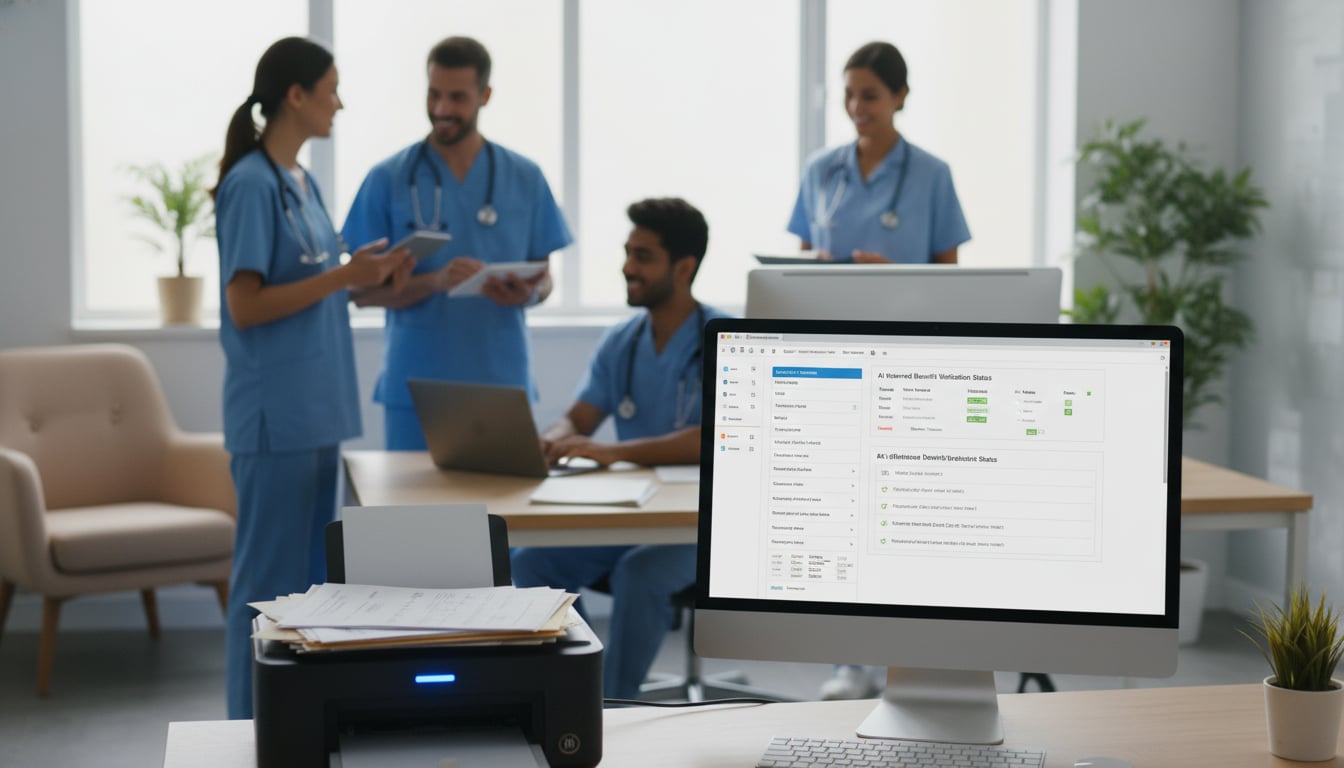
Verifying a patient’s insurance used to mean long phone calls, hold music, and tedious paperwork. This manual process is not only slow but also prone to errors that lead to costly claim denials and frustrated patients. Fortunately, the healthcare industry is shifting gears, embracing technology that automates and streamlines this critical front end task.
Welcome to the world of ai benefit verification, the process of using artificial intelligence to automatically and accurately confirm a patient’s insurance coverage. This guide will walk you through everything you need to know about how this technology is transforming insurance eligibility, making it faster, more accurate, and more efficient for everyone involved.
To understand the power of modern ai benefit verification, it helps to see how far we’ve come.
In the past, verifying benefits was a completely manual job. Staff would call insurers or send faxes, a process that could take hours or even days. The first major leap forward came with electronic benefit verification (EBV) using HIPAA mandated transactions. By 2022, adoption of these electronic systems reached about 90% for medical plans. This switch saves a medical provider an average of 14 minutes for each transaction.
Early automation often relied on logic based systems, like Robotic Process Automation (RPA). These “bots” follow a strict set of rules, like logging into a specific payer portal and clicking the same buttons every time. They are fast and efficient for repetitive tasks and have helped organizations save billions in administrative costs.
The limitation, however, is rigidity. If a payer changes its website, the bot breaks. An ai benefit verification system is different. It uses machine learning and natural language processing to understand context, adapt to changes, and handle variability. With over 1,100 health insurers in the U.S., each with its own quirks, an AI’s ability to learn and adapt is a game changer. While humans might get 70% to 80% of complex benefit details correct, a well trained AI can achieve 95% to 99% accuracy.
So what does an AI powered verification process actually look like? It involves several interconnected technologies working together to get a complete and accurate picture of a patient’s coverage.
A real time eligibility check provides an immediate, on the spot answer about a patient’s coverage. Instead of waiting hours, you can get a response in seconds. This is critical for preventing care delays, which affect roughly 22% of patients due to verification issues. The impact on the bottom line is huge. One medical practice saw its denial rate fall from 11% to just 4% after implementing real time checks, while another saw a 40% reduction in denials within months.
Not all insurance information is available through standard electronic transactions. Sometimes, staff need to log into payer portals or read dense PDF documents. AI automates this too. Software bots can log into these portals 24/7, scrape the necessary data, and even use optical character recognition (OCR) to read documents. For related workflows, see our guide to AI-powered automation solutions for healthcare call centers.
A standard eligibility check might tell you a patient has a $1,000 deductible. Real time benefit mapping goes a step further by applying that information to a specific service. If you schedule an MRI (CPT code 70551), the system can instantly tell you if that specific procedure is covered, if it requires prior authorization, and what the patient’s estimated cost will be. This granular detail helps avoid denials related to authorization issues, which account for about 11.6% of all denials.
Insurance plans are full of fine print, like limits on how many physical therapy sessions are covered per year or exclusions for certain procedures. An ai benefit verification system acts as a built in rulebook. It can automatically flag a scheduled service that might breach a frequency limit or fall under an exclusion, giving your team a chance to address the issue before a denial happens. This is incredibly valuable, as “service not covered” is the reason for over 10% of claim denials.
Implementing a smart verification process has a direct and positive impact on a healthcare organization’s financial health, especially for medical billing teams.
The primary goal of automated eligibility is denial reduction. Industry analysis shows that a staggering 85% of claim denials are preventable, with many stemming from front end registration and eligibility errors. By catching issues like inactive policies or coverage limitations before a service is rendered, providers can dramatically clean up their claims. Since reworking a single denied claim can cost an average of $72, preventing them in the first place offers a massive return on investment.
What about patients listed as self pay? Studies suggest that 20% to 40% of these patients actually have billable insurance coverage that was missed during intake. Coverage discovery automation uses advanced tools to search databases and uncover these hidden policies. This process can turn millions of dollars in potential write offs into payable claims, significantly reducing the financial strain of uncompensated care. For a step‑by‑step overview of best practices, see benefits investigation.
In an era of price transparency, patients expect to know their out of pocket costs upfront. In fact, 75% of patients say this knowledge influences their choice of provider. Accurate cost estimates are only possible with precise, real time benefit data. An ai benefit verification system provides the detailed deductible, copay, and coinsurance information needed to generate reliable estimates, building patient trust and preventing surprise bills.
Not all automated systems are created equal. A truly effective solution is built on a foundation of quality control, intelligent design, and seamless integration.
The old saying “garbage in, garbage out” is especially true for AI. Data quality governance involves the policies and processes that ensure the data fed into your AI system is accurate and consistent. With about 20% of patients finding errors in their medical records, and 56% of providers citing patient information errors as a major cause of denials, clean data is non negotiable. A good system will have checks and balances to flag discrepancies and maintain data integrity.
Even the most advanced AI needs a helping hand sometimes. A human in the loop system design means that while AI handles the vast majority of verifications automatically, it knows when to flag a complex or uncertain case for human review. For instance, if an AI voice agent for healthcare gets a confusing response from a payer, it can seamlessly hand the task off to a human staff member. This hybrid approach combines the speed of AI with the critical judgment of experienced professionals, ensuring near 100% accuracy.
To manage the human in the loop process, AI systems use a dynamic confidence threshold. The AI assigns a confidence score (e.g., 0 to 100%) to its results. You can set a threshold, say 95%, so that any verification with a lower score is automatically sent to a human for a second look. This provides a crucial safety net, balancing the need for speed with the demand for accuracy.
Insurance payers are constantly changing their policies, and about 67% of healthcare organizations have noticed these changes are happening more frequently. A payer surveillance method is a system for continuously monitoring payer websites, bulletins, and policy documents for updates. This ensures your verification rules are always current, preventing denials that happen simply because your team was working with outdated information.
On a more technical note, some advanced ai benefit verification platforms use tools like genetic algorithms for feature selection. Inspired by natural selection, these algorithms help the AI determine which data points (e.g., patient age, procedure code, insurance type) are most important for making accurate predictions, such as the likelihood of a claim denial. This makes the AI model smarter, faster, and more efficient.
Adopting a new technology platform requires careful planning, from integration and training to choosing the right partner.
The true power of automation is unlocked when it’s integrated directly into your existing Electronic Health Record (EHR) and Practice Management System (PMS). A well integrated solution pulls patient data from your system, runs the verification, and posts the results back without staff ever having to leave their primary software or perform double data entry. When evaluating solutions, always ask about their integration capabilities. Leading platforms like Prosper AI offer seamless integration with major EHRs to embed these powerful checks into your team’s existing workflow.
Proper onboarding and training are critical for a successful rollout. A surprising 46% of healthcare organizations report that a lack of thorough training contributed to an increase in claim denials. Staff need to understand what the AI does, what their role is in the new workflow, and how to handle exceptions. A good vendor will provide comprehensive training and support to build user confidence and ensure the technology is used to its full potential.
How do you know if your investment is paying off? A performance dashboard with metric tracking is your control panel for success. It displays key performance indicators (KPIs) in real time, such as:
Tracking these metrics is essential for demonstrating ROI and identifying areas for continuous improvement. A great system should make it easy to see progress, like a denial rate dropping from 11% to 4%.
Automating benefit verification isn’t just a win for the billing department. It creates a ripple effect of positive change that benefits everyone.
Selecting the right partner is crucial. When evaluating solutions for ai benefit verification, consider these criteria:
By carefully evaluating these factors, you can find a solution that will truly transform your revenue cycle. Are you ready to see how an advanced ai benefit verification platform can help your organization? Request a demo to get started.
1. What is the main benefit of AI benefit verification?
The primary benefit is a significant reduction in claim denials. By catching eligibility errors, coverage limitations, and authorization requirements upfront, ai benefit verification ensures that claims submitted are clean and accurate, leading to faster payments and less rework.
2. Can AI completely replace human staff for verifications?
Not entirely. The most effective approach is a “human in the loop” system where AI handles the vast majority (90% or more) of routine verifications. Humans then step in to manage complex exceptions or cases where the AI has low confidence, ensuring maximum accuracy.
3. How does AI handle the thousands of different insurance plans?
Unlike rule based systems, AI uses machine learning to learn and adapt. It can be trained on vast amounts of data to recognize patterns across different payer portals, documents, and phone systems, allowing it to handle the variability of the U.S. insurance landscape.
4. How long does it take to implement an AI benefit verification system?
Implementation times vary, but modern, cloud based solutions with pre built integrations can often be up and running in a matter of weeks, not months. A good vendor will have a streamlined onboarding process to get you started quickly.
5. Is AI benefit verification secure and HIPAA compliant?
Yes. Reputable vendors in the healthcare space build their platforms with security as a top priority. They must adhere to strict HIPAA regulations, using data encryption, secure connections, and audit trails to protect patient information.
6. How does automated verification improve the patient experience?
It leads to a faster, more transparent process. Patients experience shorter wait times at check in, get clear and accurate estimates of their costs before treatment, and avoid the stress of surprise bills or dealing with claim denial issues later on.
7. What kind of ROI can we expect from an AI verification platform?
The ROI comes from multiple areas: reduced costs from reworking denials (which average $72 each), recovered revenue from fewer write offs, saved labor costs from automating manual work (about 14 minutes per check), and improved cash flow from faster payments. Many organizations find the technology pays for itself very quickly. Ready to calculate your potential ROI? Request a demo to see how the numbers work for your practice.
Discover how healthcare teams are transforming patient access with Prosper.

Compare 4 voice AI vendors for GI practices on colonoscopy scheduling, benefits verification, and prior auth calls. See which ones stop at booking.

Compare 5 AI voice agents for ENT and allergy practices. See which handle scheduling and the payer calls for prior auth and benefits checks.

Best AI agents for orthopedic practices compared on prior auth, outbound payer calling, and billing. Only 1 vendor resolves 60%+ of calls end-to-end.


