




Best AI Agents for Orthopedics: September 2026
Best AI agents for orthopedic practices compared on prior auth, outbound payer calling, and billing. Only 1 vendor resolves 60%+ of calls end-to-end.
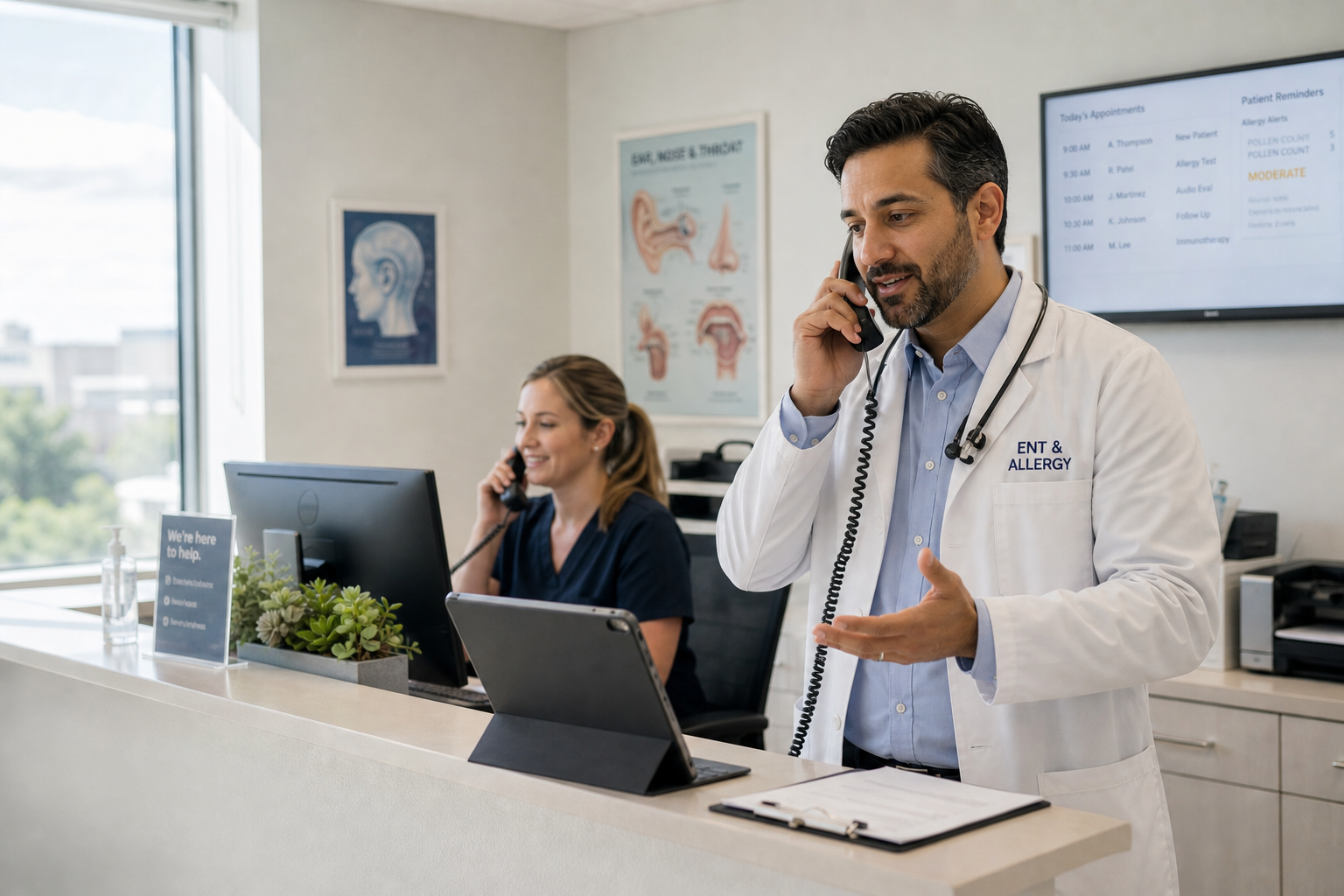
For ENT and allergy practices, the best AI voice agent is the one that keeps working after the appointment is booked. Prosper AI is the only vendor in this comparison that handles patient calls (scheduling, intake, after-hours) and payer calls (benefits verification, prior auth follow-up) in one workflow. The other 4 cover the patient side and leave most payer work to staff.
Scheduling is the easy part. Prior auth follow-up, benefits checks, and billing calls are where most tools tap out, and your staff picks up the slack.
AI voice agents for ENT and allergy practices are healthcare voice AI agents that handle inbound and outbound calls for scheduling, insurance verification, prior authorization follow-up, billing questions, and after-hours coverage, then write each outcome back to the EHR. They hold natural, multi-turn conversations, so a patient can switch from rescheduling to a coverage question mid-call without getting transferred.
ENT call volume spans surgical scheduling, audiology, allergy testing, and recurring immunotherapy visits. A voice agent works as an always-on extension of the front office, so staff can spend their time on the calls that need a person.
We ranked each vendor on how much of an ENT and allergy practice's phone work it can finish without staff, from booking the visit to clearing it with the payer. That scope matters because prior auth is a daily workload. According to AMA, physicians complete an average of 40 prior authorizations per week, which eats up about 13 hours of physician and staff time. Each manual prior auth costs specialists $15.12, versus $6.61 electronically.
ENT procedures like tonsillectomies, septoplasties, sinus surgeries, and audiology diagnostics routinely need prior auth, and allergy practices add biologic and immunotherapy authorizations on top. Here are the criteria we used:
A vendor that only handles scheduling leaves payer calls, benefits checks, and billing questions on your staff's plate.
Prosper AI is a healthcare-native AI workforce of voice agents built to cover the full administrative call surface, from inbound scheduling through outbound payer calls, without splitting the workflow across multiple vendors. For ENT and allergy practices where prior authorization for sinus surgeries, septoplasties, audiology diagnostics, and allergy biologics is routine, that end-to-end scope matters more than it does in lower-complexity specialties.
Here is what that looks like in practice:
Prosper AI is the only option in this comparison that automates both patient-facing and payer-facing calls within a single workflow, making it the strongest fit for ENT practices vetting voice AI for healthcare front-desk automation with high procedure volume and complex payer requirements.
Assort Health is a patient-facing AI voice agent for specialty scheduling. It raised a $120M Series C in June 2026. Using a scripted agentic state machine, the architecture is deterministic and auditable, which works well when call flows are narrow and predictable.
What they offer:
For ENT practices with stable, narrow scheduling workflows, Assort is functional. The limitations show up fast in higher-complexity settings: eligibility is handled through a post-call web form instead of real-time in-call verification and expanding to new call types after go-live requires vendor engineering instead of self-configuration. ENT practices with routine prior authorization for sinus surgeries or audiology diagnostics will likely hit that ceiling within the first few months.
Over $95M raised and deployed across 45+ health systems (per Hyro), Hyro is purpose-built for large health system scale. It handles patient-facing conversations well, particularly where Epic integration and multi-channel reach matter.
What they offer:
Hyro is a reasonable fit for large health systems that need patient-facing call containment at scale. The gap for ENT practices is payer-side coverage: Hyro handles patient-facing interactions but does not automate outbound calls to insurance payers for prior authorization, benefits verification, or claims follow-up. For an independent or PE-backed ENT and allergy group where surgical prior auth for tonsillectomies or sinus procedures generates daily call volume, that gap is hard to work around.
Parakeet Health launched in October 2024 with a generative AI voice agent focused on patient engagement, securing $3 million in seed funding led by Canvas Ventures.
What they offer:
For ENT practices researching voice AI use cases for specialty clinics and wanting to automate outbound patient engagement alongside basic scheduling, Parakeet is worth considering. Publicly available information does not document real-time in-call insurance verification, outbound payer calls for prior authorization, or billing call automation. ENT surgical workflows, where tonsillectomy and sinus procedure prior auth drives daily volume, need that payer-facing capability built in. Practices with complex prior authorization requirements will likely find the coverage gap too wide.
Hello Patient is a generative AI voice agent purpose-built for outpatient medical practices, handling scheduling, intake, and after-hours coverage through an AI agent named Mia. It raised $22.5 million in Series A funding and now powers 10,000 to 20,000 provider-patient conversations per day.
What they offer:
For smaller ENT practices researching AI voice agents in healthcare that need multi-channel patient communication without a heavy implementation lift, Hello Patient is a credible option. The constraint is payer-side coverage: insurance verification, prior authorization calls, and billing automation.
This table compares the 5 vendors on the capabilities that decide how much ENT and allergy phone work actually gets automated, from scheduling to payer calls. Competitor details come from each vendor's public materials as of 2026.
| Capability | Prosper AI | Assort Health | Hyro | Parakeet Health | Hello Patient |
|---|---|---|---|---|---|
| Inbound scheduling and rescheduling | Yes | Yes | Yes | Yes | Yes |
| After-hours coverage | Yes | Yes | Yes | Yes | Yes |
| Real-time in-call insurance verification | Yes (payer API + payer call) | Partial (electronic check at intake) | Partial (basic verification) | No | No |
| Outbound payer calling for prior authorization | Yes | No | No | No | No |
| Billing call automation | Yes | Partial (patient balances only) | Partial (patient balances only) | No | Partial (patient balances only) |
| EHR write-back integration | Yes | Yes | Yes | Yes | Partial |
| Multilingual support | Yes | Yes | Yes | Yes | Yes |
| RCM workflow coverage | Yes | No | No | No | No |
Prosper AI is the best fit for ENT and allergy practices because it automates the payer calls that other voice agents hand back to staff. Those calls decide whether a booked surgery gets paid. Eligibility errors like inactive plans, lapsed coverage, and wrong member IDs are the third-largest cause of claim denials. And more than half of providers still checking eligibility by hand spend over 10 minutes per check.
Prosper AI's two-stage insurance verification, outbound payer calling for prior authorization, and 80+ EHR integrations for ENT practices are the structural reasons it outperforms the other options here. Every other vendor in this comparison hands at least one of those workflows back to staff. Prosper AI handles all of them within a single automated workflow, which is why it is the only option that actually covers the full administrative surface of an ENT practice.
See end-to-end coverage with Prosper AI.
Start by mapping your full call mix, not merely scheduling volume. ENT practices with routine prior authorization for sinus surgeries, septoplasties, and tonsillectomies need a vendor that covers outbound payer calls and in-call insurance verification, beyond appointment booking. Any vendor that hands payer-side workflows back to staff is automating less than half the problem.
They can be, if the vendor signs a Business Associate Agreement (BAA) and holds independent security certification like SOC 2 Type II. Ask for both before any patient call data flows. Prosper AI signs a BAA with every customer and is SOC 2 Type II certified.
Ask directly whether the tool writes outcomes back to your EHR, handles outbound calls to insurance payers for prior authorization without staff involvement, and covers billing inquiries in addition to scheduling. Then call a live customer number and test whether the agent handles an off-script insurance question or a mid-call topic change without transferring.
A scripted system works when call flows are narrow, stable, and predictable. ENT practices with mixed surgical and audiology scheduling, complex payer requirements, and billing inquiries generate enough intent variance that scripted architectures quickly hit their coverage ceiling. Generative systems handle mid-call topic changes, off-script questions, and multi-step payer interactions that scripted state machines require vendor engineering to support.
Yes, if the agent can follow your rules for allergy testing, recurring immunotherapy injections, and biologic follow-ups. Allergy practices should also test payer-side coverage, since biologics for asthma and chronic rhinosinusitis with nasal polyps usually need prior authorization. Prosper AI learns practice-specific appointment rules during implementation and handles the payer calls tied to them.
Published go-live timelines range from about 3 weeks to several months. Prosper AI goes live in 3 weeks with no custom coding. Assort Health reports an average of 7 weeks from data access, and Hello Patient says most clients go live in about 6 weeks.
Discover how healthcare teams are transforming patient access with Prosper.

Best AI agents for orthopedic practices compared on prior auth, outbound payer calling, and billing. Only 1 vendor resolves 60%+ of calls end-to-end.

The 7 best AI voice agents for ophthalmology practices. Find platforms with ModMed & Nextech integrations, prior auth support, and patient automation.

Our September 2026 FQHC voice agent comparison covers Medicaid verification, payer calls, prior auth, and multilingual support across five tools.


