




AI Voice-Enabled Patient Engagement: What Specialty Practices Should Expect in 2026
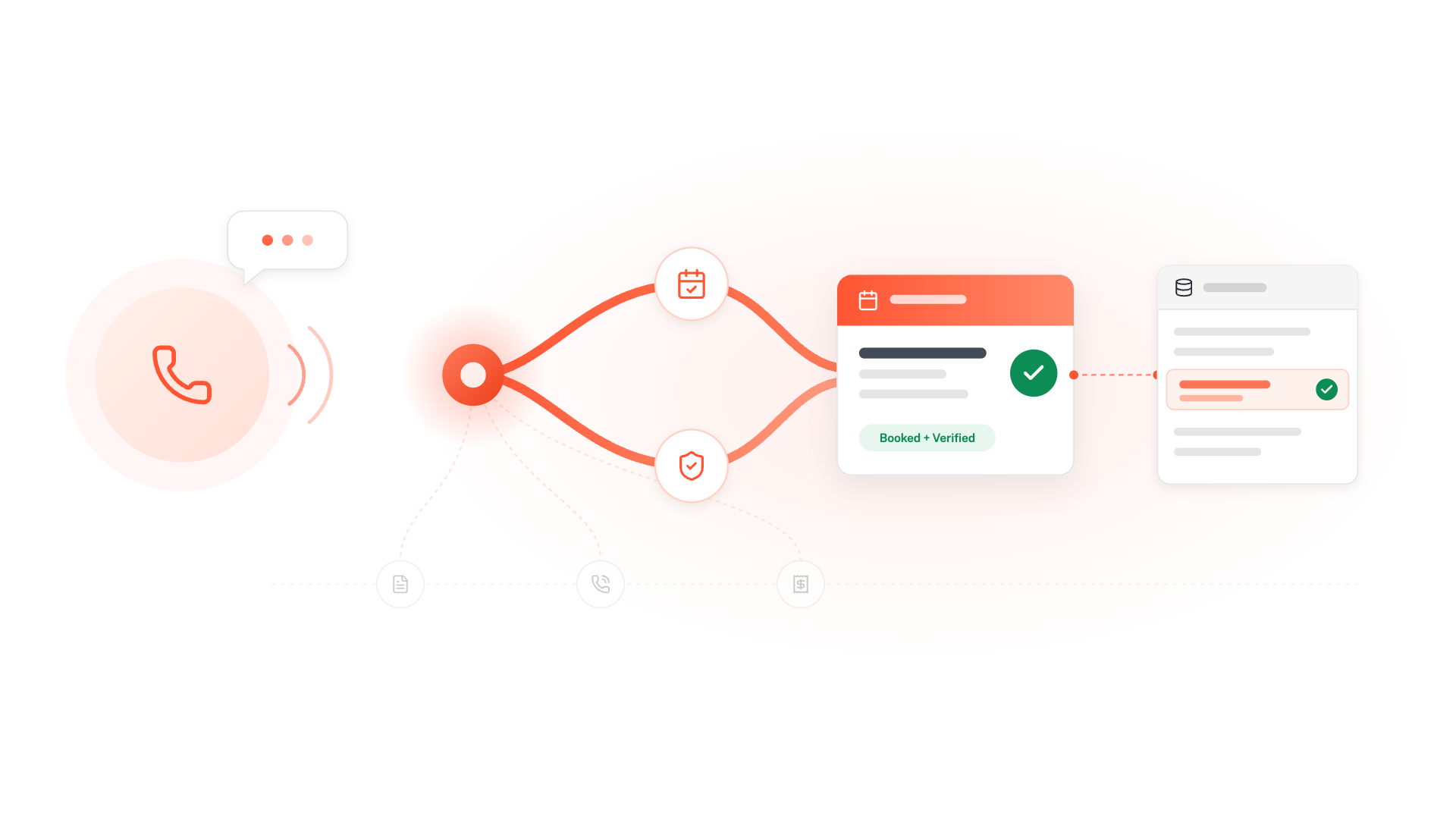
AI voice-enabled patient engagement now covers scheduling, benefits verification, prior auth, and billing calls in one system. See what to evaluate be

If you're weighing an AI receptionist for your practice, you've probably already seen a demo where everything goes smoothly. The patient calls, the AI books the appointment, done. What those demos rarely show is what happens when a patient calls to reschedule, asks about their copay, and then wants to know if their new insurance is accepted, all in one call. That's the real test, and it's where most systems hit a wall. Here's a clear-eyed look at how AI receptionists work, what the different options cover, and what actually matters when you're choosing one.
TLDR:
Front-desk turnover hit a multi-year peak of roughly 47% in 2025, with average time-to-fill for medical receptionist roles stretching to 62 days. Hiring your way out of call volume stopped being a reliable strategy a while ago. That staffing pressure is driving most practices toward AI receptionists.
In concrete terms, an AI receptionist answers inbound calls, schedules and reschedules appointments, handles cancellations, sends reminders, covers after-hours calls, and fields common questions about insurance, directions, and office hours. When it completes a task, it writes the outcome directly to the EHR, so staff don't have to manually enter the result.
What it does not do: clinical triage, prescription decisions, or any judgment call requiring medical knowledge. Those still belong to staff. The accurate framing is that an AI receptionist handles the high-volume administrative layer so your team can focus on the calls that actually need a human.
Three models dominate the market right now, and they serve genuinely different needs.
Remote human receptionists handle complex, judgment-heavy interactions well, but cost scales linearly with volume and coverage hours. After-hours and weekend calls mean paying for round-the-clock staffing.
AI voice agents handle high-volume, repeatable calls, including scheduling, reminders, FAQs, and insurance questions, at a fixed cost regardless of call volume. They cover 24/7 without shift premiums. The tradeoff: truly complex or sensitive calls still need a human in the loop.
Hybrid models layer both: AI handles the first pass and routes unresolved calls to a pool of human agents. This works well for practices with a high proportion of complex calls or patients who strongly prefer live interaction.
A rough self-qualifier:
Most mid-size outpatient groups land in the AI-first or hybrid category, depending on how much of their call mix is genuinely routine.
Three architectural generations exist in this market, and the differences are structural, not cosmetic.
AI voice agents vs. traditional IVR systems show that Gen 2 and Gen 2.5 systems have a coverage ceiling set at build time. Adding a new call type requires vendor engineering, not self-configuration. Gen 3 systems handle adaptive, multi-turn conversations and write structured outcomes directly back to the EHR, which is why they can resolve a broader slice of your actual call mix.
Scheduling typically accounts for 40-50% of inbound volume. Billing, insurance questions, refills, and FAQs make up the rest. A scripted system built for scheduling leaves the majority of your call surface unautomated, regardless of what the marketing page says. The right buyer question: not "what's your deflection rate," but "what's your deflection rate on my total call mix, and how will it expand over the next 18 months?"
Inbound calls at most outpatient practices break down roughly like this: scheduling and rescheduling (~50%), billing and insurance questions (~25%), clinical and refill requests (~20%), and FAQs (~5%). An AI receptionist that only handles scheduling is covering half the board at best.
A full-coverage deployment handles all of the following without staff involvement:
The distinction that matters: scripted systems handle stable, single-intent calls cleanly. A patient who calls to reschedule, then asks about their copay, then wants to know if the provider accepts their new insurance mid-call is not a single-intent call. AI-native agents track that shift and continue; scripted systems get stuck or transfer.
Partial coverage rarely reduces front-desk workload in practice. Selecting the best voice AI for healthcare front-desk automation matters: if the AI resolves scheduling calls but can't handle billing questions, staff still field every billing call, every refill request, and every off-script call the AI punts. Those calls tend to be the harder ones.
Any voice AI vendor handling protected health information must sign a Business Associate Agreement. As federal law requires, this is non-negotiable. If a vendor hesitates on a BAA, stop the evaluation there.
Beyond the BAA, the compliance checkpoints worth verifying:
SOC 2 Type II matters more than Type I. Type I is a point-in-time snapshot; Type II covers six to twelve months and reflects how controls hold up in production. Ask which one the vendor holds.
State call-recording consent laws add another layer. Two-party consent states require notifying all parties before recording begins. If your patient population spans state lines, confirm the vendor's recording disclosure logic accounts for where the patient is calling from, and not merely where your practice is located.
Read-only EHR integration looks functional in a demo. When comparing voice AI systems for patient call automation, in production it moves the work without eliminating it: the AI gathers information, then a staff member manually enters the result into the EHR. One step becomes two, and the second still belongs to a human.
Bidirectional integration means the AI books directly in the system of record, captures insurance fields, and automatically creates structured notes. No manual entry, no follow-up data task.
Here are the questions worth asking during evaluation:
Integration depth is the single most important technical criterion in any AI receptionist evaluation. A system with shallow integration sets a hard ceiling on what it can automate, regardless of how capable the voice layer sounds. Ask every vendor: "Show me exactly what gets written to the EHR after a completed call, and what your staff still has to touch."
Transfers happen. A well-designed system treats them as a workflow outcome, not a failure.
Common triggers include clinical questions, complex insurance edge cases, HMO referral requirements, and any caller who asks to speak with a person. These should route immediately without the AI attempting to resolve them.
What separates a good handoff from a bad one is context preservation. When Prosper AI transfers a call, it writes detailed notes to the EHR and passes full conversation context to the staff member before the handoff completes. The patient does not repeat themselves. The staff member picks up knowing what was discussed, what was attempted, and what remains open.
Ask any vendor: what does the staff member see when a transferred call lands?
Research suggests healthcare call centers running a 7% abandonment rate on 2,000 daily calls see roughly 140 calls abandoned each day.
Most practices lose calls in predictable windows: Monday mornings, the lunch hour, the end of the day, and anything after 5 PM. AI after-hours patient scheduling without extra staff converts calls that would otherwise disappear into booked appointments.
After-hours calls get answered with the same workflow as peak-hours calls, not a degraded answering service. At one Prosper AI customer, 40% of AI-booked visits were same-day or next-day appointments, reflecting the direct revenue recovery possible when cancellation slots get filled instead of sitting empty overnight.
Human staffing cannot solve a volume problem that spikes unpredictably. Coverage that runs continuously, without shift premiums or Monday-morning backlogs, is the structural answer.
Specialty determines how much of your call mix an AI receptionist can realistically resolve. High scheduling variance, complex insurance rules, and prior authorization requirements push toward AI-native architecture. Simpler, stable visit patterns can often run on scripted tools.
Strong architectural fit:
Scripted tools tend to be sufficient for practices with narrow, stable scheduling patterns: imaging centers, dialysis scheduling, and single-specialty optometry. These settings have low intent variance and rarely require mid-call pivots or insurance reasoning.
The practical test: if a patient commonly calls with more than one question, or if your payer mix requires insurance verification before confirming a slot, a scripted system will hit its ceiling quickly.
Six metrics tell you whether your AI receptionist is actually reducing staff workload or just answering calls:
The distinction that matters most is "calls answered" versus "calls resolved." Answered means the AI picked up. Resolved means staff never touched it. A vendor reporting answered volume is measuring availability, not workload reduction.
A December 2025 MGMA practice leaders poll found phone access ranked among the top four patient access priorities for 2026. If your AI handles scheduling but abandonment rate stays flat and no-show rate is unchanged, the deployment is not covering enough of your call mix to move those numbers.
Six criteria cut through vendor noise quickly.
EHR integration depth: confirm read-write, not read-access alone. Ask exactly what gets written to the EHR after a completed call and what staff still touch manually. A demo that shows the AI collecting information proves nothing if someone still enters it downstream.
HIPAA compliance: request a BAA before any detailed technical discussion, SOC 2 Type II attestation (not Type I), and a full subprocessor list. Vendors who process PHI through third-party AI infrastructure need a BAA with each subprocessor, and a top-level compliance badge alone is not enough.
Conversation quality: call the vendor's live customer lines yourself. Ask an off-script question, change topics mid-call, ask about insurance, and call after hours. A scripted demo reflects the best-case scenario the vendor engineered; a live customer line reflects what patients actually experience.
Pricing model alignment: per-resolved-call pricing aligns vendor incentives with your outcomes since you only pay when a call is fully handled without staff involvement. This is especially relevant when comparing healthcare call center automation platforms. Per-minute or flat subscription models can obscure low resolution rates behind high answered-call volume.
Implementation timeline: "go-live in three weeks" typically means initial limited coverage, not a fully optimized deployment. Ask what the ramp to full production looks like and when to expect stable performance benchmarks.
Ongoing support: ask who owns your account post-launch and how to add a new call type after deployment. If expanding coverage requires a vendor engineering ticket instead of a configuration change, your ceiling is set on day one.
Prosper AI covers inbound scheduling, insurance eligibility, prior authorization, billing inquiries, and outbound payer calls within a single automated workflow, offering a fuller picture of what AI voice agents for healthcare and RCM can accomplish end-to-end. In a six-vendor athenahealth RFP, Prosper AI achieved 60%+ end-to-end call resolution in production, compared to roughly 30% for other vendors (based on Prosper AI's customer deployment data). That gap comes from covering the full call mix, not scheduling alone.
The system integrates with 80-plus EHR and practice management systems with native read-write capability, and each customer gets a dedicated AI PM at a 1:5 ratio who owns configuration and ongoing optimization. Go-live typically takes about three weeks.
The structural differentiator is outbound payer calling. For the roughly 20% of eligibility cases that payer APIs cannot resolve, Prosper AI places outbound calls directly to the insurance company, including waiting on hold, without staff involvement. No legacy IVR offers this, and few AI voice competitors include it. That capability is the clearest test of whether a vendor has actually closed the workflow loop or handed the hard part back to your team.
The evaluation criteria in this post are designed to expose coverage gaps, not feature lists. A system that answers calls is not the same as one that resolves them without staff involvement. Your front desk already knows the difference. Start a conversation with Prosper AI to see what full-coverage resolution looks like on your actual call mix.
An AI scheduling agent handles high-volume, repeatable calls at a fixed cost around the clock, while a virtual medical receptionist service uses remote humans who handle judgment-heavy interactions but scale linearly in cost with call volume and coverage hours. The practical distinction is coverage ceiling: a well-architected AI voice agent resolves scheduling, billing questions, insurance inquiries, and FAQs without staff involvement, whereas a virtual receptionist service still requires human capacity to expand. For practices running more than a few hundred calls per week, the cost-per-resolved-call gap compounds quickly.
The AI transfers the call and simultaneously writes detailed notes to the EHR, passing full conversation context to the staff member before the handoff completes. The patient does not repeat themselves, and the staff member receives a record of what was discussed, what was attempted, and what remains open. Common transfer triggers include clinical questions, HMO referral requirements, and callers who ask to speak with a person; these route immediately without the AI attempting to work through them.
Production-grade AI voice platforms use layered controls: right-gates technology that blocks incorrect EHR writes in real time, structured tool-calling so the agent cannot confirm a booking the EHR did not actually make, and a flagged-calls dashboard that surfaces accuracy issues for selective staff review. Prosper AI's right-gates framework reduced EHR write errors from roughly 10% to around 1% in production (based on Prosper AI's customer deployment data). The areas that need the most attention during any pilot are new patient registration, insurance field routing, and assigned-provider selection. Ask any vendor for current action-correctness benchmarks on these specific error buckets, not merely a headline accuracy figure.
An AI voice agent covers inbound calls continuously, including after hours and weekends, running the same workflow at midnight as at 9 AM, with no shift premiums or Monday-morning backlogs. The practical revenue case is straightforward: calls that previously went unanswered during lunch hour, end of day, or overnight get answered and booked. At one Prosper AI customer, 40% of AI-booked visits were same-day or next-day appointments, reflecting cancellation slots recovered instead of lost overnight.
Most AI voice platforms run a benefits check against payer APIs during the call and stop there, leaving the roughly 20% of cases APIs cannot resolve for staff to handle manually. A full-coverage approach uses a two-stage process: API-first for real-time eligibility, then automated outbound phone calls directly to the insurance company when the API fails, including waiting on hold, all without staff involvement. That second stage is the practical test of whether a vendor has closed the verification loop or handed the hard part back to your team.
Discover how healthcare teams are transforming patient access with Prosper.
AI voice-enabled patient engagement now covers scheduling, benefits verification, prior auth, and billing calls in one system. See what to evaluate be
Compare 4 voice AI vendors for GI practices on colonoscopy scheduling, benefits verification, and prior auth calls. See which ones stop at booking.

Compare 5 AI voice agents for ENT and allergy practices. See which handle scheduling and the payer calls for prior auth and benefits checks.


