




Report: The $108 Billion AI Opportunity for Specialty Practices
New research quantifies four ways AI can help specialty practices reach more patients, and get paid for the care they deliver—with an annual opportuni

Is your front-desk team drowning in calls? It’s a common story in healthcare. Staff burnout is high, patient hold times are long, and missed calls mean missed revenue and care opportunities. The constant pressure to manage appointment scheduling, answer billing questions, and verify insurance can feel overwhelming. But what if you could give your team a superpowered assistant, one that works 24/7, never gets tired, and handles repetitive calls with perfect accuracy?
This is where voice AI comes in, transforming the healthcare front-desk from a point of friction into a model of efficiency. The best voice ai for healthcare front-desk automation is a solution that is fully HIPAA-compliant, integrates deeply with your existing EHR and phone systems, and can handle complex, natural conversations 24/7. It’s not just about technology; it’s about improving patient access, supporting your staff, and strengthening your bottom line. This guide will walk you through everything you need to know to choose the right platform for your practice.
The reasons for adopting voice AI are compelling and rooted in the daily struggles of modern healthcare practices. A major driver is the need to relieve exhausted staff and improve patient access to care. Healthcare call centers are facing historic strain, with turnover rates roughly double the national average. This constant churn makes it difficult to keep up with call volume.
At the same time, patient expectations have changed. Long hold times are no longer acceptable.
On average, medical practices miss about 23% of all incoming calls.
About 34% of patients will hang up after just two minutes of waiting on hold.
An estimated 67% of callers will hang up by the five minute mark.
Every abandoned call is a lost opportunity. By adopting voice AI, providers can offer instant responses and zero second hold times, which can dramatically lower call abandonment. One health group, for example, saw an 89% drop in abandoned calls after implementing an AI scheduler. This move directly addresses the reality that over 55% of patients now expect 24/7 phone access to basic services.
The ideal voice AI solution acts like your most proficient front-desk employee. It’s fast, accurate, empathetic, and deeply integrated into your specific workflows. Here are the core capabilities that define a top tier system.
Scheduling is one of the most high volume tasks for any practice. A primary care office can receive about 53 inbound calls per physician each day, many of them for appointments. The best voice ai for healthcare front-desk automation tackles this head on. Despite the rise of online portals, about 67% of patients still prefer scheduling over the phone. An AI agent can answer these calls instantly, find available slots by checking the provider’s schedule in real time, and book the appointment in a single, quick conversation. For a deeper dive into playbooks and benchmarks, see our AI patient scheduling guide. This automation led one large GI group to offload over half of its front-desk scheduling calls to an AI agent within weeks, clearing backlogs and getting patients seen faster.
A truly effective voice AI goes beyond scheduling. It can handle crucial pre visit tasks that consume significant staff time.
Patient Intake: The AI can perform pre visit calls to confirm demographics, ask screening questions, and ensure necessary forms are completed, saving valuable time during check in.
Insurance Verification: This process is a notorious time sink, with staff spending 20 to 30 minutes per call to an insurer. A dedicated voice AI can place these calls, navigate the phone menus, wait on hold, and capture dozens of data points like co pays and deductibles with 99% accuracy. Automating this workflow prevents last minute surprises and reduces claim denials.
A significant number of patients try to connect outside of standard business hours. An estimated 41% of all patient calls happen outside the 9 to 5 window. Relying on voicemail is ineffective, as around 62% of callers hang up without leaving a message. A voice AI agent ensures no call goes unanswered. It can book appointments, answer frequently asked questions, or triage urgent issues to on call staff at any time of day or night, meeting patient expectations for round the clock access. For strategy tips and staffing models, explore our AI‑powered healthcare contact center guide.
Healthcare conversations are rarely simple, one question exchanges. The best systems use advanced natural language processing to handle multi turn conversations, where the dialogue flows back and forth. A patient might ask to schedule an appointment, then ask a follow up question about parking, and then remember they also need to update their insurance. A sophisticated AI can handle these conversational twists and turns, maintaining context just like a human would. This ability is key to resolving more issues in a single call. For foundational concepts and examples, see our complete guide to AI voice agents for healthcare.
Finding the best voice ai for healthcare front-desk automation means looking under the hood. The technology must be robust, secure, and built to integrate seamlessly into the complex healthcare IT environment.
This is non negotiable. A voice AI must be able to “talk” to your Electronic Health Record (EHR) and practice management software. Through secure Application Programming Interfaces (APIs), the AI can check a doctor’s real time availability, book appointments directly into the calendar, and pull patient information to personalize the conversation. Without this deep integration, the AI is just a fancy message taker, creating more manual work for your staff. Leading providers like Prosper AI offer out of the box integrations with over 80 EHR and practice management systems, including major platforms like Epic, Cerner, and athenahealth.
The AI must also connect flawlessly with your phone system.
PSTN and SIP Trunking Support: Whether you use traditional phone lines (PSTN) or modern Voice over IP (VoIP) systems via SIP trunking, the AI platform must support it for routing calls.
Call Quality: The audio must be crystal clear. Muffled or robotic voices create a poor patient experience and can lead to misunderstandings.
Low Latency Requirement: The delay between a caller speaking and the AI responding must be minimal. High latency creates awkward pauses and makes the conversation feel unnatural and frustrating.
In healthcare, nothing is more important than protecting patient data. Any voice AI solution you consider must be built on a foundation of security and compliance.
Any vendor handling Protected Health Information (PHI) is a “business associate” and must be HIPAA compliant. This means signing a Business Associate Agreement (BAA) and implementing strict technical safeguards like end to end encryption for all data. Healthcare has the highest average data breach cost of any industry, a staggering $10.93 million in 2023, so the stakes are incredibly high. For a practical checklist and safeguards, see our HIPAA‑compliant AI guide for healthcare.
You need to know exactly how your data is being handled. This includes:
Transparency: The vendor should be clear about where data is stored and who can access it. Top providers offer detailed audit logs.
Control: You should have control over your data. This means the vendor will not use your PHI to train their models without explicit permission. Look for vendors who offer zero day retention policies with any third party AI services they use.
Regional Data Residency: For compliance or policy reasons, you may need to ensure patient data stays within a specific geographic region, like the United States or the EU. The vendor should be able to accommodate this.
With a clear understanding of what makes a great platform, you can begin the evaluation process. A methodical approach will help you select a partner that truly meets your needs.
Start by defining your goals. Are you trying to reduce patient hold times, automate scheduling, or free up staff from insurance calls? Then, use a checklist to assess potential solutions:
Compliance and Security: Do they sign a BAA? Do they have certifications like SOC 2 Type II?
Integration Capability: Can they connect with your specific EHR and phone system?
Conversational Accuracy: How well do they understand different accents and complex requests?
Healthcare Experience: Does the vendor specialize in healthcare, or is it a generic tool? A healthcare focus means the AI is already trained on medical terminology and workflows.
Scalability: Can the solution grow with you as your needs expand?
Create a side by side comparison of your top candidates.
Feature Comparison: Look at specifics. Does Vendor A support multilingual communication while Vendor B only supports English? Does one platform provide a no code editor for you to easily tweak call scripts?
Vendor Comparison: Evaluate the companies themselves. Look at their track record, customer case studies, and support models. A startup with strong venture backing and positive client testimonials, like Prosper AI, can be more agile and focused than a massive tech conglomerate.
Deploying a voice AI doesn’t have to be a massive, months long project. With a clear plan, you can go live and see results quickly.
A successful rollout requires careful planning. Your checklist should include:
Defining Scope: Start with one or two key workflows, like appointment scheduling.
Technical Setup: Configure the phone system routing and EHR API connections.
Script Customization: Work with the vendor to tailor the AI’s language to match your practice’s tone.
Staff Training: Ensure your team understands what the AI does and how to handle calls that are escalated to them.
Pilot Launch: Go live with a single department or for after hours calls only to monitor performance before a full rollout. Top vendors can help clients go live in as little as three weeks.
No AI is perfect. The best voice ai for healthcare front-desk automation knows when to ask for help. A critical feature is a seamless live agent fallback. If a caller asks for a “real person” or presents a complex issue the AI can’t handle, the system should instantly and gracefully transfer the call to a human staff member, preferably with context about what the call is about so the patient doesn’t have to start over.
The goal is to improve the patient experience. Following patient communication best practices means being transparent and accommodating. In the U.S., where over 67 million people speak a language other than English at home, multilingual support is essential for providing equitable access to care. A top tier voice AI should be able to converse fluently in the languages your patients speak, such as Spanish.
The impact of a voice AI should be measurable. Key performance metrics to track include:
Call Containment Rate: What percentage of calls are fully handled by the AI without human intervention?
Call Abandonment Rate: Has this number dropped since implementation?
Patient Hold Times: This should ideally drop to zero for calls answered by the AI.
Appointments Scheduled: How much volume is the AI handling, and has it helped fill your calendar?
Staff Satisfaction: Is your front-desk team less stressed and able to focus on higher value tasks?
The Return on Investment (ROI) comes from several areas: recaptured revenue from appointments that would have been missed, significant labor cost savings, and improved patient retention due to better service. In U.S. healthcare, missed appointments alone cost an estimated $150 billion annually, making any tool that improves scheduling and access incredibly valuable.
1. What is the best voice AI for healthcare front-desk automation?
The best solution is one that is HIPAA compliant, deeply integrates with your EHR, handles complex, multi turn conversations naturally, and is provided by a vendor with proven experience in healthcare workflows. It should automate key tasks like scheduling and intake while providing a seamless fallback to human agents when needed.
2. How does voice AI handle patient privacy and HIPAA?
Reputable voice AI vendors for healthcare are fully HIPAA compliant. They sign a Business Associate Agreement (BAA) and use security measures like end to end encryption, access controls, and secure data centers. They should also provide you with control over your data, ensuring it is not used for other purposes without your consent.
3. Will a voice AI replace my front-desk staff?
No, the goal is to augment, not replace. By handling high volume, repetitive calls, the voice AI frees up your human staff to focus on more complex patient needs, provide in person care, and handle tasks that require a human touch. It helps reduce burnout and makes their jobs more rewarding.
4. How long does it take to implement a healthcare voice AI?
Implementation time varies, but it’s faster than you might think. With a focused plan and a vendor that offers pre built integrations, many practices can go live in just a few weeks. A pilot program focusing on a single workflow can often be launched even more quickly.
5. Can the AI understand different accents and languages?
Yes, modern voice AI is trained on vast datasets to understand a wide variety of accents and dialects. Many leading platforms also offer multilingual support, with Spanish being a common and critical second language for serving diverse patient populations in the U.S.
6. What happens if the AI doesn’t understand a patient?
A well designed system has a built in “escalation path.” If the AI fails to understand a request after one or two attempts, or if the patient simply asks to speak with a person, the call is automatically and smoothly transferred to a live staff member.
7. How much does a voice AI solution cost?
Pricing models vary. Some vendors charge per call or per minute, while others use a monthly subscription model based on volume. When evaluating cost, it’s important to consider the total ROI, including savings from reduced staff workload, lower call abandonment rates, and increased appointment bookings.
8. Can a voice AI do more than just answer inbound calls?
Absolutely. Many platforms can also place outbound calls for things like appointment reminders or re engagement campaigns to encourage overdue patients to schedule a visit. Some solutions can also handle calls to insurance companies to verify benefits or check on prior authorizations, automating both patient facing and back office workflows.
If you are ready to see how the best voice ai for healthcare front-desk automation can transform your practice, schedule a demo with Prosper AI to see these capabilities in action.
Discover how healthcare teams are transforming patient access with Prosper.
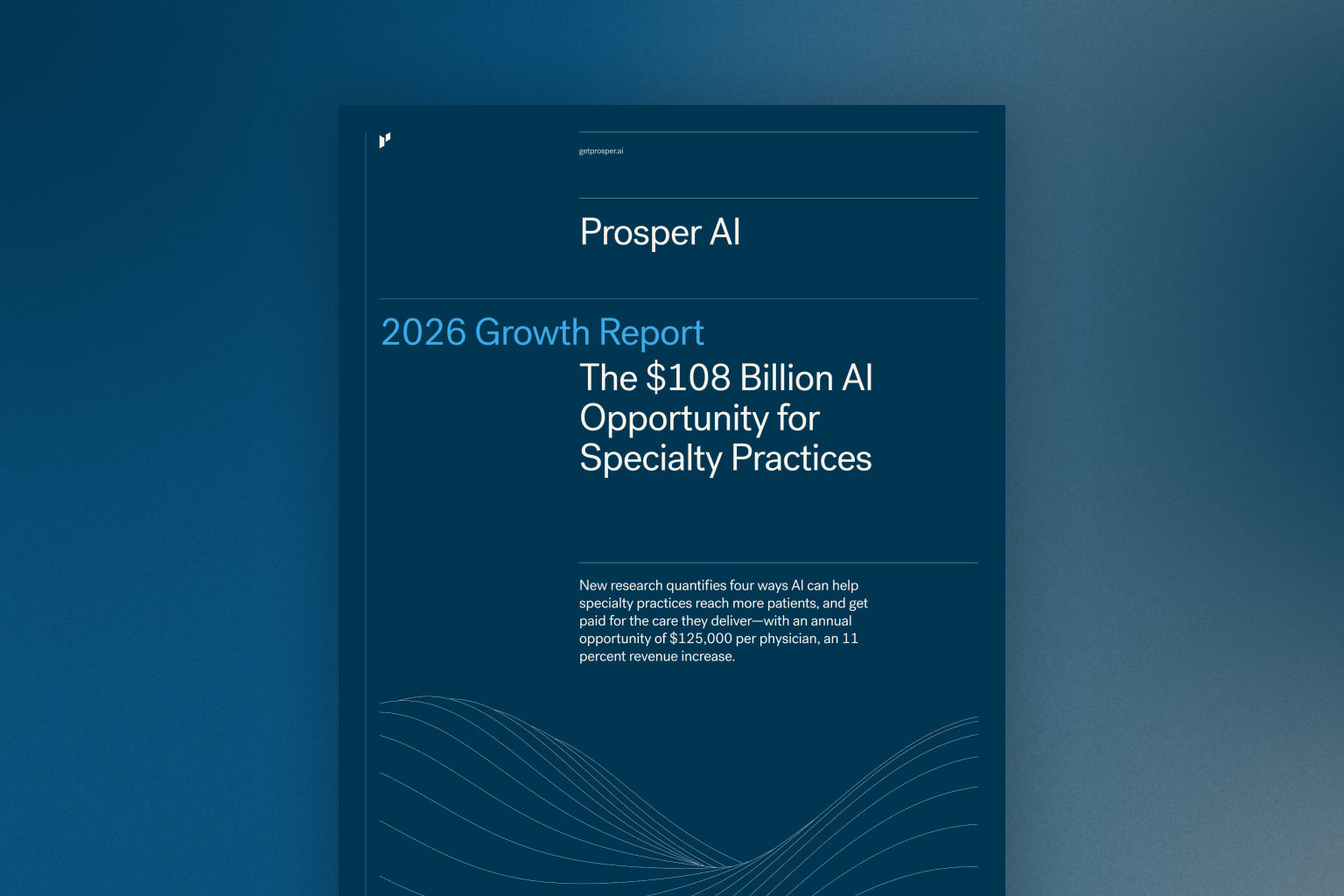
New research quantifies four ways AI can help specialty practices reach more patients, and get paid for the care they deliver—with an annual opportuni
Select your specialty and enter your number of physicians to estimate your practice's annual revenue opportunity, broken down across 4 levers.
Specialty healthcare practices leave an estimated $125K per physician uncaptured each year. See the 5 takeaways from Prosper AI’s 2026 Growth Report.


