




Report: The $108 Billion AI Opportunity for Specialty Practices
New research quantifies four ways AI can help specialty practices reach more patients, and get paid for the care they deliver—with an annual opportuni

AI voice agents for cardiology practices are phone-based AI systems that answer inbound calls without routing every request to a staff member, covering scheduling, benefits verification, prior authorization status, and after-hours triage. Prosper AI is the only tool in this comparison built to handle both the patient-facing calls and the payer-facing prior auth calls that cardiology front desks field every day.
Most AI voice agents stop at scheduling. Cardiology practices know the harder calls come after that: a stress test prior auth stuck in review, a referral that needs coordinating, an after-hours call that can't wait until morning. The real question when comparing vendors isn't which one has the longest feature list — it's how much of your actual call volume each tool can resolve without pulling a staff member in.
AI voice agents for cardiology practices are phone-based AI systems that handle patient calls autonomously, without routing to a human staff member for routine requests. They can schedule appointments, answer questions about referrals and prior auth requirements, collect insurance information, and send follow-up reminders, all over a live phone call.
Cardiology front desks field a high volume of calls that are repetitive but time-sensitive. Cardiology voice AI handles that call load without pulling staff from urgent work. A patient calling to confirm a stress test or ask about a Holter monitor return is not a complex clinical case, but that call still pulls a staff member away from higher-priority work. AI voice agents handle that call end to end.
In cardiology, nuclear, echo, and stress test prior auths represent the highest-volume authorization category, a call type that most scheduling-only tools leave entirely to staff.
Ranking AI voice agents for cardiology practices requires more than checking a feature list. We looked at five factors that matter most to cardiology operations teams actively comparing vendors.
A few things worth noting as you read this table. End-to-end resolution figures for non-Prosper AI vendors reflect general industry estimates and vary based on call mix and configuration. Prosper AI's 60%+ figure is based on customer deployment data. Prior auth support involves routing and status-check handling, with no clinical decision-making involved; see the prior authorization automation guide for a full breakdown of how this works in practice. After-hours handling refers to full call resolution without staff intervention, excluding voicemail capture.
Prosper AI is built for the full scope of what a cardiology front desk actually handles: the routine calls and the complex ones. Where many AI voice tools stop at appointment scheduling, Prosper AI covers the full patient journey: scheduling, benefits verification, patient billing, prior auth status checks, referral coordination, prescription refill routing, and after-hours triage handoffs.
Prosper AI resolves 60%+ of inbound calls end-to-end in production, based on Prosper AI's customer deployment data. Understanding how voice AI systems for patient call automation achieve these rates helps practices set realistic benchmarks. For a cardiology practice fielding high call volumes around procedure scheduling and referral intake, that containment rate means fewer calls reaching staff and shorter queues for patients who genuinely need a human.
Prosper AI is a strong fit for cardiology groups running on major EHR systems who want call coverage across scheduling, benefits verification, and patient billing workflows without stitching together separate point solutions for each. Prosper AI typically goes live in about three weeks with a dedicated AI program manager at a 1:5 practice ratio, so your team gets a partner who knows your specific workflows rather than a generic software deployment.
Assort Health is an AI voice agent built for health systems and large specialty groups. It focuses on inbound call handling, appointment scheduling, and some post-visit follow-up workflows, with EHR integrations across a handful of major systems including Epic and Cerner.
The product handles scheduling calls well in structured environments, where appointment types are predictable and insurance rules are relatively uniform. Based on Assort Health's publicly documented feature set, the tool focuses on scheduling and reminders; coverage for call types such as billing questions, referral coordination, and prior auth status checks is not described in their public materials.
Assort Health suits larger organizations that need a scheduling-focused voice layer and have staff available to handle the remaining call types manually.
Hyro is an AI voice agent built for large health systems, with publicly referenced deployments at institutions including Cedars-Sinai and Providence. It handles inbound call routing, appointment scheduling, and FAQ responses across high call-volume environments.
Where Hyro performs well is scale. Health systems fielding tens of thousands of calls monthly get consistent call containment across multiple service lines. The architecture is designed for enterprise rollouts, not single-specialty clinics.
For cardiology practices, that scale orientation is a tradeoff. Based on Hyro's publicly documented implementation approach, adding new call types or specialty-specific workflows requires vendor engineering rather than self-service configuration, which can extend timelines for practices scoping changes after go-live. Smaller or mid-size cardiology groups may find that onboarding overhead outpaces their actual call volume.
If your practice sits inside a large health system already running Hyro, the fit may be reasonable. For independent or specialty cardiology groups reviewing standalone options, the enterprise-oriented build may not align with the speed and flexibility those groups typically need. See the full Prosper AI vs Hyro comparison for a detailed side-by-side.
Artera is a patient communication tool built around two-way messaging, appointment reminders, and care gap outreach. It gives patients a way to confirm, cancel, or reschedule directly from a reminder message, which reduces some manual follow-up for front desk staff.
For cardiology practices, the appeal is in reducing no-show rates through automated outreach. But Artera's core design is messaging-first. Phone call handling falls outside its primary scope, so practices fielding high inbound call volumes for referral intake, prior auth status checks, or post-procedure follow-up questions still need staff to cover that ground.
Artera suits practices that want to cut no-shows through better messaging but aren't looking to reduce inbound call load or front desk staffing. If your primary pain point is inbound phone volume, Artera's messaging-first design may not cover that call load based on its documented feature set.
Cardiology practices field a specific mix of calls that most AI voice agents aren't built for: post-procedure check-ins, medication refill requests, prior auth status inquiries, and urgent symptom triage routing. Prosper AI handles the routine administrative layer across all of it, resolving 60%+ of inbound calls end-to-end in production, based on Prosper AI's customer deployment data.
Prosper AI also powers outbound voice agents built directly into the athenahealth platform for 160,000+ providers, and runs the outbound calls athenahealth's own RCM team makes to payers. Where narrow-scope tools stop at scheduling, Prosper AI covers the full patient journey: scheduling, benefits verification, billing, prior auth AI status checks, and after-hours call handling without routing patients to voicemail. It writes directly back to your EHR, so nothing lands in a staff queue waiting to be manually entered.
In cardiology, that means a patient calling to confirm whether their stress test requires prior auth gets an answer. A patient calling at 9 PM about a prescription refill gets routed correctly. Staff handle what requires judgment. Prosper AI handles the rest.
What should I look for in an AI voice agent for a cardiology practice?
Call containment depth matters more than appointment scheduling alone. Cardiology practices field a high volume of calls around benefits verification, billing, and prior auth status. An agent that handles only scheduling leaves most of that call mix to staff. Look for EHR integration, configurable call type coverage, and documented voice AI deflection rates in healthcare from cardiology or comparable specialty deployments.
How does an AI voice agent handle cardiology-specific calls like prior auth inquiries?
The better agents connect directly to your EHR or PMS to pull real-time authorization status and relay it to the caller without staff involvement — a core feature of automated prior authorization workflows. Weaker implementations route the caller to a voicemail or staff queue the moment the request falls outside a narrow scheduling scope. Ask vendors to walk through exactly what happens when a patient calls asking about a pending stress test auth.
Will patients find it hard to talk to an AI voice agent?
Many patients who interact with well-configured AI voice agents report not noticing a meaningful difference from speaking with staff. The gap tends to show up with older patient populations or complex multi-issue calls, where escalation to a live person matters most. A well-designed agent escalates gracefully, without looping or dropping the caller.
How do I choose between Prosper AI, Assort Health, Hyro, and Artera for a cardiology practice?
Start with your call mix, not your feature checklist. If your front desk fields benefits verification, billing, and prior auth status checks alongside routine scheduling, you need a tool that covers all of those call types, appointments included. Narrow-scope tools like Artera handle reminders well but leave inbound call volume to staff, while options like Assort Health and Hyro cover scheduling but tend to stop short of prior auth and benefits verification workflows.
How does an AI voice agent handle prior authorization inquiries without clinical staff involvement?
The agent connects directly to your EHR or practice management system to retrieve real-time authorization status and relay it to the caller. Prosper AI goes further by making outbound calls to payers when API-based verification is incomplete, closing the loop without a staff member picking up the phone. Tools that lack EHR write-back or outbound payer calling route the caller to a staff queue the moment the request moves past basic scheduling.
What makes Prosper AI a stronger fit for cardiology than enterprise tools like Hyro?
Cardiology practices need depth across the full call mix, not just scale. Hyro is built for large health system rollouts where consistent routing across many service lines matters more than specialty-specific workflow coverage. That model works inside a major health system already standardized on Hyro, but it comes with tradeoffs: adding new call types requires vendor engineering rather than self-service configuration, and the implementation overhead can be significant for groups whose call volume does not justify an enterprise build. Prosper AI is designed for the specific call types cardiology front desks actually field, including prior auth status checks, benefits verification, and patient billing, and lets your team configure new workflows without waiting on vendor engineering. For independent or mid-size cardiology groups, that difference in speed and flexibility is often the deciding factor.
How long does it take to go live with an AI voice agent for a cardiology practice?
Prosper AI's standard go-live is about three weeks, supported by a dedicated AI program manager at a 1:5 practice ratio. Given current implementation demand, it's worth confirming slot availability during your evaluation. Across the broader vendor landscape, deployments typically run four to twelve weeks depending on EHR complexity and the number of call types scoped at launch. Ask any vendor you review for a reference deployment in cardiology or a comparable specialty with similar call volume before committing to a timeline estimate.
Is an AI voice agent for cardiology practices HIPAA compliant?
Any AI voice agent handling cardiology calls is handling PHI, so it should run on HIPAA-compliant infrastructure with a signed BAA and audit logging in place before go-live. Ask any vendor you're evaluating for that documentation directly, since compliance posture varies significantly across AI voice agent vendors.
Prosper AI build voice AI agents that cover inbound scheduling, insurance eligibility, prior authorization, billing inquiries, and outbound payer calls in a single automated workflow—one system for both sides of the phone.
In a six-vendor RFP, Prosper AI hit 60%+ end-to-end call resolution in production, compared to roughly 30% for other vendors. Most practices are live in 3 weeks, with no custom coding and no disruption to staff, and integrate with 80+ EHR and practice management systems.
Book a demo with Prosper AI to see what full-coverage resolution looks like on your actual call mix.
Discover how healthcare teams are transforming patient access with Prosper.
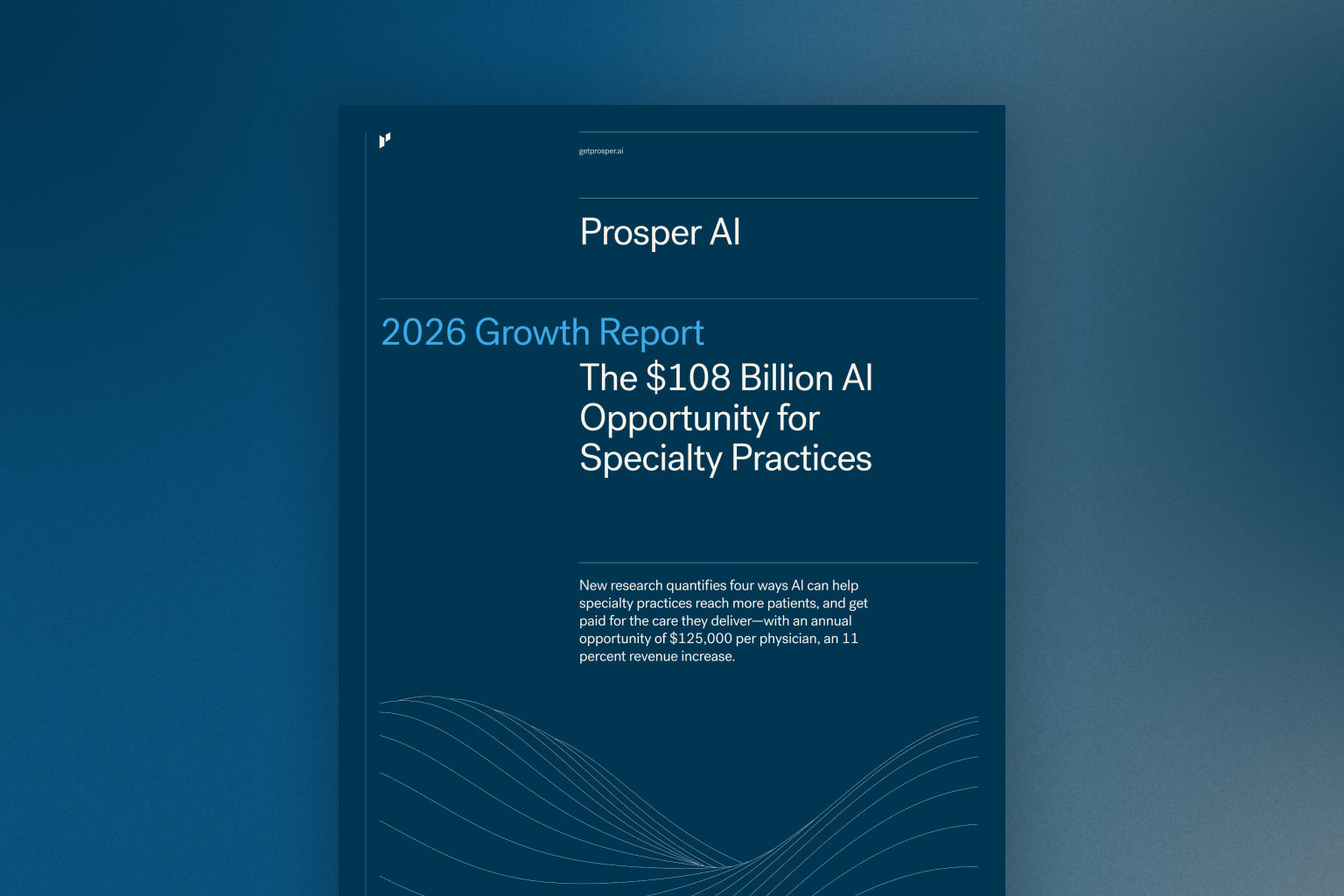
New research quantifies four ways AI can help specialty practices reach more patients, and get paid for the care they deliver—with an annual opportuni
Select your specialty and enter your number of physicians to estimate your practice's annual revenue opportunity, broken down across 4 levers.
Specialty healthcare practices leave an estimated $125K per physician uncaptured each year. See the 5 takeaways from Prosper AI’s 2026 Growth Report.


