




Best Voice AI for Gastroenterology Practices: 4 Options Compared (2026)
Compare 4 voice AI vendors for GI practices on colonoscopy scheduling, benefits verification, and prior auth calls. See which ones stop at booking.

Prosper AI is a healthcare voice AI platform that automates both patient-facing calls (scheduling, intake) and payer-facing calls (benefits verification, prior auth, billing), resolving over 60% of inbound calls end-to-end. Assort Health is a scheduling-focused voice AI agent for practices; billing and prior auth calls still reach staff.
Assort Health is an AI-powered voice agent built for healthcare. The product focuses on automating inbound patient calls, such as appointment scheduling, reminders, and basic eligibility checks. Its voice agent answers calls, walks patients through scheduling workflows, and can confirm or cancel existing appointments without requiring staff involvement.
The company positions itself toward narrow-triage specialties like orthopedics, medical dermatology, dentistry, and ophthalmology, where its hand-built workflow logic can be scoped per specialty. Assort Health integrates with a handful of EHR and practice management systems, though its integration depth tends toward scheduling modules and stops short of full RCM workflows.
Where Assort Health stops is worth noting for anyone mid-evaluation. Call types like benefits verification, prior auth status checks, billing inquiries, and payor calls often fall outside what the product handles, meaning staff still field a meaningful share of inbound calls even after deployment.
Prosper AI builds AI voice agents for healthcare providers that handle the full scheduling workflow — new patient intake, specialty routing, reschedules, and EHR write-back — without staff involvement.
The same platform extends to benefits verification, prior auth, and billing calls, which means practices don't need a separate tool when call mix grows beyond scheduling.
Prosper AI resolves over 60% of inbound calls end-to-end in production, based on Prosper AI's customer deployment data, across scheduling, benefits verification, prior auth status checks, and billing inquiries. See voice AI deflection rates in healthcare for real benchmarks. The AI handles the full call without transferring to staff.

Assort Health focuses on scheduling and intake workflows. Its voice AI for patient intake books appointments, collects insurance details at intake, and sends two-way text confirmations that let patients confirm, cancel, or request a reschedule directly from the reminder message. Those workflows are handled well. But calls involving billing questions, prior auth status, or prescription refill routing still reach the front desk. Assort Health has no published equivalent resolution number.
The coverage gap matters in practice. Scheduling and intake often account for roughly half of inbound call volume. The remainder, benefits verification, and billing calls, stays with staff under a scheduling-focused approach. Healthcare call center data shows the average practice handles around 2,000 calls daily, leaving a large share unresolved when only scheduling is automated.
▶ Case Study: How Frederick Foot & Ankle Reduces Scheduling Calls by 70% with Prosper AI
Assort Health's public focus is narrow: AI-driven scheduling and patient engagement. There is little evidence of payor-side automation in their product set. Benefits verification, prior auth routing, and RCM workflows appear to sit outside their scope, which means practices using Assort Health often still rely on staff to manage the payor-facing side of patient access. A 2025 AMA prior authorization survey found that 93% of physicians report care delays tied to prior auth, a signal of how much unresolved call volume this area still generates.
Prosper AI covers both sides. Beyond scheduling and call handling, Prosper AI automates benefits verification, prior auth status checks, and denial-related follow-up calls. These workflows account for a meaningful share of front-desk call volume, and leaving them unautomated limits the overall call containment a practice can actually achieve.
For practices already tracking RCM gaps during their AI voice search, that coverage difference is worth weighing directly against whatever scheduling gains either vendor delivers.
Assort Health markets itself toward orthopedics, medical dermatology, dentistry, and ophthalmology for scheduling and intake. Those are also among Prosper AI's strongest specialties: scheduling-only coverage misses the prior auth and payer-calling volume they generate, and an orthopedics practice that already has a scheduling tool in place still has that RCM volume unaddressed.
Assort Health's architecture is best suited to specialties where narrow-triage appointment types and finite scheduling workflows can be hand-built into its scripted state machine. Primary care, urgent care, and multispecialty groups tend to be poor fits, because their high intent variance exceeds what a scripted system can encode. See the AI patient scheduling guide for more on how scheduling automation fits into a broader call mix.
Prosper AI is built for a wider range of specialties, including orthopedics, ophthalmology, OB/GYN, podiatry, and multi-site health systems where call mixes routinely include prior auth inquiries, benefits verification requests, and after-hours triage hand-offs. These call types go well beyond scheduling and require the AI to handle branching workflows without dropping the interaction back to staff.

For practices where the majority of inbound calls fall into a handful of predictable categories, Assort Health may cover enough of the call surface to be worthwhile. For specialty clinics and health systems where call volume is high and the mix is varied, voice AI systems for patient call automation that cover the full call mix often leave a large share of calls unresolved with narrower tools, which means staff still absorb the volume that automation was supposed to reduce.
Deployment timelines and ongoing service quality often reveal more about a vendor than their demo ever will.
Assort Health's architecture means that adding new call types after go-live requires vendor engineering, not self-configuration. The initial implementation takes 6 weeks and scopes what the system can handle. Expanding beyond that scope is a vendor project — not something practices can adjust on their own. For practices whose call mix stays within what was built at launch, that is workable. For those who need to grow coverage over time, the ceiling is set on day one.
Prosper AI's deployment model is built for speed without sacrificing configuration depth. Practices can go live in 3 weeks, with the implementation team handling EHR and PMS integration, call flow mapping, and voice tuning before handoff. Practices looking to improve patient scheduling will find the configuration depth matters a great deal at this stage. After launch, Prosper AI's team monitors resolution rates and call mix actively, adjusting routing logic and coverage as the practice's needs shift.
Where many vendors treat post-launch as a support ticket queue, Prosper AI operates more like an ongoing service relationship, with regular reviews tied to actual call containment data instead of generic check-ins.
Prosper AI and Assort Health take meaningfully different approaches to automating patient access, and the differences show up most clearly when you map each product against the full range of calls a front desk actually handles.
Assort Health focuses on AI-driven scheduling conversations, letting patients book, reschedule, or cancel appointments through a voice interaction. Practices weighing AI voice agents vs. traditional IVR will find the scope of call coverage is often the deciding factor. That covers a real slice of inbound volume, but scheduling calls often represent only a portion of what a front desk fields each day. Calls about referrals, benefits verification, billing questions, and prescription inquiries land outside that scope and return to staff.
Prosper AI is built to cover the broader call mix: scheduling, benefits verification, referral intake, and more. In production, Prosper AI resolves 60%+ of inbound calls end-to-end (based on Prosper AI's customer deployment data), across call types, well beyond appointment requests.
Both products connect to EHR and practice management systems, but the depth varies. Assort Health writes scheduling data back to the calendar. Prosper AI reads and writes across scheduling, insurance, and patient record fields, which is what makes multi-step calls like benefits verification possible without staff intervention.
Prosper AI resolves 60%+ of inbound patient calls end-to-end in production (self-reported), covering scheduling, insurance verification, prior auth, and billing in one system.
This means staff handle exceptions and edge cases while routine volume runs on autopilot. That coverage matters because scheduling typically accounts for roughly half of front-desk calls. A tool that only handles scheduling may automate 50% of calls at best, and only a fraction of those end-to-end.
Prosper also integrates directly with major EHR and PMS systems, writing appointment data back without staff intervention. See AI voice agents built for healthcare to review the full range of supported workflows. For practices fielding hundreds of calls daily, that eliminates a meaningful category of manual follow-up work that narrow-scope tools leave on the desk.
Scope is really the deciding factor here. Assort Health does appointment scheduling well, and for some practices that is enough. For specialty clinics and multi-site operations where the call mix includes prior auth, billing, and benefits verification, your staff will still absorb a large share of inbound volume after deployment. Prosper AI covers more of that surface. See what Prosper AI can automate.
Prosper AI is built for multi-site specialty groups, health systems, and practices with varied call mixes that include billing inquiries, prior auth status checks, benefits verification, and prescription refill routing alongside scheduling. Assort Health covers scheduling and intake in those same specialties, but doesn't address the prior auth and payer-calling volume that orthopedics, dermatology, and ophthalmology practices also generate. Prosper AI competes directly in those verticals for that reason — not just in primary care or multispecialty settings.
Assort Health automates scheduling conversations and two-way text confirmations, which covers a real share of front-desk volume but leaves billing questions, prior auth status, and referral calls with staff. Prosper AI reads and writes across scheduling, insurance, and patient record fields in the EHR, which is what makes multi-step workflows like benefits verification and prior auth status checks possible without staff involvement.
Start by mapping three months of inbound call data and categorizing calls by type. If scheduling and intake represent the vast majority of your volume, Assort Health may cover enough of the call surface to be worthwhile. If billing questions, prior auth inquiries, referral coordination, or insurance verification calls make up a meaningful share of daily volume, a scheduling-focused tool will leave much of that load with your staff regardless of how well it handles appointments.
Prosper AI calls insurance payers directly by phone for the roughly 20% of benefits verification cases that payer APIs cannot resolve, completing the workflow end-to-end without staff intervention. This payor-side automation, which also covers prior auth status checks and denial-related follow-up, sits outside Assort Health's documented scope and is typically left to staff under a scheduling-focused approach.
Prosper AI's standard deployment targets go-live in approximately three weeks, with a dedicated AI PM handling EHR integration, call flow mapping, and voice tuning before handoff. As of mid-2026, implementation slots are extending into late summer due to sales growth outpacing current delivery capacity, so buyers should confirm current queue timelines directly during the selection process instead of assuming the three-week window applies immediately.
Discover how healthcare teams are transforming patient access with Prosper.
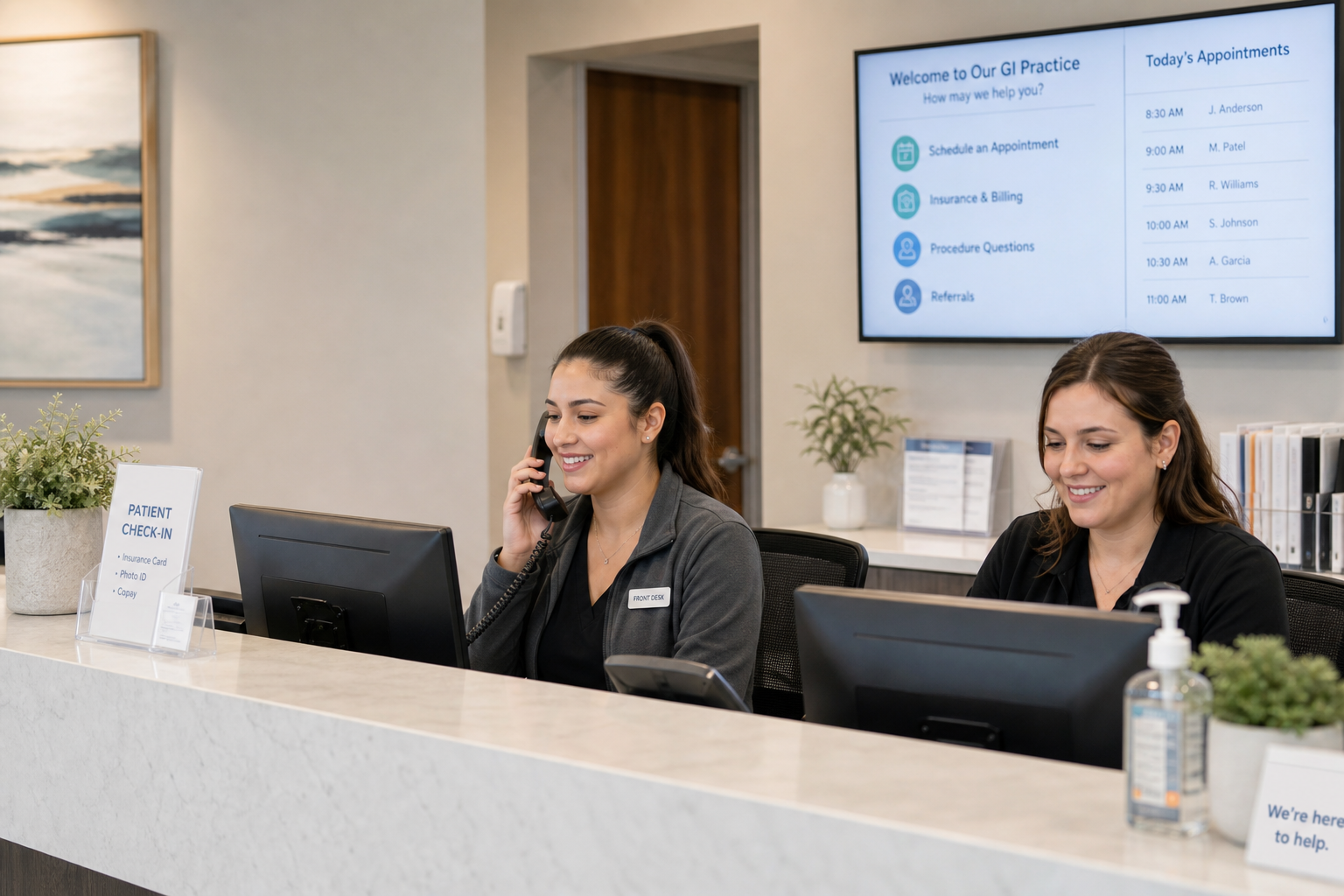
Compare 4 voice AI vendors for GI practices on colonoscopy scheduling, benefits verification, and prior auth calls. See which ones stop at booking.

Compare 5 AI voice agents for ENT and allergy practices. See which handle scheduling and the payer calls for prior auth and benefits checks.

Best AI agents for orthopedic practices compared on prior auth, outbound payer calling, and billing. Only 1 vendor resolves 60%+ of calls end-to-end.


