




AI Voice-Enabled Patient Engagement: What Specialty Practices Should Expect in 2026
AI voice-enabled patient engagement now covers scheduling, benefits verification, prior auth, and billing calls in one system. See what to evaluate be

Most operations leaders vetting voice AI for healthcare already know the demo isn't the whole picture. What's harder to figure out is what questions actually separate a vendor with real production reliability from one that built a great-looking proof of concept. Compliance integrity, conversational accuracy, and system uptime each fail differently, and each requires a different line of questioning to surface.
TLDR:
Reliability in healthcare carries different weight than in other industries. A voice AI agent that misbooks a dinner reservation is an inconvenience. One that writes the wrong insurance carrier to an EHR, misses a crisis indicator on a behavioral health call, or goes down during a Saturday morning surge is something else entirely.
Operations leaders who have watched a polished demo know this gap exists. The question is how to pressure-test it before signing.
In healthcare, reliability breaks into three distinct dimensions:
Each dimension has its own failure mode, and none of them show up in a demo. A vendor can demo flawlessly and still carry a 10% EHR write error rate in production, telephony dependencies that drop calls during maintenance windows, or escalation paths that transfer patients without context. The rest of this piece works through each dimension so you know exactly what to ask.
A Business Associate Agreement is a federal requirement under HIPAA, not a vendor courtesy. Any voice AI agent that touches protected health information (PHI) must operate under a signed BAA before it handles a single call. If a vendor hesitates, the conversation is over.
The BAA is the floor, not the ceiling. For a breakdown of HIPAA-compliant voice AI providers worth vetting, the technical controls underneath it are where compliance actually lives:
The distinction worth pressing vendors on: was HIPAA compliance designed into the architecture from the start, or retrofitted onto a general-purpose voice product? Understanding healthcare voice AI generations compared helps clarify which architectural approach a vendor actually built from. The latter tends to hold up in demos and crack under production conditions: proxy-caller edge cases, mid-call topic changes, or verbatim disclosure requirements that get paraphrased instead of played back exactly.
SOC 2 Type II certification is worth asking about separately. Type I confirms controls exist at a point in time. Type II confirms they operated effectively over an extended period, typically six to twelve months. For a vendor processing thousands of patient calls daily, that difference is not trivial.
A vendor listing 80 EHR integrations on their website tells you almost nothing about what the agent actually does inside your EHR. The more useful question is whether the integration is read-only or read-and-write.
A read-only agent can pull a patient's appointment history or insurance carrier during a call, but it cannot book the appointment, update the insurance field, or flag a follow-up task. This distinction matters for integration depth: write-back capability is often the dividing line between a system that handles a call and one that completes the outcome. The call got handled; the outcome didn't get recorded. Someone still has to open the EHR and finish the job.
Write-back integration closes that loop. When a patient schedules, cancels, or updates their insurance during a call, the agent commits that outcome directly to the EHR in real time, no manual entry required.
The underlying infrastructure matters here. FHIR R4 API connectivity supports real-time, bidirectional data exchange during the call itself. Legacy SFTP batch sync pushes data after the fact, on a schedule, meaning a patient calling mid-day may get responses based on slot availability or insurance status that is hours out of date.
| Read-Only Integration | Read-and-Write Integration (FHIR R4) | |
|---|---|---|
| What the agent can do | Pull appointment history and insurance carrier during the call | Pull and commit bookings, cancellations, insurance updates in real time |
| Data sync method | Legacy SFTP batch sync (data pushed on a schedule) | FHIR R4 API: bidirectional, real-time exchange during the call |
| Data freshness | Potentially hours out of date mid-day | Current at the moment of the call |
| Manual follow-up required | Yes, because staff must open EHR and complete the outcome | No, because the agent commits the outcome directly; no manual entry needed |
| What to ask the vendor | N/A | Has this been tested in production on your specific EHR? What happens if the EHR API times out mid-call? |
Ask directly whether the integration has been tested in production on your EHR, whether it supports read-and-write, and what happens if the EHR API times out mid-call. That last question tends to separate vendors who have built this in production from those who built it for a demo.
Generative AI systems can produce responses that sound authoritative and are factually wrong. A 2026 BMC Health Services Research review found that in clinical settings, AI hallucinations can generate fabricated citations, incorrect treatment statements, and inaccurate patient summaries, each capable of propagating unsafe downstream decisions. Voice delivery makes this worse: a fluent, confident tone makes an ungrounded claim feel settled before anyone can check it.
Three architectural controls reduce this risk in production:
The evaluator question isn't whether the vendor has tested for hallucinations. It is whether they can show continuous production monitoring with measurable, current error rates. Ask for the metric they actually track, how they calculate it, and what the number was last month.
No voice AI agent resolves every call. The gap between a reliable system and an unreliable one is often not resolution rate. It is what happens at the edge cases.
Escalation trigger logic should cover at minimum: crisis or distress signals mid-call, failed patient authentication, complex insurance scenarios the agent cannot resolve, and any clinical question requiring staff judgment. A wider range of these scenarios is covered in AI voice agent in healthcare use cases. If a vendor cannot tell you how each of these is detected and routed, that is a gap.
The handoff mechanism itself matters just as much. A cold transfer forces patients to repeat everything they just said, and call abandonment follows. A production-grade escalation path writes full conversation context and relevant patient data to the EHR before the transfer completes, so the receiving staff member picks up mid-conversation, not from zero.
Ask vendors directly: does the EHR note-write happen automatically on every transfer, or only when a staff member manually flags it? The former is a structural feature. The latter is a workflow gap dressed up as a capability.
For calls that end without resolution, the system should automatically generate a staff follow-up task instead of letting the call disappear into a log. A unified ticketing queue that surfaces these without requiring manual call-log review is the production standard worth asking about.
When vetting voice AI systems for patient call automation, conversational AI reliability sits on two separate stacks, and most buyers ask about only one.
AI infrastructure uptime covers the models, EHR integrations, and the orchestration layer. Telephony uptime covers the carriers that actually carry the call from a patient's phone to the agent. A vendor can have solid AI infrastructure and still drop patient calls during a carrier maintenance window. These are not the same number, and vendors do not always distinguish them when quoting SLAs.
In a production healthcare deployment, telephony redundancy means maintaining active relationships with multiple carriers so a single provider event does not cause a patient-facing outage. SIP transfer stability is most critical when calls escalate to staff: an unstable transfer drops the call at the exact moment a patient most needs to reach a human. Latency below 200 milliseconds is generally cited as the ceiling for conversational audio to feel natural; above that, the interaction degrades in ways patients notice without knowing why.
The questions worth asking any vendor: How many carrier relationships do you maintain in production? What happened the last time one went down? A vendor with real production history will answer from incident data. One without it will answer from architecture slides.
Most practices go live without a defined success metric, then argue about the numbers at the 90-day review. Agree on KPIs before the pilot starts.
The metrics worth tracking:
Most pilots need at least 500 resolved calls before resolution rates stabilize. Below that, a single unusual week skews the picture.
When a metric underperforms, ask whether the problem is configuration or architecture. A high transfer-back rate on billing calls usually means the agent wasn't given the right knowledge, which is fixable. A low resolution rate across every call type outside scheduling usually means the architecture wasn't built to handle those call types, which isn't.
Starting clinic-wide on day one is the fastest way to generate complaints before the system has been tuned to your workflows. A bounded pilot produces decision-quality data with far less exposure.
Five steps worth following before expanding:
After-hours calls are a practical pilot entry point. Clinical complexity is lower, and the comparison baseline is usually an answering service or voicemail, a bar that most AI-based call center solutions for healthcare should clear without difficulty.
One expectation to calibrate: the gap between a vendor's go-live date and a fully optimized deployment typically spans 10 to 12 weeks. Go-live gets the system answering calls. The optimization period is where resolution rates actually reach their ceiling.
Reliability here isn't theoretical. Each dimension maps directly to production infrastructure we've built and are actively measuring.
On accuracy: Prosper AI's right-gates tech reduced EHR write hallucinations from 10% to 1% in production, a result that reflects the architectural standards healthcare voice AI evaluation for practice leaders. A hallucination detector runs as a real-time quality control layer, with monthly rechecks to catch drift as conversation patterns change. A flagged-calls dashboard routes issues to scheduling managers for selective review, no manual audit of full call logs required.
Resolution breadth is where the architecture pays off. Based on our customer deployment data, Prosper AI resolves 60%+ of total inbound calls end-to-end in production, covering scheduling, billing, insurance inquiries, refills, and FAQs. A system handling only scheduling will show strong scheduling resolution and weak performance in everything else.
The dedicated AI PM model is part of the reliability structure. Each AI PM carries five practices in the same specialty on the same EHR, monitors performance, surfaces edge cases, and proactively pushes workflow improvements. When something underperforms, there's a named person accountable for fixing it.
The gap between a polished demo and a production deployment is real, and the questions in this post are how you close it. Ask for current error rates, test the escalation path yourself, and get the telephony SLA in writing before you commit. A vendor with real production history won't flinch at any of it. Start a conversation with Prosper AI if you want to see what those answers look like in practice.
The three most common failure points are EHR write errors, telephony outages, and weak escalation paths, none of which appear in a demo. Ask any vendor for their current EHR write accuracy rate, how many carrier relationships they maintain for telephony redundancy, and whether conversation context transfers automatically to staff on every escalation. A vendor with real production history answers from incident data; one without answers from architecture slides.
Track end-to-end resolution rate against your full inbound call mix (not scheduling alone), call abandonment rate before and after, EHR scheduling accuracy, transfer-back rate, and after-hours resolution rate measured separately from peak hours. Set these targets before the pilot starts. Without pre-agreed numbers, the 90-day review becomes a negotiation and not a measurement.
Prosper AI's right-gates framework reduced EHR write hallucinations from 10% to 1% in production. Ask any vendor for this metric and how they calculate it.
A production-grade escalation path writes full conversation context and patient data to the EHR before the transfer completes, so staff picks up mid-conversation instead of starting from zero. Cold transfers (where patients repeat everything they just said) are a workflow gap, not a structural feature. Ask vendors directly whether the EHR note-write happens automatically on every transfer or only when a staff member manually flags it.
A legacy IVR routes callers through fixed menus and breaks on anything off-script; a healthcare-specific voice AI handles adaptive, multi-turn conversations across scheduling, billing, insurance inquiries, and refills, and it writes structured outcomes directly back to the EHR. The architectural gap matters because scheduling is only 40 to 50% of a typical inbound call mix; billing, insurance, and FAQs make up the rest, and scripted systems hit a hard ceiling there that no amount of configuration can close.
Discover how healthcare teams are transforming patient access with Prosper.
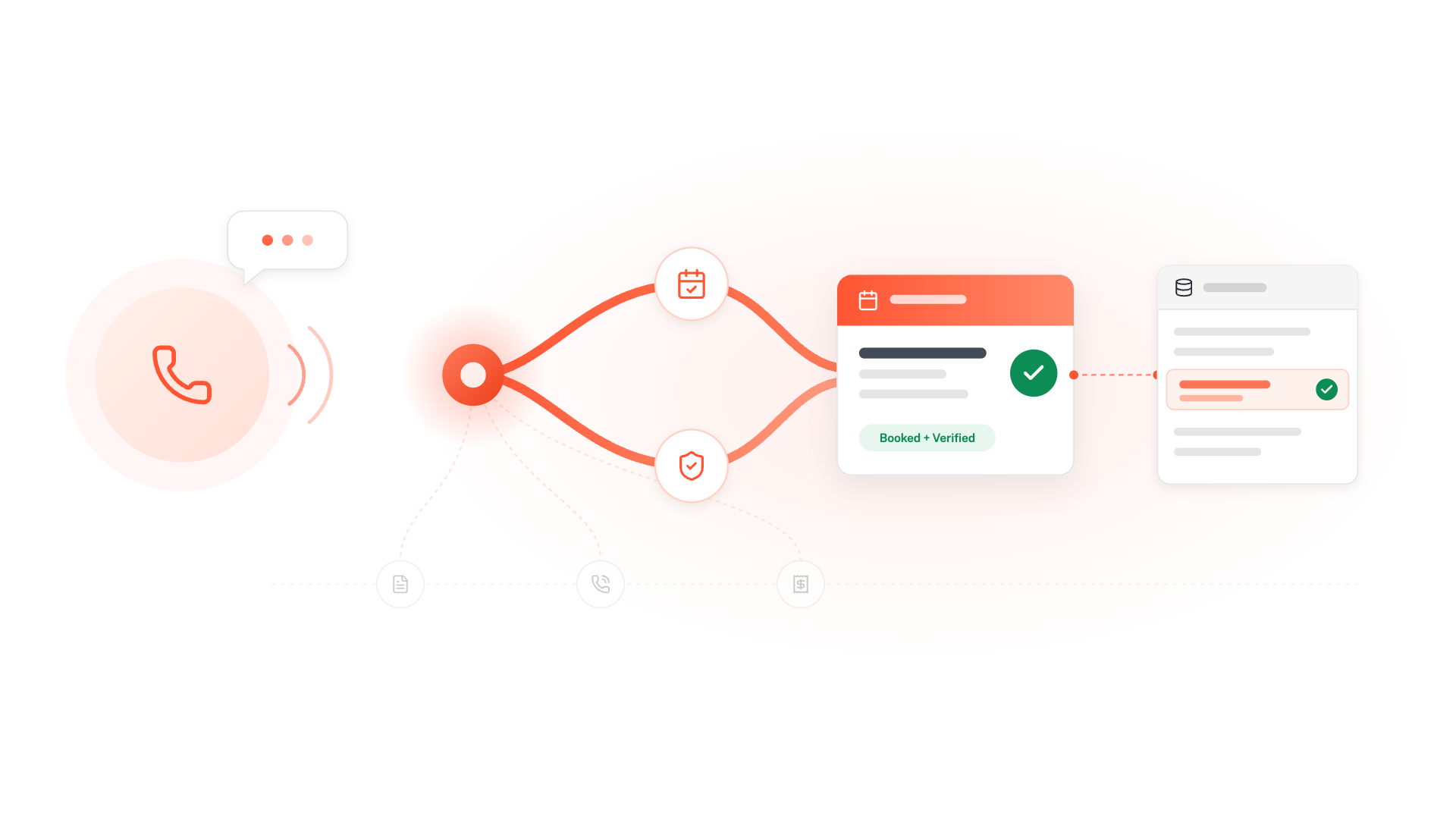
AI voice-enabled patient engagement now covers scheduling, benefits verification, prior auth, and billing calls in one system. See what to evaluate be

Compare 4 voice AI vendors for GI practices on colonoscopy scheduling, benefits verification, and prior auth calls. See which ones stop at booking.

Compare 5 AI voice agents for ENT and allergy practices. See which handle scheduling and the payer calls for prior auth and benefits checks.


