




Best Voice AI for Gastroenterology Practices: 4 Options Compared (2026)
Compare 4 voice AI vendors for GI practices on colonoscopy scheduling, benefits verification, and prior auth calls. See which ones stop at booking.

Your staff is burning out. Patients and customers face long hold times, navigating confusing phone menus only to be disconnected. This isn’t just a customer service issue; it’s a direct threat to your revenue and operational efficiency. Traditional call centers are struggling to keep up with rising call volumes and staffing shortages. The solution is an AI based call center, a new generation of technology that automates conversations, resolves issues instantly, and operates 24/7. This technology is no longer a futuristic concept; it’s a practical tool that businesses, especially in complex fields like healthcare, are using today to transform their operations and improve the human experience.
An AI based call center uses artificial intelligence, particularly conversational voice AI, to manage and automate phone based interactions. Unlike simple chatbots or rigid IVR (Interactive Voice Response) systems that offer a limited menu of options, AI voice agents can understand natural language, navigate complex conversations, wait on hold, and even speak with human agents at other organizations. A truly advanced ai based call center can handle both inbound and outbound calls, performing tasks that once required a team of human agents, from scheduling appointments to verifying insurance benefits.
Not all AI call center platforms are created equal. When evaluating solutions, look for these key capabilities:
Pre trained AI Models: The best platforms come with AI agents already trained on specific industry workflows. For example, Prosper AI offers “Blueprints” trained on healthcare tasks like prior authorizations and claims status checks, dramatically reducing deployment time.
Conversational Intelligence: The AI must be able to understand context, handle interruptions, and converse naturally. It should be able to navigate the complex phone trees used by insurance companies and other large organizations.
Automated Quality Assurance: An elite ai based call center includes built in QA. The AI should review 100% of its calls for accuracy and compliance, providing analytics and performance scores in near real time. This is a significant leap from the standard practice of manually reviewing a small fraction of human agent calls.
Omnichannel Communication: While voice is critical, the system should also integrate with SMS and email to provide reminders, follow ups, and a more complete patient or customer journey.
In regulated industries like healthcare and finance, security is non negotiable. An enterprise grade ai based call center must provide robust security and compliance features.
Key requirements include:
HIPAA Compliance: For healthcare, the vendor must be HIPAA compliant and willing to sign a Business Associate Agreement (BAA).
SOC 2 Type II Certification: This demonstrates a commitment to enterprise level security controls, audited by a third party.
Data Encryption: All data must be encrypted both in transit (using protocols like TLS) and at rest (using AES 256).
Zero Day Data Retention: When using third party large language models, ensure the vendor has agreements for zero day data retention, meaning your sensitive data is not stored or used for training.
Deployment Flexibility: The ability to choose between a secure cloud or an on premise deployment provides flexibility for organizations with strict data residency or security policies.
An AI call center cannot operate in a silo. Its true power is unlocked when it integrates seamlessly with your core systems of record, like your EHR (Electronic Health Record), PMS (Practice Management System), or CRM. This connectivity allows the AI agents to read relevant information and write structured data back into the system, creating a fully automated workflow. Leading platforms like Prosper AI offer over 80 native integrations with major systems including Epic, athenahealth, Cerner, and NextGen, ensuring data flows smoothly without manual intervention.
An ai based call center can automate a wide range of repetitive, high volume phone workflows. This frees up human staff to focus on more complex, revenue generating, or empathy driven tasks.
Common use cases include:
Appointment Management: Scheduling, rescheduling, confirming, and sending reminders.
Benefits & Eligibility Verification: Calling insurance payers to confirm coverage details. See our Benefits Verification guide for healthcare providers.
Prior Authorization Status: Following up with payers on the status of pending authorizations. Learn more about AI for prior authorization.
Claims Status & Denial Follow up: Checking the status of submitted claims and gathering details on denials. Read our definitive guide to AI‑automated claims management.
Patient Balance Reminders: Proactively contacting patients about outstanding balances and facilitating payments.
Re engagement Campaigns: Calling overdue patients to schedule necessary preventative care or follow up visits.
Healthcare is arguably the industry feeling the most pain from administrative bottlenecks and staffing shortages. An ai based call center designed for healthcare can deliver transformative results. Health systems and a Fortune 50 pharma hub are already using this technology to handle hundreds of thousands of calls.
Here is how it makes a difference:
Patient Access: AI agents can offer zero second wait times for scheduling calls, dramatically improving the patient experience. One Northeast OBGYN group used AI to automate approximately 50% of its scheduling calls. This can reduce call abandonment rates by as much as 89% and decrease no shows by around 30%.
Revenue Cycle Management (RCM): Automating calls to insurance payers is a massive efficiency gain. AI agents can verify benefits or check on prior authorizations with 99% accuracy in under two hours, a task that can take human staff days to complete. This leads to cleaner claims, fewer denials, and a 50% reduction in the cost of follow up.
For healthcare providers buried in administrative work, an AI voice platform built for healthcare is the clearest path to reducing operational burden and improving financial health.
With the strategic benefits of automation established, the focus shifts to identifying the specific platforms that can deliver these efficiency gains to your organization. This list highlights the top 9 AI-based call center software solutions currently leading the market, grouped together for their exceptional ability to streamline operations and provide superior data-driven insights.
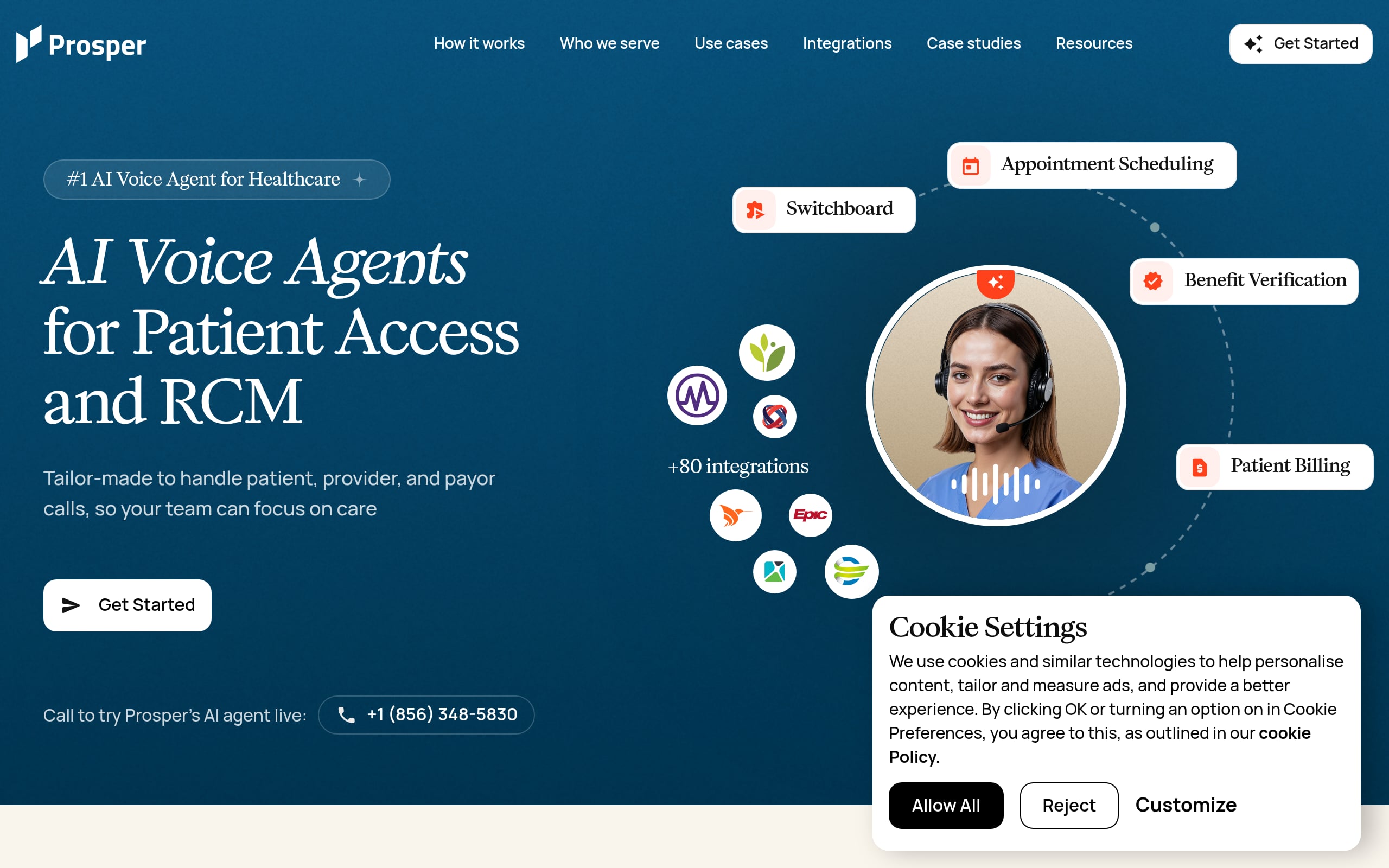
Prosper AI focuses squarely on healthcare, bringing lifelike voice agents to patient access and RCM workflows that traditionally swamp call centers. Built for scale, it tackles high-volume scheduling, billing questions, and payer calls while safeguarding PHI throughout the stack.
Compliance & deployment: Cloud-first with HIPAA compliance, SOC 2 Type II, and signed BAAs; overlays your existing telephony via SIP or CCaaS APIs and preserves audit-ready logs.
High-containment voice agents for scheduling, intake, and proactive reminders
Complex billing Q&A tied to real-time RCM data and secure payments
Autonomous payer IVR navigation for claim status and prior auths
Deep EHR connectivity with Epic, athenahealth, Cerner, and NextGen
Telephony-agnostic via SIP trunking or existing CCaaS APIs
Advanced analytics tracking sentiment, containment, clinical safety, and session logs
Outcomes & rollout: Reported 60% to 80% containment cuts hold times and lifts collections; pilots typically stand up in 4 to 6 weeks. Custom EHR mapping can extend timelines for full enterprise rollout.
Pricing & best fit: Usage-based pricing plus platform fees; best for enterprise systems handling 50,000+ monthly calls. Smaller practices may want simpler medical answering alternatives.
PolyAI’s “Patient Access 2.0” brings a polished, enterprise voice experience to complex healthcare calls—from new appointments to billing confusion—without breaking stride on accuracy or speed.
Compliance & deployment: Cloud-native with HIPAA/BAA, SOC 2 Type II, and automated PHI redaction; deploys alongside existing CCaaS.
NLU tuned for noisy, accented speech with high containment
Bi-directional scheduling with Epic, Cerner, and athenahealth
Automated payer IVR for benefits and claims verification
Telephony-agnostic overlays for Genesys, NICE, Five9, and Avaya
Sentiment analysis and conversation mapping for QA
Enterprise posture with TLS 1.3 and 99.99% uptime
Voice agents for intake, reminders, and billing
Outcomes & rollout: Health systems report 40% to 60% handle-time reduction within 6 to 10 weeks. Expect heavier upfront design for nuanced clinical flows and a premium enterprise price point.
Pricing & best fit: Custom, volume-based pricing for large systems; smaller practices may find simpler IVR plug-ins more practical.
Retell AI pairs ultra-low latency with healthcare-specific call flows, giving patients fast, humanlike conversations while keeping RCM teams unblocked. It’s a developer-friendly platform that handles the heavy lifting for scheduling, intake, billing, and pre-op instructions.
Compliance & deployment: Cloud-native with HIPAA/BAA and SOC 2; PHI-safe design for mission-critical operations.
Sub-800ms latency for natural turn-taking and higher containment
Automated intake, insurance verification, claims explanation, and payer IVR
Robust EHR integrations with Epic, athenahealth, and Cerner via APIs/webhooks
Universal telephony support for Twilio, RingCentral, and Genesys (SIP/WebSockets)
Real-time observability with sentiment analytics and detailed transcripts
Enterprise-grade uptime SLAs for reliability and security
Outcomes & rollout: Users cite up to 80% containment and 25% collections lift; pilots often go live in 2 to 4 weeks. API-centric depth can require technical resources for complex EHR write-backs.
Pricing & best fit: Usage-based at roughly $0.10 to $0.15/minute; ideal for enterprises and high-volume billing firms seeking customizable, low-latency voice automation.
CloudTalk brings modern conversational AI to healthcare access centers, offering a flexible way to automate routine scheduling and billing calls without ripping out your current stack.
Compliance & deployment: Pure cloud with HIPAA/BAA support, SOC 2 Type II, and full encryption.
Natural language voice agents that raise containment and FCR
Automated scheduling and intake syncing to clinic calendars
AI-driven billing Q&A and autonomous payer IVR handling
API-first integrations with Epic, athenahealth, and Salesforce Health Cloud
Real-time sentiment analysis to monitor patient satisfaction
Global telephony with 99.99% uptime for healthcare orgs
Outcomes & rollout: Typical pilots yield a 30% to 45% containment lift in 4 to 6 weeks. Deep clinical mapping can be complex, and pricing may vary with very high usage.
Pricing & best fit: Tiered per-user pricing from $25; a strong pick for multi-specialty practices and RCM firms needing a flexible, API-led call center.
Hyro’s adaptive conversational AI leans on a knowledge graph to eliminate brittle intent mapping, making it well-suited for sprawling health systems where information changes quickly and accuracy is paramount.
Compliance & deployment: Cloud-native with HIPAA/BAA and SOC 2 Type 2; engineered for secure PHI handling.
Adaptive voice agents for scheduling, intake, and billing
Advanced IVR for insurance verification and claims status
Plug-and-play with Epic, athenahealth, Cerner, and Salesforce
Agnostic telephony across Genesys, Five9, and Twilio
Real-time analytics for sentiment and automated QA
Enterprise controls (SSO, encryption) and 99.9% uptime SLAs
Outcomes & rollout: Organizations report 60–85% hold-time reductions and deployments in about four weeks. Fragmented data can raise setup complexity, and pricing is less transparent for smaller providers.
Pricing & best fit: Custom annual fees plus usage tiers; tuned for enterprise systems and high-volume RCM. Smaller clinics may prefer lightweight receptionist tools.
Synthflow brings no-code speed to healthcare voice automation, letting teams launch 24/7 scheduling and triage without a deep engineering bench—yet still connecting to the clinical systems that matter.
Compliance & deployment: Cloud-native with HIPAA/BAA, SOC 2 Type II, encrypted PHI; optional Azure privacy configurations.
Humanlike voice with sub-500ms latency and clinical-grade noise cancellation
Drag-and-drop workflow builder for intake and routing
Real-time scheduling with native booking confirmations
Automated payer IVR for claims and payments
Native athenaOne integration; Epic/Cerner via APIs
Dashboards for sentiment, success rates, and script adherence
SSO, SIP trunking, and 99.99% uptime SLA
Outcomes & rollout: Partners cite a 60% efficiency boost and 30% fewer no-shows. Go-live ranges from one week to two months; note potential geographic latency variance.
Pricing & best fit: HIPAA-ready tiers from $1,250/month; ideal for high-volume mid-market clinics needing low-IT-lift automation. Consider Retell AI if you require deeper LLM customization.
Talkdesk’s Healthcare Experience Cloud blends robust CCaaS with AI to orchestrate patient access and RCM at enterprise scale, keeping compliance tight without sacrificing agility.
Compliance & deployment: HIPAA with BAA, HITRUST, SOC 2 Type II, and PHI redaction; cloud-native and enterprise-ready.
AI voice agents for scheduling, intake, and billing inquiries
Real-time Copilot for next-best actions in complex RCM workflows
Deep integrations with Epic, Cerner, athenahealth, and Salesforce
Payer IVR automation for benefits and prior auth checks
Automated analytics scoring 100% of calls for compliance
Enterprise security with SSO, encryption, and ambitious uptime SLAs
Outcomes & rollout: Customers report ~50% containment and 20% fewer no-shows; implementations often span 60 to 120 days. Expect intricate AI configuration and potentially opaque scaling costs.
Pricing & best fit: User pricing starts around $75/month; best for large health systems prioritizing deep EHR ties over turnkey simplicity.
Five9’s enterprise CCaaS and IVA help health systems modernize access centers while giving RCM leaders clear levers to reduce handle times and escalate only the exceptions.
Compliance & deployment: HITRUST CSF, HIPAA/BAA, and SOC 2 Type 2; built for secure PHI operations.
IVA for scheduling, intake, and billing Q&A with strong NLP
Automated outbound reminders and claims status navigation
Integrations with Epic, athenahealth, Cerner, and Salesforce Health Cloud
Agent Assist for live transcription and auto-summaries
Enterprise security with AES-256, SSO, global 99.999% uptime, and full REST APIs
Outcomes & rollout: Reported 70% containment and 25% lower handle times; integration windows of 3 to 6 months are common. Trade-offs include pricing opacity and a steeper admin learning curve.
Pricing & best fit: Seat-based pricing near $149/month; right-sized for large enterprises with massive volumes. Smaller practices may find the buildout heavy.
Genesys Cloud CX brings a mature AI toolkit to healthcare contact centers, unifying voice, chat, and SMS while keeping clinical context intact across channels.
Compliance & deployment: Cloud-native with HIPAA configurations, BAAs, and SOC 2; engineered for secure PHI handling.
AI voicebots for scheduling, intake, and natural billing Q&A
Deep EHR integrations with Epic, Oracle Health, and athenahealth
Payer IVR navigation plus workforce engagement and QA
Omnichannel routing that preserves clinical context
Enterprise security with SSO, AES-256 encryption, and 99.999% uptime SLAs
Outcomes & rollout: Typical gains include ~35% containment and 15% lower billing handle times. Expect 4 to 9 months for complex EHR integrations, with premium pricing and setup complexity.
Pricing & best fit: Starts around $75/user monthly; best for enterprises prioritizing deep interoperability. Smaller clinics should consider leaner options like Zoom.

YourGPT lets you build, deploy, and manage intelligent AI phone agents and omnichannel solutions without writing code. Train the AI on your business data, connect it to your tools, and let it handle inbound calls, outbound campaigns, and repetitive inquiries across channels, freeing your team to focus on what matters while keeping support agents unblocked. It's built for teams that need voice automation and speed without complexity.
Compliance & deployment: Cloud-native with SOC 2 Type II and GDPR, enterprise-ready out of the box.
Train on your data: Documents, Google Drive, Notion, Confluence, YouTube, the agent learns your business, not generic patterns
15+ integrations across channels: WhatsApp, Discord, Slack, email, Shopify, WordPress; meet customers where they already are
Multi-model flexibility: Choose Claude, GPT-4, O1, Gemini, DeepSeek, switch without rebuilding
Omnichannel consistency: One trained agent, seamless across web chat, messaging apps, email, and more
Human-in-the-loop controls: Step in when you need to guide the AI; build conversational flows with AI Studio
Real-time analytics and transcripts: See what's working, what isn't—adjust on the fly
Enterprise-grade SLAs: Reliability and security built for mission-critical operations
Outcomes & rollout: Teams report faster response times and reduced support volume—pilots typically go live in 2 to 3 weeks. No API rewrites, no complex migrations.
Pricing & best fit: Subscription-based starting at $39 (billed annually), scaled by agents and usage. Ideal for support teams, sales squads, and operations-heavy businesses looking for customizable, low-friction automation.
When choosing an AI based call center solution, consider these factors to find the right partner:
Industry Specialization: Does the vendor understand the specific workflows and compliance needs of your industry? A generic solution will require far more customization than one built for healthcare or finance.
Speed to Value: How long does implementation take? Look for vendors with pre built workflows that can go live in weeks, not months. Prosper AI can launch batch pilots in just a couple of days and achieve full EHR integration in about three weeks.
Integration Depth: Verify that the vendor has proven, native integrations with your most critical software systems.
Accuracy and Reliability: Ask for documented accuracy rates and uptime SLAs. A 99% accuracy rate and a 99.9% uptime SLA should be the standard.
Customization and Control: The platform should allow your operational teams to tweak scripts and workflows using no code tools, without needing to rely on engineers for every small change.
A successful rollout of an ai based call center requires a thoughtful approach.
Start with a Pilot: Identify one or two high volume, repetitive workflows to automate first. This allows you to prove the ROI and build internal buy in before a wider deployment.
Define Clear Goals: Establish specific KPIs from the start. What are you trying to achieve? Lower call abandonment, faster collections, or reduced staff burnout?
Appoint a Program Manager: Designate a point person, like the “AI Agent Manager” that Prosper AI provides, to oversee the implementation, monitor performance, and manage the relationship with the vendor.
Communicate with Staff: Frame the AI as a tool to help your team, not replace them. Emphasize that the AI agents will handle the tedious, repetitive calls, freeing up skilled staff for more fulfilling and valuable work.
The impact of an ai based call center should be clearly measurable. Key performance indicators (KPIs) to track include:
Call Containment Rate: The percentage of calls fully resolved by the AI without human intervention.
Call Abandonment Rate: A significant decrease here is a strong indicator of improved customer experience.
Cost Per Call: Automation can reduce this metric by 50% or more.
First Call Resolution: The percentage of issues resolved on the first attempt.
Revenue Metrics: For RCM use cases, track improvements in collection rates and reductions in claim denial rates. One study showed a 15% higher collection rate on denials handled by AI.
A strong business case will show a clear return on investment within months, driven by direct cost savings and increased revenue capture.
The technology behind the ai based call center is evolving rapidly. We can expect to see AI agents that are more proactive, personalized, and emotionally intelligent. They will handle increasingly complex multi turn conversations and integrate even more deeply into core business processes. As the technology matures, AI voice agents will become a standard, indispensable part of any organization’s communication and operational strategy.
The era of long hold times, frustrating phone menus, and overworked call center agents is coming to an end. An AI based call center offers a powerful solution to some of the most persistent challenges in customer service and administrative operations. By automating routine phone calls with stunning accuracy and efficiency, businesses can reduce costs, increase revenue, and free their valuable human teams to focus on what they do best. For organizations ready to embrace the future of communication, the time to act is now.
See how leading healthcare organizations are using AI voice agents to transform their operations. Explore the Prosper AI platform today. Ready to see it in action? Get started.
An AI based call center is a customer service and operations solution that uses conversational artificial intelligence to automate phone calls. Unlike traditional IVR systems, AI voice agents can understand and respond to natural language, allowing them to handle complex tasks like scheduling appointments, verifying insurance, and answering billing questions without human intervention.
It improves the experience primarily by eliminating wait times and providing 24/7 availability. Customers can get immediate assistance for common requests instead of waiting on hold. This leads to higher satisfaction, lower call abandonment rates, and a more efficient service delivery model.
Yes, provided you choose a vendor with the right certifications. A secure, HIPAA compliant ai based call center platform will offer a BAA, hold a SOC 2 Type II certification, and use end to end data encryption to protect sensitive patient information.
Absolutely. Leading AI platforms are designed for interoperability. They offer extensive libraries of native integrations with key business systems like EHRs, CRMs, and practice management software, enabling seamless, automated workflows.
A chatbot primarily interacts via text, often on a website or in an app, and typically handles a more limited set of queries. An AI voice agent operates over the phone, managing live, spoken conversations. Advanced voice agents can navigate complex phone systems, wait on hold, and even converse with other humans, making them suitable for much more complex B2B and B2C workflows.
The timeline can vary, but modern platforms with pre built models have significantly accelerated deployment. A pilot project using batch data can often go live in just a few days, while a full integration with a core system like an EHR might take around three weeks.
The goal of an ai based call center is typically to augment, not replace, human staff. By automating high volume, repetitive, and often frustrating tasks, AI agents free up human employees to focus on more complex, high value interactions that require empathy, critical thinking, and a personal touch.
Performance is measured using concrete KPIs such as call containment rate, call abandonment rate, first call resolution, cost per call, and task completion accuracy. For business specific use cases, you can also measure its impact on revenue, such as increased appointment bookings or faster claims processing.
Discover how healthcare teams are transforming patient access with Prosper.

Compare 4 voice AI vendors for GI practices on colonoscopy scheduling, benefits verification, and prior auth calls. See which ones stop at booking.

Compare 5 AI voice agents for ENT and allergy practices. See which handle scheduling and the payer calls for prior auth and benefits checks.

Best AI agents for orthopedic practices compared on prior auth, outbound payer calling, and billing. Only 1 vendor resolves 60%+ of calls end-to-end.


