




Missed Calls Leave $44,800 per Physician on the Table. Here's How Specialty Practices Capture It.
Specialty practices miss 18% of patient calls in office hours and 81% after hours. See the cost per physician and how voice AI books every call.

Calling a scheduling tool "intelligent" covers a lot of ground these days, from basic online booking to systems that handle open-ended conversations, write back to your EHR in real time, and work down a waitlist when a cancellation comes in. If you're trying to cut through that, the right question isn't what features a vendor lists. It's where the workflow stops and your staff has to take over.
TLDR:
Most scheduling tools let patients pick a time slot. That's a calendar with a web form, not intelligence.
The word "intelligent" gets applied to three very different things in scheduling software, and conflating them leads to expensive mistakes:
The third category is what "intelligent" should mean. If a vendor's system requires patients to speak in predictable phrases or transfers calls the moment a question falls outside a preset menu, it belongs in the second bucket, regardless of how it's marketed.
| Scheduling Type | What It Does | Where It Breaks Down | EHR Write-Back? |
|---|---|---|---|
| Simple online booking | Patients self-select from available slots; no real-time logic | No conversation handling; can't adapt to unexpected inputs | No |
| Rules-based scheduling | Enforces provider rules, visit types, and availability constraints | Breaks the moment a patient says something outside the preset decision tree | Partial / manual |
| AI-driven adaptive scheduling | Handles open-ended conversation, verifies insurance mid-call, manages reminders and waitlist backfill | Ceiling depends on EHR integration depth and failure-path design | Yes, bidirectional, real-time |
The failure usually starts before anyone picks up. A patient calls during lunch, hits a queue, waits four minutes, and hangs up. That call doesn't get returned. The appointment doesn't get booked. If the practice is lucky, the patient tries again. Often, they don't.
After-hours is worse. Most front desks close at 5 p.m. Patients who work during the day have no real option. Voicemail fills up. Staff arrive the next morning to a backlog, mixing highest-intent calls in with everything else.
The downstream cost is measurable. Patient no-show rates vary widely by specialty. Missed appointment costs to healthcare are estimated at $150 billion annually. A meaningful share of those no-shows trace back to friction at the scheduling stage, not patient disinterest.
Not every feature on a vendor's spec sheet earns the "intelligent" label. A few of them actually do.
Each feature reduces a specific failure mode. Together, they shift scheduling from a staff-dependent manual process into something that runs continuously, without coverage gaps.
The question buyers skip in demos: does the system book the appointment, or does it hand the request to a staff member who does?
According to one AI voice scheduling analysis, a generic voice tool answers calls and captures patient requests but requires staff to complete the booking manually. An EHR-integrated agent reads live provider availability, applies scheduling rules, writes directly to the practice management system, and confirms the appointment with the patient before the call ends.
That write-back is where most tools stop investing, and it also introduces real risk. Ask any vendor you're reviewing how their system detects a failed or incorrect EHR write in real time, and what the patient hears when that happens. A system without a clear answer to that question is creating work for staff to find and fix later.
Most scheduling apps collect insurance information. Fewer actually verify it.
Collecting a member ID and policy number takes no intelligence. The real question is what happens next: does the system check whether that coverage is active before the visit gets booked, or does staff find out at check-in that the plan lapsed six months ago?
A system that genuinely handles AI patient scheduling and eligibility at the point of scheduling runs a real-time check against payer APIs during the call. For most major carriers, that returns a result within seconds. But payer APIs fail or return incomplete data more often than vendors admit. When that happens, a partially intelligent system stops and flags the call for staff. A fully resolved workflow makes an outbound call to the payer directly, waits on hold if needed, gets the answer, and closes the loop before anyone from your team is involved.
The buyer question worth asking in any demo: "If your API call to the payer fails or times out, what does the patient hear, and what lands in my staff queue?" A system with a real answer handles the failure path. A system that pauses and hands off an unfinished task has set a ceiling on what it can actually automate.
Booking the appointment is step one. Keeping the slot filled is where most tools stop showing up.
Automated reminders via voice, SMS, or email catch a portion of no-shows before they happen. But a reminder that tells a patient to "call us if you need to reschedule" is a one-way broadcast, not a closed loop. The patient intends to call, forgets, and the slot goes empty.
Two-way confirmation changes the math, and is central to how to reduce no-show appointments. When the system can confirm attendance, offer rescheduling options, and update the EHR within a single outbound interaction, cancellations surface earlier and leave more time to fill the slot.
Waitlist recovery is where the financial case gets concrete. A cancelled slot that sits empty costs a practice roughly $150 to $200 in lost revenue. A system that detects the cancellation and immediately works down a waitlist converts that loss into a booked visit. In production deployments, a large share of AI-booked visits have been same-day or next-day appointments, a direct measure of how cancellation recovery captures revenue that would otherwise disappear.
The distinction worth drawing in any vendor evaluation: does the system trigger an outbound message, or does it close the loop? A passive reminder tool stops when the message sends. An intelligent scheduling system tracks whether the slot was filled and keeps working until it is.
Multi-site groups that grew through acquisition rarely chose their EHR stack. They inherited it. One location runs athenahealth, the next runs ModMed, a newly acquired practice brought eClinicalWorks along with it. A scheduling tool that works cleanly on one system will hit a wall on the others.
Multi-location healthcare groups often operate with multiple EHR or practice management systems, with acquisitions bringing disparate systems and regional variations that persist long after the deal closes.
Every new acquisition creates integration debt. A scheduling solution without broad native connectivity forces a workaround for each new system, and workarounds accumulate into staff work that defeats the point of automation.
An intelligent scheduling app in this environment needs to do three things across every site it covers: read live provider availability from whichever EHR that location runs, enforce that location's scheduling rules without manual configuration resets, and write confirmed appointments back to the correct system of record. Centralized reporting across all locations follows from that. If each location's scheduling data lives in a separate system with no unified view, performance gaps across a portfolio stay invisible until they surface as revenue problems.
The most useful test costs nothing: call a vendor's live customer number before you request a demo. Change topics mid-call. Ask something the system wasn't scripted for. Back up and correct yourself. A system that handles those without transferring or looping is worth continuing the conversation. One that doesn't has shown you its ceiling early.
Post-deployment, track four numbers: call containment rate, call abandonment rate, EHR write accuracy, and staff escalation rate. Review voice AI deflection rates healthcare benchmarks before accepting vendor claims. Any vendor can report against the first two. The third and fourth are where accountability separates from marketing.
Ask directly: what percentage of your total inbound call volume does the AI resolve, beyond scheduling calls alone? Scheduling typically accounts for 40-50% of inbound volume, so a system resolving 70% of scheduling calls is handling roughly 30-35% of everything that comes in. That math rarely appears in vendor decks.
Also ask whether their performance data covers every call or only completed interactions. Vendors who exclude transfers and hang-ups from their resolution figures are measuring a subset, not a system.
Prosper AI covers the criteria an intelligent scheduling app requires, and does so in production. Resolution sits at 60%+ of total inbound call volume end-to-end, based on Prosper AI's customer deployment data, roughly twice what most voice AI vendors achieve. The gap traces to architecture: competing tools cap out at scheduling, which covers 40 to 50% of inbound calls. Prosper AI handles billing inquiries, insurance questions, refills, and FAQs across that full call surface.
Bidirectional EHR write-back runs across 80+ systems, so confirmed appointments, insurance updates, and staff task flags land in the system of record without manual entry. Insurance verification runs API-first; when payer APIs fail, Prosper AI places an outbound call to the insurer directly and waits on hold if needed, closing the loop without staff involvement.
After-hours coverage runs on the same workflow as peak hours, with no degraded service mode or answering service handoff.
That breadth reflects what a Gen 3 LLM-native healthcare voice AI architecture makes structurally possible: coverage that expands as foundation models improve, without re-engineering the underlying system for each new call type.
The vendor demo shows you the best case. What you actually need to see is the worst case: the after-hours call, the failed insurance check, the cancellation that needs to be backfilled before the slot goes cold. A system that handles those without creating a staff queue on the other end is worth the investment. One that doesn't will cost you more in manual cleanup than it saves. See Prosper AI in action.
When a patient calls to book, an intelligent scheduling app runs an eligibility check against payer APIs during the call; most major carriers return a result within seconds. When the API fails or returns incomplete data, a fully resolved workflow places an outbound call directly to the payer, waits on hold if needed, and closes the verification loop before the visit is confirmed. Ask any vendor you're vetting exactly what the patient hears when the API times out. A system with a real answer handles the failure path; one that flags the call for staff has set a ceiling on what it can automate.
Accuracy depends on the guardrails built around the generative layer. Prosper AI uses a right-gates framework that detects and blocks scheduling errors in real time before they reach the EHR, reducing write errors from 10% to roughly 1%, combined with a hallucinations detector that flags responses not grounded in the practice's knowledge base. When reviewing any vendor, ask for their current "action correctness" rate (the share of EHR write operations completed with zero input data errors) and how errors in new patient registration and insurance selection are caught mid-call instead of surfaced by staff after the fact.
Track four numbers post-deployment: call containment rate, call abandonment rate, EHR write accuracy, and staff escalation rate. The first two appear in most vendor decks; the third and fourth are where accountability separates from marketing. Also ask what percentage of your total inbound call volume the AI resolves, covering all call types beyond scheduling. Scheduling typically covers 40 to 50% of inbound volume, so a vendor resolving 70% of scheduling calls is handling roughly 30 to 35% of everything coming in, a gap most vendor presentations leave out.
Yes, provided the platform has native read-and-write integration across the relevant EHR systems instead of relying on workarounds. Multi-site groups that grew through acquisition often inherit two to four different EHRs, and a scheduling tool that works cleanly on one system will hit a wall on the others. The capability that matters is bidirectional: the system must read live provider availability from whichever EHR a given location runs, enforce that location's scheduling rules, and write confirmed appointments back to the correct system of record. Without that, each new acquisition adds integration debt that staff absorb manually.
A rules-based system enforces provider constraints and availability logic, but breaks when a patient says something outside its preset decision tree: a topic change, an unexpected insurance question, or a mid-call correction triggers a transfer. An intelligent patient scheduling app handles open-ended conversation, reads and writes to the EHR in real time, verifies insurance during the call, and manages post-booking workflows like automatically updating the EHR waitlist when a slot opens, with practice staff coordinating outbound follow-up from there. The practical test: call a vendor's live customer number, change topics mid-call, and ask something the system wasn't scripted for. A rules-based system transfers or loops; a generative one continues.
Discover how healthcare teams are transforming patient access with Prosper.
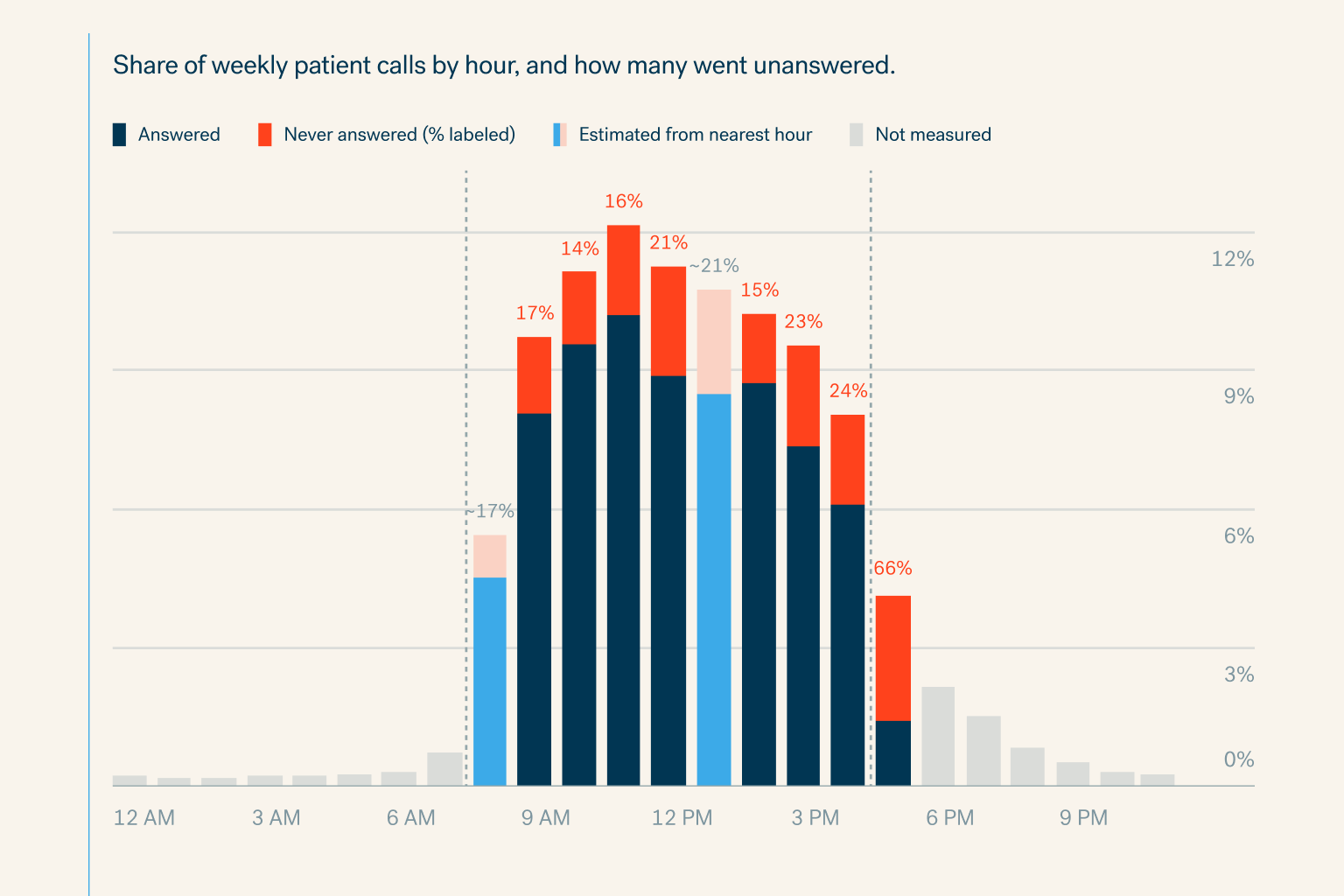
Specialty practices miss 18% of patient calls in office hours and 81% after hours. See the cost per physician and how voice AI books every call.
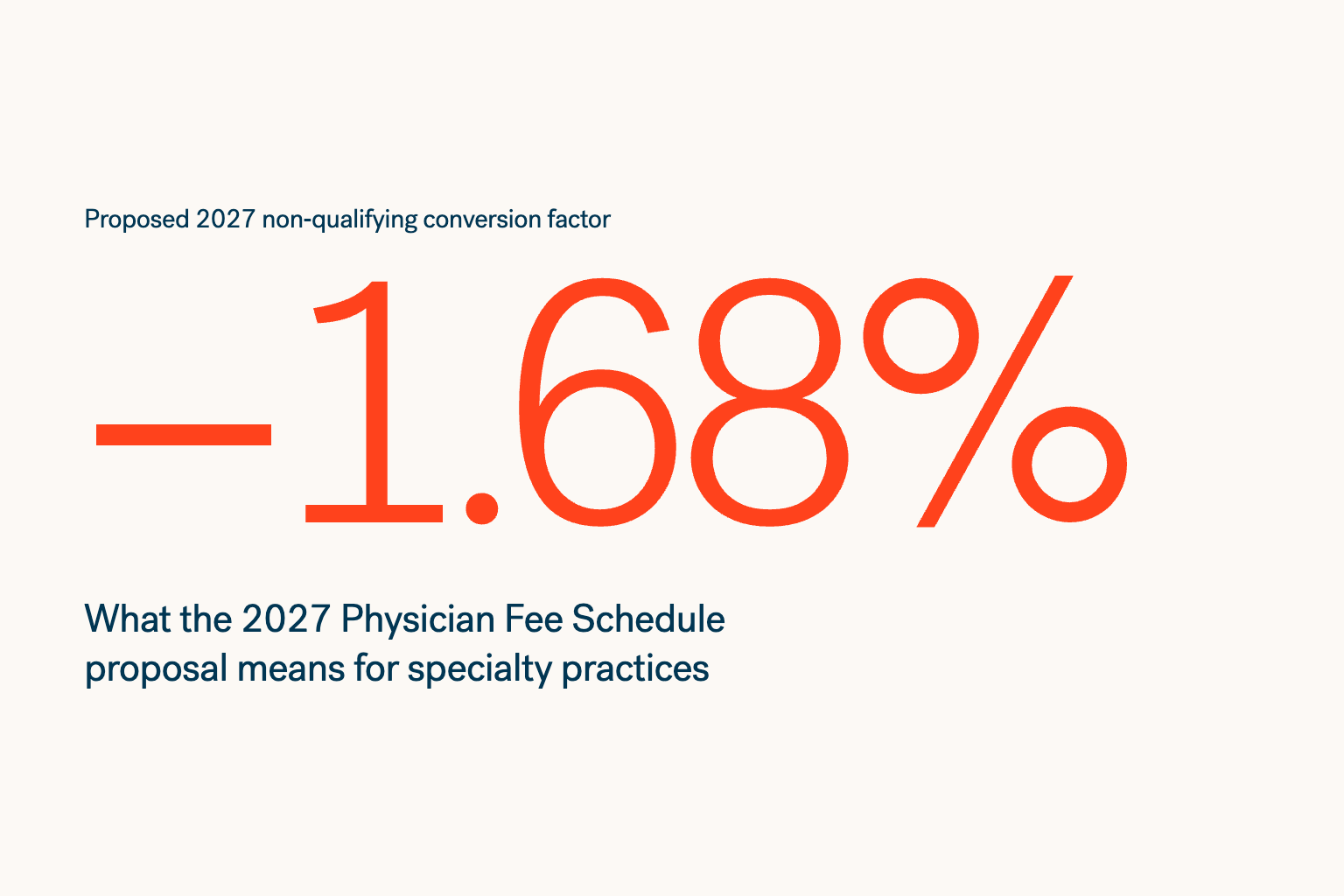
CMS proposes 2027 Medicare conversion factors down 1.19% to 1.68%. See the impact on specialty practices and the revenue levers you still control.
New research quantifies four ways AI can help specialty practices reach more patients, and get paid for the care they deliver—with an annual opportuni


