




Best AI Voice Agents for ENT (2026 Guide)
Compare 5 AI voice agents for ENT and allergy practices. See which handle scheduling and the payer calls for prior auth and benefits checks.
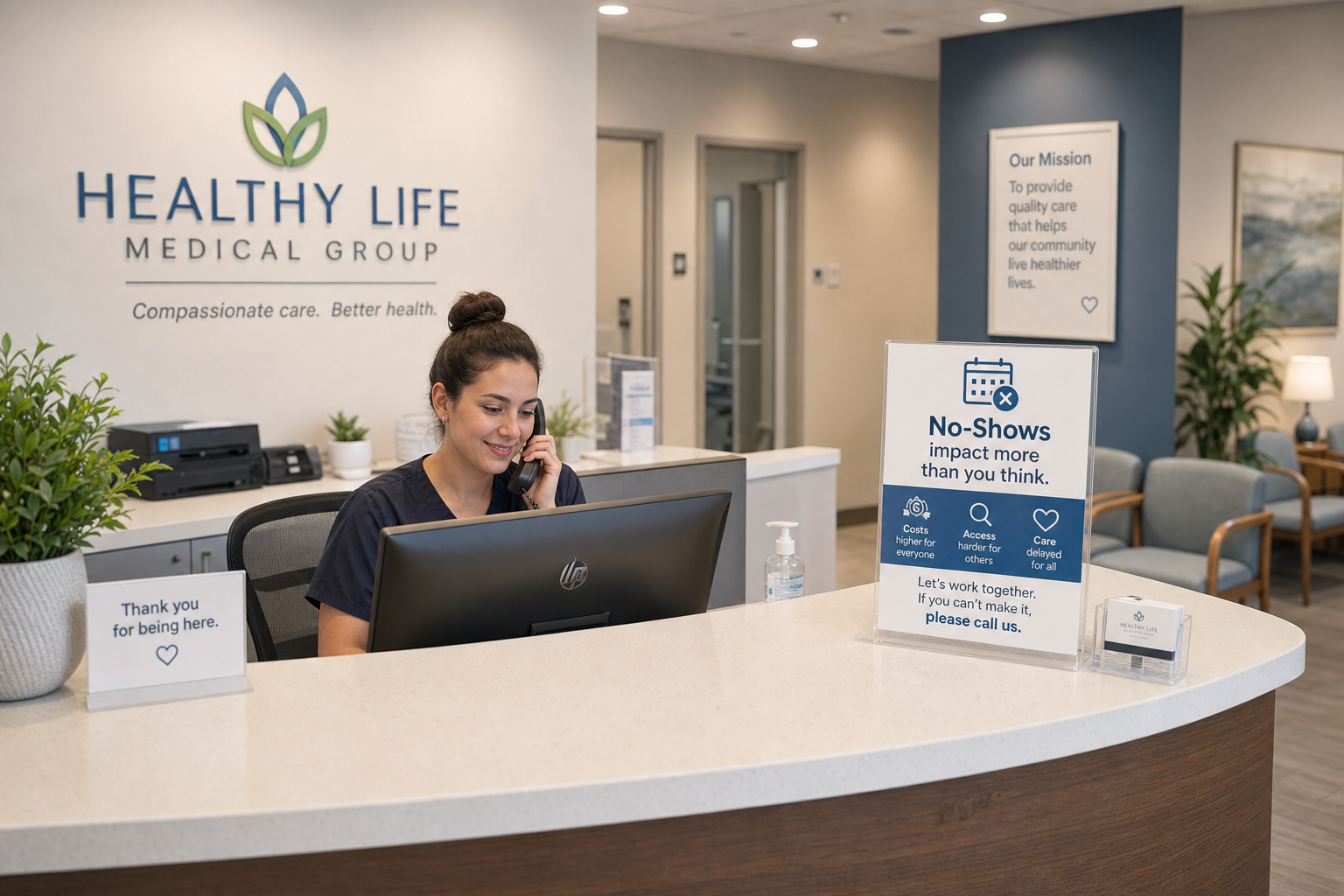
Check your schedule from last week and count the gaps. Empty slots don't just cost you missed appointment revenue, they compound across staff hours, wasted exam room time, and provider capacity you can't bill or recover. Most outpatient clinics sit somewhere between 23% and 33% no-show rates, which means the problem isn't isolated, it's predictable. What changes the outcome is whether you've built the systems to prevent it.
TLDR:
Patient no-shows cost the U.S. health system $150 billion every year, and each missed appointment represents an average revenue loss of $200 per physician. For a practice that looks fully booked on paper, the gap between scheduled and seen is pure EBITDA erosion.

The national average no-show rate across all specialties sits around 6.8%. Outpatient settings tell a harder story: no-show rates can reach up to 50%. Beyond direct revenue loss, the compounding effect matters too: staff scheduled around volume that never arrives, empty exam rooms, and provider time that can't be recovered or rebilled.
No-shows rarely reflect patient indifference. They trace to barriers that are predictable and, in many cases, preventable.
The most common drivers:
A patient who books six weeks out has six weeks to forget or run into a conflict. Shorter lead times, better reminders, and clearer financial communication are all levers a practice can pull.
No-shows don't hit every specialty equally. Sleep clinics, pediatrics, and dermatology sit at the high end, while endocrinology and dentistry run closer to the national average. Knowing where your specialty falls helps you size the problem accurately.
Despite the scope of the problem, only 42% of medical group leaders report using a no-show fee. The other 58% absorb the loss without a policy in place to recover even a fraction of it.
A clear, written policy is the foundation of any no-show reduction effort. Without one, staff have no consistent way to respond when patients miss appointments, and patients have no reason to take cancellations seriously. Automated enforcement helps ensure policies are applied consistently.
At minimum, a no-show policy for a medical office should cover:
Patients should receive the policy at intake and again in appointment reminders.
Charging patients a no-show fee is legal in most U.S. states, but the rules vary by payer contract and patient population. A few boundaries are worth knowing before you set your policy.
Most Medicaid programs prohibit no-show fees for enrolled patients. Medicare allows fees in limited circumstances, but CMS guidance generally discourages them. Before charging any government-insured patient, review your state Medicaid contract and consult your billing compliance officer.
For privately insured or self-pay patients, fees are broadly permissible provided:
Unpaid no-show fees can be sent to collections, though many practices avoid this for patient retention reasons. The fee must be documented, disclosed, and defensible to hold up.
Practices that combine even a few of these tactics see meaningful improvement. Done consistently, the full stack can cut no-shows by up to 70%.
Ranked roughly by ease of implementation:
SMS reminders have been the default no-show reduction tool for years, and they do help. Studies show text reminders alone can cut no-show rates by 8 to 20%. But they have a hard ceiling: a text can notify a patient, it cannot confirm intent, handle a reschedule request, or catch the patient who never responds.
AI voice agents work differently. They call patients, carry a two-way conversation, confirm attendance, and route reschedule requests without staff involvement. Where SMS is a broadcast, an AI voice agent is a conversation.
For practices already running high no-show rates, that difference matters. A patient who would ignore a text will often respond to a voice call that actually waits for an answer. This is where AI for patient scheduling and appointment reminders shows real value.
When a patient cancels, that slot doesn't have to go empty. AI-powered waitlist management automatically identifies the next eligible patient and fills the opening before it becomes lost revenue.
Traditional waitlists require staff to manually call through a list, often during the same hours they're managing check-ins and incoming calls. Most slots go unfilled simply because there aren't enough hands.
AI handles the outreach instantly. When a cancellation comes in, the system matches the slot to a waitlisted patient based on provider, location, and availability, then sends an automated confirmation request. Frederick Foot & Ankle filled 40% same-day, recovering revenue from last-minute cancellations. No staff time required.
For practices already losing thousands per no-show, recovering even a fraction of those slots adds up fast.
Prosper AI handles the patient communication work that drives no-shows in the first place. Automated reminders go out via text and voice before every appointment, confirmations get collected without staff involvement, and patients who need to reschedule can do it without calling in.
When a patient does cancel, Prosper can automatically offer that slot to waitlisted patients, keeping schedules full without front desk intervention. Practices using Prosper have seen measurable reductions in no-show rates alongside lower call volume to staff. Learn more about AI patient scheduling and how it delivers ROI.
The result is fewer gaps in the schedule, less time spent on reminder calls, and a front desk that isn't spending half the day chasing down confirmations.
The math on reducing no-show rates in outpatient clinics is straightforward: every percentage point you recover is money that was already on your schedule. Most practices know what they're losing, they just don't have the staff hours to manually confirm, reschedule, and backfill at the pace it takes to actually move the number. That's where automation makes the difference. Your front desk can stop spending half the day on reminder calls, and your schedule can start reflecting the volume you thought you had. Start here if you're ready to see what your utilization could look like with less manual work.
The national average no-show rate across all specialties ranges from 5% to 8%, but outpatient settings run much higher at 23% to 33%. Sleep clinics and pediatrics can see no-show rates as high as 39% and 30% respectively, while endocrinology and dentistry typically stay closer to the national average at 14% to 15%.
No, most Medicaid programs prohibit no-show fees for enrolled patients. Medicare also generally discourages them, though fees are permitted in limited circumstances. Before charging any government-insured patient, review your state Medicaid contract and check with your billing compliance officer to avoid contract violations.
AI voice agents handle two-way conversations that confirm attendance and immediately reschedule cancellations without staff involvement, while SMS reminders simply notify patients one-way. SMS can reduce no-shows by 8 to 20%, but voice agents go further by catching patients who ignore texts and filling canceled slots through automated waitlist outreach before they become lost revenue.
Start with automated reminders at 72 hours, 24 hours, and same morning, then add patient self-scheduling to improve commitment (this alone drops no-shows by 29%). Shorten your booking lead times when possible and remove friction from rescheduling so patients don't default to no-showing instead. Practices that combine these tactics see reductions up to 70%.
Unpaid no-show fees can legally be sent to collections if they were disclosed in writing before the appointment and the amount is reasonable. However, many practices avoid collections for patient retention reasons and instead apply the fee to the patient's account balance or require payment before scheduling the next appointment.
Discover how healthcare teams are transforming patient access with Prosper.
Compare 5 AI voice agents for ENT and allergy practices. See which handle scheduling and the payer calls for prior auth and benefits checks.

Best AI agents for orthopedic practices compared on prior auth, outbound payer calling, and billing. Only 1 vendor resolves 60%+ of calls end-to-end.

The 7 best AI voice agents for ophthalmology practices. Find platforms with ModMed & Nextech integrations, prior auth support, and patient automation.


