


2027 Medicare Physician Fee Schedule: What Changes for Specialty Practices
CMS proposes 2027 Medicare conversion factors down 1.19% to 1.68%. See the impact on specialty practices and the revenue levers you still control.
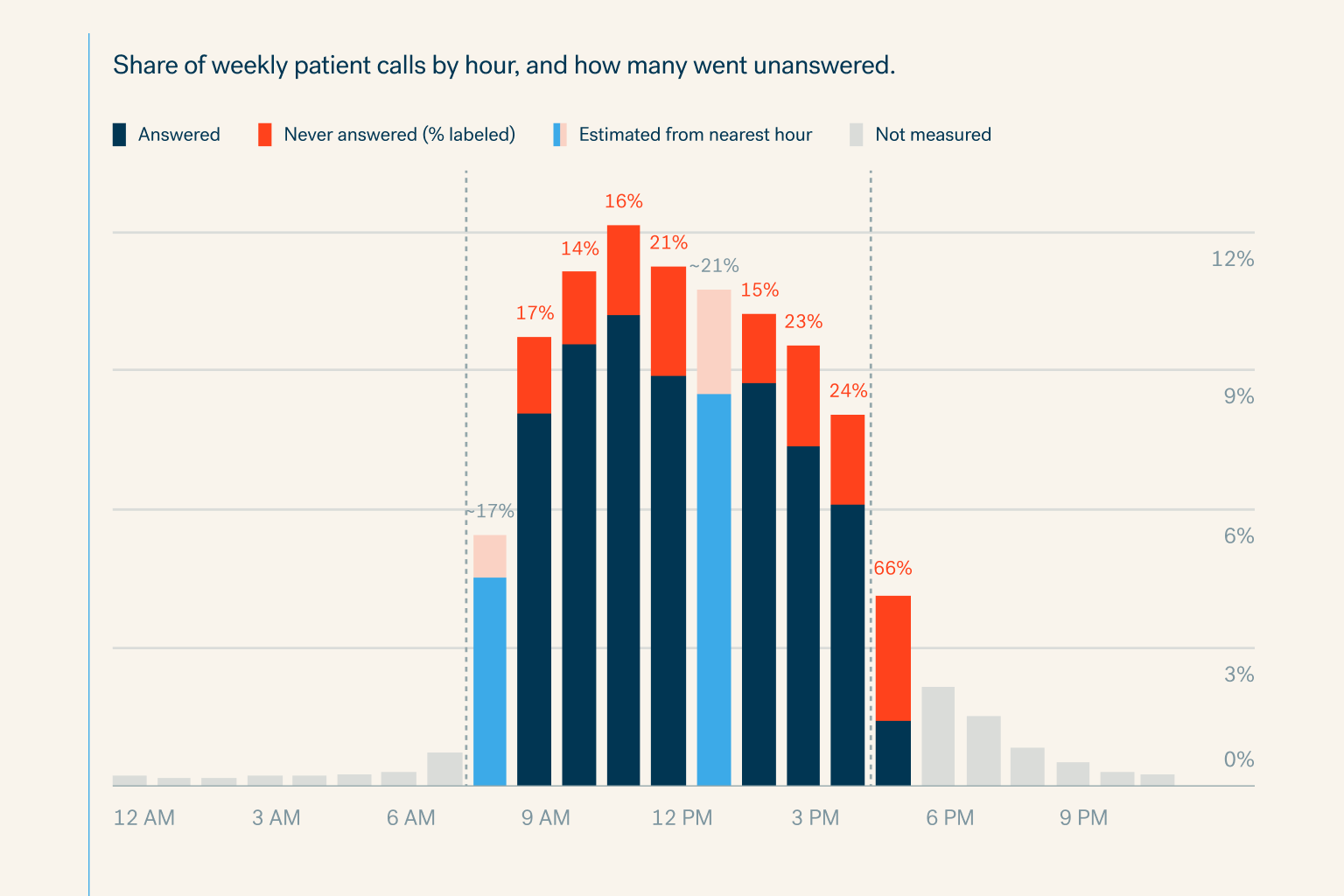
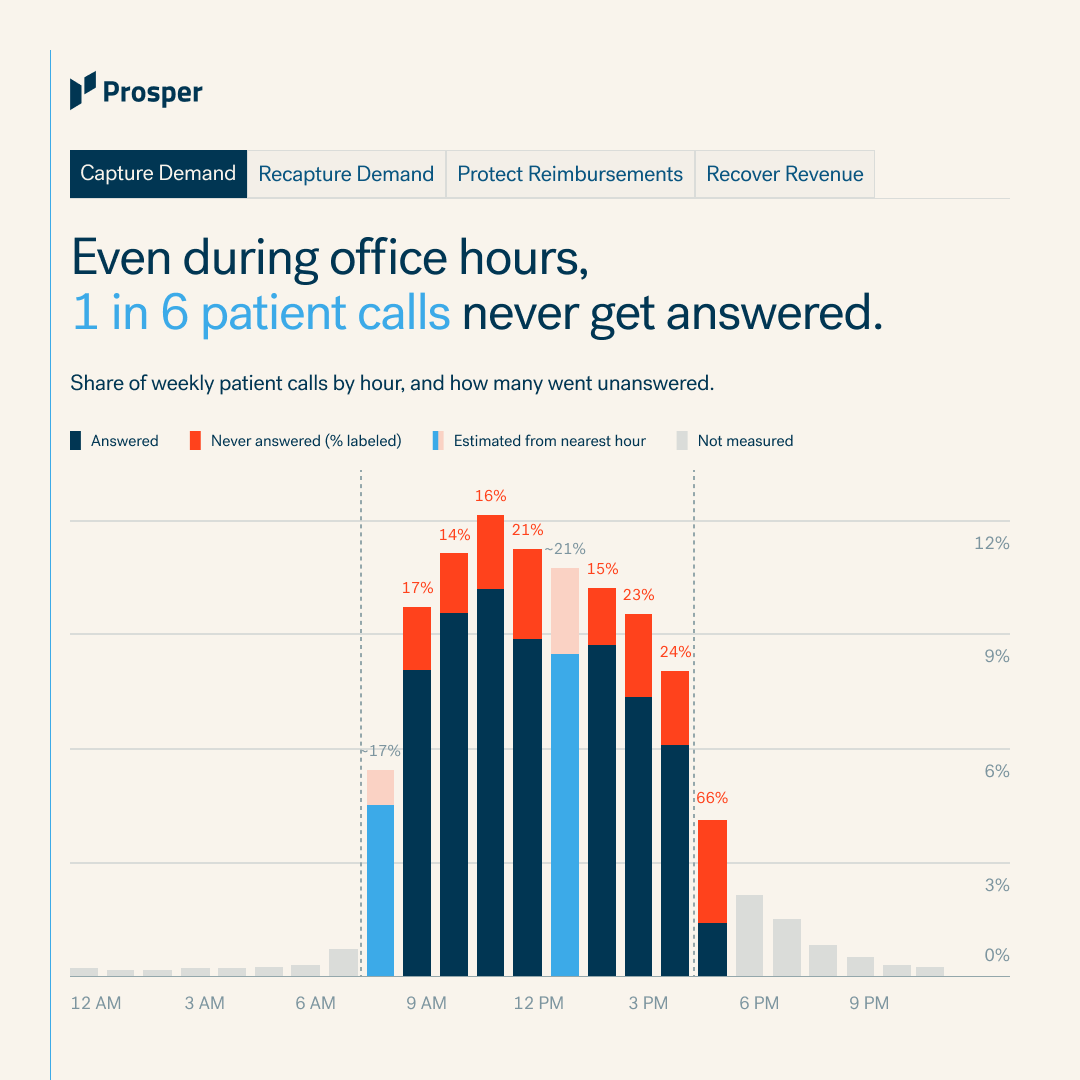
A missed patient call is a call to a practice that no one answers live. Specialty practices miss about 18% of patient calls during office hours and 81% after hours, per Prosper AI's CallIQ study of 31,712 calls. Capturing them is worth an estimated $44,800 per physician per year.
Prosper AI builds voice agents for multi-location specialty groups. They answer patient calls, book into the EHR and call payers to verify coverage before the visit.
Your front desk works the phones all day and still misses about 1 in 6 calls. 42% of those callers are trying to book a visit. And 80% of them never get recovered by a callback.
Prosper AI's 2026 Growth Report sizes the opportunity at an estimated $44,800 per physician per year, the biggest of the 4 revenue levers we sized for specialty practices. For a 20-physician practice, that's nearly $900,000 a year in appointments waiting on the other end of the phone line.
Specialty practices miss about 18% of patient calls during office hours and 81% of calls after hours. Those numbers come from CallIQ, the phone-access study in Prosper's 2026 Growth Report: 31,712 calls to 1,994 specialty practices across dermatology, ophthalmology, gastroenterology, OB/GYN, primary care and orthopedics, in 29 states.
We called each practice about 16 times at fixed times, in its local time, and booked nothing. For every call we tracked how long it took a live person to pick up and how long it took to start scheduling.
Here's what a patient runs into:
The after-hours number gets the attention. But 88% of patient call volume lands between 8 AM and 5 PM, so most of the opportunity sits in daytime calls, while your front desk is fully staffed and still can't keep up.
Answering every call is worth an estimated $44,800 a year for the average specialty physician, or 3.6% of the $1.24M a physician brings in, according to Prosper's 2026 Growth Report. The math is 4 factors multiplied together:
If you run patient access, read the same math as yield. Every unanswered call is a patient your marketing already paid to bring to the phone.
The number moves a lot by specialty. Here's the estimated missed-call opportunity per full-time physician, from the same model run against each specialty's MGMA benchmarks:
Now multiply by headcount. A 20-physician dermatology group is looking at roughly $1.5M a year in missed-call opportunity alone, before you count no-shows, denials or unpaid balances.
Callbacks reach patients too late, and new hires still can't cover the spikes. In Prosper's data, 80% of callers who don't get through are never recovered by a callback. By the time your team works the voicemail list, the patient has booked somewhere else or given up.
Hiring is the obvious next move, and it's expensive. 84% of medical groups report higher operating costs than a year ago, up 11% on average (2026 MGMA Stat poll). And a bigger front desk still staffs for the average hour, while calls arrive in spikes.
So you end up paying twice: once for the extra headcount, and again for the open slots it still doesn’t fill. 19% of provider schedules go unfilled in Prosper’s research, and some practices leave up to half their capacity empty.
That's the gap in one line: open slots on the schedule, patients trying to fill them, and a phone line between the two that drops 18% of calls.
Of the 4 common ways to cover the phones, only an AI voice agent answers every call live, at any hour, and books the visit in the same conversation. Here's how they compare on what a COO or patient access lead actually measures:
The row most groups underweight is the third one. A call that ends in a message or a transfer still needs a person to finish it, which is the same staffing problem you started with.
The best voice AI for a multi-location specialty group answers every call, books straight into your EHR, follows each location's scheduling rules and verifies coverage with the payer before the visit. Check these 6 things before you shortlist:
Piedmont Plastic Surgery & Dermatology booked 17% more appointments once Prosper's AI voice agents picked up every call. The North Carolina group has 37 providers. We compared August 2025, before go-live, with August 2026, running on Prosper: appointments rose from 19,209 to 22,524 and peak wait fell from 7 minutes to 0.
At the MGMA dermatology benchmark of $392 per visit, those 3,315 extra appointments come to an estimated $1.3M in added revenue for the month.
How to read these numbers: Appointments are all channels, from Piedmont's scheduling system. Revenue uses the MGMA 2025 dermatology average ($392 net revenue per visit), not Piedmont's own collections. Annualizing (about $421K per provider) assumes the August lift holds for 12 months and is fully attributable to Prosper. Phone metrics come from Prosper call data and the practice's pre-AI baseline.
A filled slot only turns into revenue if the claim gets paid. That's why Prosper books benefit-verified appointments: coverage confirmed and the patient's cost explained before the visit, so the slot is revenue you can count on.
The same agent that books the patient also checks eligibility and flags when a visit needs prior authorization. When that takes a payer call, it makes the call. Your team gets a clean appointment instead of a surprise at check-in or a denial weeks later.
First-submission denial rates average 10%, and front-end errors (eligibility, benefits, missing auths) drive about 45% of them. Fixing those is worth an estimated $28,500 per physician a year on its own. We break that math down in Lever 3: Protect Reimbursements.
Most scheduling tools stop at the calendar. Answering the phone fills the schedule; verifying the visit is what gets it paid.
Most groups go live on Prosper AI in about 3 weeks, with no custom coding and no change to how your staff works. And you pay $0 until go-live.
EHR connection. Prosper reads and writes directly in athenahealth, ModMed, eClinicalWorks, Veradigm and other specialty EHRs. The agent sees live provider calendars at every location and your scheduling rules, then writes the booked appointment, new patient details, insurance information and a call summary back to the chart.
Scheduling rules. Specialty groups run on dozens of appointment types, and the rules for each usually live in your schedulers' heads. Bring us your appointment types and each site's quirks; we learn them during implementation. Every call the agent can't finish gets categorized and reviewed every 2 weeks, then fed back into the build.
What to measure. Track 3 numbers weekly from day one: answer rate, appointments booked per 100 calls and calls resolved without staff. Together they show whether the missed-call opportunity is turning into booked visits.
What's a normal missed-call rate for a medical practice?
About 18% of calls go unanswered during office hours at the average specialty practice, based on Prosper AI's CallIQ study of 31,712 calls to 1,994 practices. After hours, 81% go unanswered.
Does AI phone answering book directly into my EHR?
Yes. Prosper AI reads live provider calendars and writes the appointment back into athenahealth, ModMed, eClinicalWorks, Veradigm and other specialty EHRs during the call, so your staff doesn't re-key a message the next morning. It follows your appointment types and scheduling rules, the same ones your schedulers use.
Is voice AI HIPAA compliant?
It can be, and you should ask every vendor for proof. Prosper AI is HIPAA-compliant, SOC 2 Type II certified, and signs a BAA with every customer.
Can it handle insurance and benefits questions on the call?
Yes. The agent can answer coverage questions, check eligibility and flag visits that need prior authorization before they're booked. When the answer requires a payer, Prosper calls the payer too, so the appointment arrives benefit-verified.
Can voice AI book appointments after hours?
Yes. Prosper AI answers 24/7 and books the visit during the call, at any hour. At Piedmont Plastic Surgery & Dermatology, 2,651 after-hours calls were resolved in one month that previously went to voicemail.
Does voice AI replace front desk staff?
Prosper AI picks up the calls your team can't reach: peak-hour overflow, after-hours calls and routine scheduling. Your staff keeps the conversations that need a person, and every call the agent can't finish is reviewed every 2 weeks and fed back into the build.
The research behind this post comes from Prosper's 2026 Growth Report, which sizes all 4 revenue levers by specialty. Short on time? Read the top 5 takeaways.
Enter your specialty, physician count and call volume to estimate your missed-call revenue opportunity. Calculate your missed-call revenue →
Want to hear the agent on a real call? Book a demo →
Discover how healthcare teams are transforming patient access with Prosper.
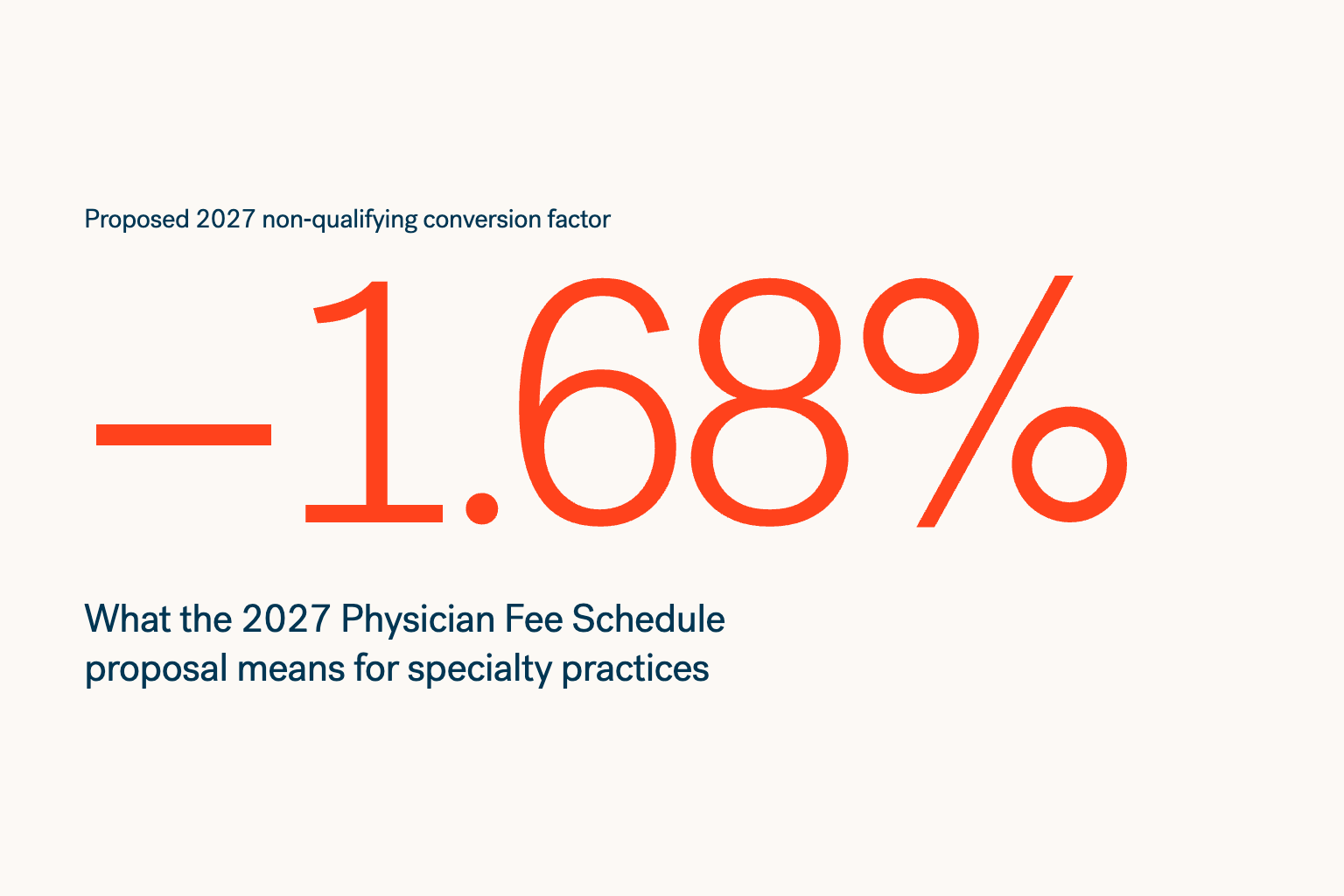
CMS proposes 2027 Medicare conversion factors down 1.19% to 1.68%. See the impact on specialty practices and the revenue levers you still control.
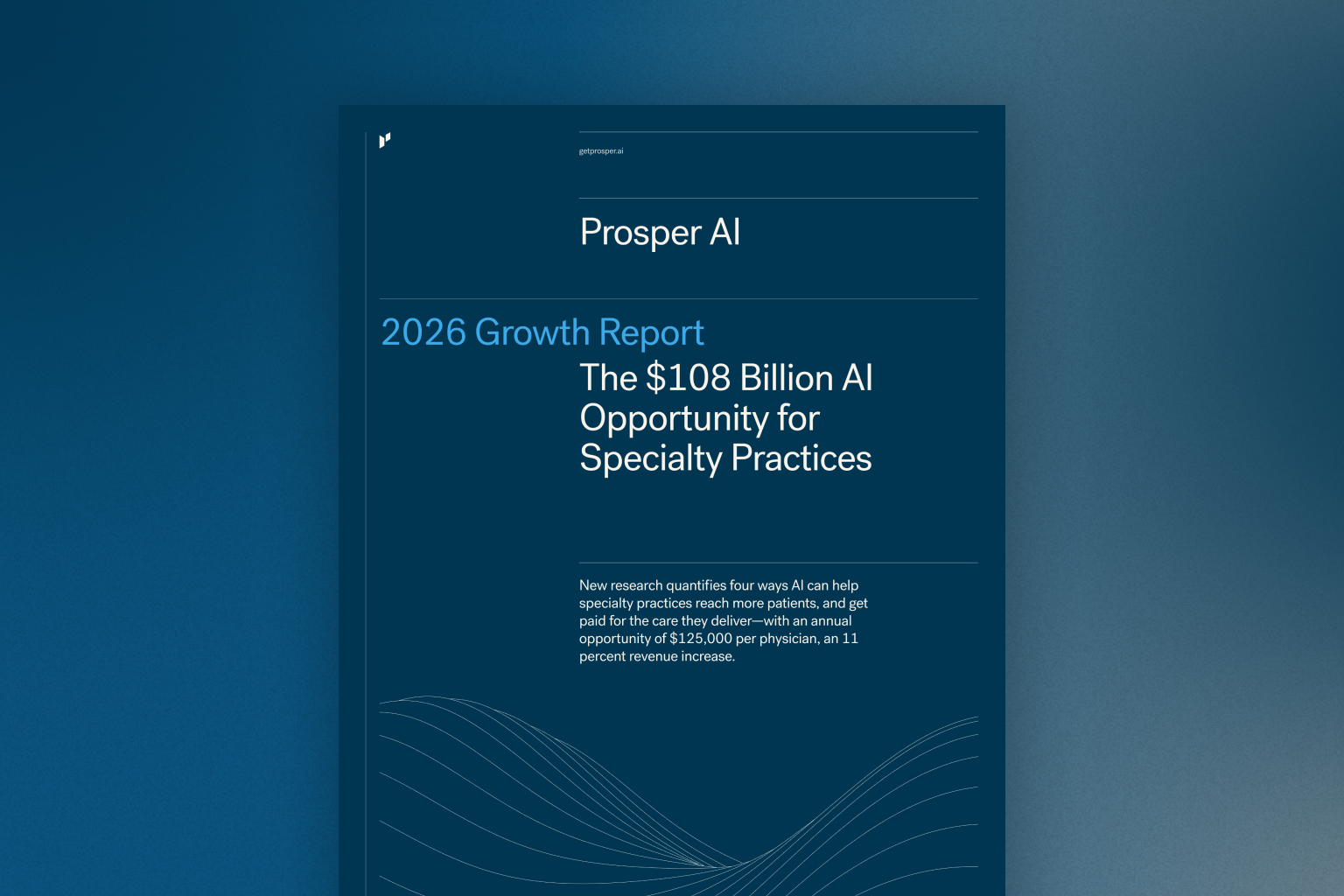
New research quantifies four ways AI can help specialty practices reach more patients, and get paid for the care they deliver—with an annual opportuni
Select your specialty and enter your number of physicians to estimate your practice's annual revenue opportunity, broken down across 4 levers.


