




Best Voice AI for Gastroenterology Practices: 4 Options Compared (2026)
Compare 4 voice AI vendors for GI practices on colonoscopy scheduling, benefits verification, and prior auth calls. See which ones stop at booking.

For years, insurance eligibility verification got treated as a back-office checklist: confirm the policy, note the copay, move on. But 41% of providers now say at least 1 in 10 claims gets denied, and 54% say claim errors are getting worse, not better.
Eligibility errors like inactive plans, lapsed coverage, and wrong member IDs are the 3rd largest cause of denials industry-wide, behind only coding errors and prior-auth failures. None of that gets created at the claims office. It gets created — or missed — at the front desk, days or weeks before the visit.
This guide covers the eligibility verification process end to end: how it works, what it costs a practice to skip, the technical standards behind it, and why "electronic" doesn't automatically mean "solved."
Insurance eligibility verification protects revenue and patient trust. 41% of providers now report at least 1 in 10 claims gets denied, and 54% say claim errors are getting worse, not better. Most of that damage traces back to a coverage question nobody checked before the visit.
By confirming coverage upfront, healthcare providers minimize the risk of delivering unpaid care, slash claim rejections, and give patients a clear picture of their expected costs. This is especially critical for enterprise scale health systems managing high patient volumes.
Skipping this step is a recipe for disaster. It leads to denied claims, lost revenue, and surprise bills that frustrate patients. Here’s a closer look at why it’s a mission critical process:
Verification fails for predictable reasons: a mistyped policy number, a plan that changed since last visit, or a call that sits on hold for 20 minutes. Manual eligibility checks now take over 10 minutes for more than half of providers still doing them by hand — time a front desk doesn't have.
Despite its importance, the insurance eligibility verification process isn’t always straightforward. Several hurdles can make it a time consuming and error prone task for administrative staff.
Common challenges include:
A structured verification process runs in five steps: collect patient insurance details, submit the inquiry electronically, review the benefit response, resolve any flags, then document and communicate the results. Each step exists to catch a problem before the claim is filed, not after.
Practices verify eligibility four ways: real-time electronic transactions, payer portals, phone calls, or automated third-party services. Speed and accuracy vary sharply between them. A phone call can take 20 minutes; an electronic 270/271 check takes seconds.
Real time insurance eligibility verification means checking a patient’s coverage instantly through electronic transactions. An inquiry is sent and a response is received in seconds. This speed is critical for catching last minute changes, like a policy that was terminated yesterday. Industry best practices now strongly encourage a real time check on the day of service for this very reason. Thanks to modern standards, the vast majority of verifications (around 94%) are now performed electronically, many in real time.
Most insurance companies offer online portals where providers can log in to check patient eligibility. This method is a step up from a phone call, as it provides instant, direct access to the payer’s data. However, it still requires manual effort. Staff must manage logins for numerous different portals and enter patient information for each search, which can become a significant bottleneck in a busy practice.
Calling the insurer’s provider service line is the most traditional verification method, and also the most inefficient. Staff must navigate automated phone systems, endure long hold times, and verbally relay sensitive information, all of which is time consuming and prone to error. This manual process is a major source of administrative waste and staff burnout.
The frustration of phone based workflows is exactly why innovative solutions are emerging. Companies like Prosper AI offer AI voice agents that can automate these calls entirely. The AI agent navigates the phone menus, waits on hold, and speaks with the representative to capture all the necessary benefit details, freeing up your staff to focus on patient care.
Automated insurance eligibility verification uses technology to handle the process with minimal human intervention. This is often done through clearinghouses or specialized third party services that connect to hundreds of payers. A practice can send a list of upcoming appointments, and the system automatically returns eligibility and benefit information for every patient.
According to the Council for Affordable Quality Healthcare (CAQH), the healthcare industry could save an estimated $3.3 billion annually by shifting from manual to automated verification. Automation not only saves money but also reduces errors and frees up staff for more complex tasks. For organizations struggling with the high volume of phone calls, exploring an automated RCM solution can transform front office efficiency and significantly reduce denial rates.
Eligibility verification is already 96% electronic for medical practices, yet eligibility-related denials keep rising. Going electronic isn't the same as going accurate. The bottleneck isn't digital versus manual anymore. It's whether the check happens in real time, before the visit, not just whether a transaction gets fired.
Electronic eligibility checks run on national standards, not ad hoc formats. The 270/271 transaction handles medical and dental benefits; NCPDP D.0 handles pharmacy. CAQH CORE operating rules require payers to respond within 20 seconds with specific financial details, like remaining deductible.
The Health Insurance Portability and Accountability Act (HIPAA) established mandatory national standards for electronic healthcare transactions. These rules ensure that all providers and payers “speak the same language” when exchanging eligibility information, which improves efficiency and protects patient privacy.
For medical and dental benefits, the HIPAA mandated standard is the ASC X12 270/271 transaction. The “270” is the eligibility inquiry sent by the provider, and the “271” is the eligibility response sent back by the payer. This standardized format is the engine that powers virtually all automated, real time eligibility checks in the U.S.
For pharmacy benefits, HIPAA mandates a different standard: the NCPDP Telecommunications Standard D.0. This is the format used every time a pharmacy checks a patient’s prescription drug coverage. It allows for instant verification of copays and coverage rules at the point of sale.
On top of the transaction standards, the Affordable Care Act (ACA) mandated a set of operating rules developed by CAQH CORE. These rules add another layer of consistency. For example, they require payers to return specific patient financial information (like remaining deductibles) and respond to real time inquiries within 20 seconds. These rules make electronic transactions more reliable and useful for providers.
A real eligibility response is more than "active" or "inactive." It should return the deductible, copay, and coinsurance amounts, confirm the service is covered for the diagnosis billed, and flag whether prior authorization is required. Missing prior auth alone accounts for nearly 12% of all denied claims.
A comprehensive eligibility response includes key patient financial responsibilities:
Having this information allows your team to collect the correct amount at the time of service and inform patients about their future financial obligations, which is critical for managing patient collections, especially for those with high deductible health plans.
True benefit verification goes beyond confirming an active policy. It confirms whether a specific service is covered. This is where CPT and ICD 10 codes become essential.
Payers use both codes together to determine medical necessity. The ICD 10 code (the diagnosis) must justify the CPT code (the service). Verifying coverage for specific service codes before the appointment helps pre-empt denials for services that are not covered under the patient’s plan for that particular diagnosis.
Sometimes, an eligibility response will indicate that a service requires prior authorization (PA), or pre approval from the insurer. This is a critical piece of information. Failing to get a required PA is one of the leading causes of claim denials. Data suggests that missing prior authorizations account for nearly 12% of all denied claims. Your verification process must include a step to identify and initiate any necessary authorizations. This is another tedious, phone heavy workflow that can be a major drain on resources, making it a prime candidate for automation.
To ensure nothing is missed, your team should confirm the following details during every verification:
The strongest verification workflows check twice: a few days before the visit, and again on the day of service. They document every result, track eligibility-related denial rate as a KPI, and treat automation as the default, not the exception.
Consistency is key to an effective verification process. Create a standard operating procedure (SOP) that outlines every step, from initial data collection to final documentation. This workflow should define who is responsible for verifications, the timeline for performing them (for example, 3 days before service and again on the day of), and the protocol for handling exceptions like inactive policies.
Thorough training is equally important. Your staff should be proficient in using all your verification tools, including your practice management system, payer portals, and any automated solutions. For manual phone calls, training should cover how to navigate complex phone menus and what specific questions to ask to get a complete and accurate benefits picture.
A strong verification process requires ongoing oversight. Regularly monitor key performance indicators (KPIs) to measure effectiveness. Important metrics to track include:
Auditing a sample of verifications can uncover gaps in your workflow or areas where staff may need additional training. Use these insights to refine your processes. Automation platforms can greatly simplify this by providing dashboards and analytics that offer near real time visibility into verification accuracy and outcomes, making continuous improvement easier to achieve.
Ultimately, a strong insurance eligibility verification process protects your practice’s bottom line and enhances the patient experience. It is the first and most effective line of defense against costly, preventable claim denials. By prioritizing accuracy, consistency, and automation, you can turn this critical administrative task into a competitive advantage.
If your team is still buried under manual phone calls for benefits and authorizations, it might be time to explore a more modern approach. Discover how Prosper AI can automate your payer communications and give your staff back the time they need to serve your patients. See the results in our case studies.
1. What is insurance eligibility verification?
Insurance eligibility verification is the process of confirming a patient’s health insurance coverage, benefits, and financial responsibility with their payer before a healthcare service is provided.
2. Why is insurance eligibility verification so important in healthcare?
It is crucial because it helps prevent claim denials, reduces uncompensated care, improves cash flow, and provides financial transparency to patients, which improves their overall experience and satisfaction.
3. How often should you verify a patient’s insurance?
Best practice is to verify insurance at least twice: once a few days before the scheduled appointment to resolve any issues, and again on the day of service to catch any last minute changes in coverage.
4. What is the difference between eligibility and benefits verification?
Eligibility verification confirms that a patient has an active insurance policy on a specific date. Benefits verification goes deeper, confirming the specific details of what the plan covers, including copays, deductibles, coinsurance, and service limitations.
5. Can insurance eligibility verification be automated?
Yes, and it is highly recommended. Automation solutions use electronic data interchange (EDI) transactions, clearinghouse services, or AI agents to verify coverage for many patients at once with high speed and accuracy, significantly reducing manual effort.
6. What is a 270/271 transaction?
The 270/271 is the HIPAA mandated electronic transaction standard for medical insurance eligibility. A 270 is the inquiry sent by a provider to an insurer, and a 271 is the response from the insurer containing the eligibility and benefit details.
7. How does eligibility verification reduce claim denials?
It directly addresses the root causes of many denials. By confirming active coverage, using correct patient and policy numbers, identifying the right payer, and flagging needs like prior authorization upfront, it ensures claims are clean before they are ever submitted.
8. What should I do if a patient’s insurance cannot be verified?
If a verification fails, you should contact the patient immediately before their appointment. Ask them to provide updated insurance information or clarify the details on file. If they have no active coverage, you can discuss self pay options or the possibility of rescheduling. Ready to reduce denials and speed up verification? Get started with Prosper AI.
9. How does eligibility verification relate to financial clearance?
Eligibility verification is one piece of financial clearance, not a synonym for it. Financial clearance also covers benefits verification and prior authorization. An appointment is only fully cleared once all three are confirmed, not just an active policy.
10. Does electronic eligibility verification prevent claim denials?
Not by itself. Eligibility verification is already 96% electronic for medical practices (CAQH Index, 2024–2025), yet eligibility-related denials keep rising. Electronic just means faster. Preventing denials also requires the check to happen in real time, close to the visit, with accurate data.
Prosper AI build voice AI agents that cover inbound scheduling, insurance eligibility, prior authorization, billing inquiries, and outbound payer calls in a single automated workflow—one system for both sides of the phone.
In a six-vendor RFP, Prosper AI hit 60%+ end-to-end call resolution in production, compared to roughly 30% for other vendors. Most practices are live in 3 weeks, with no custom coding and no disruption to staff, and integrate with 80+ EHR and practice management systems.
Book a demo with Prosper AI to see what full-coverage resolution looks like on your actual call mix.
Discover how healthcare teams are transforming patient access with Prosper.
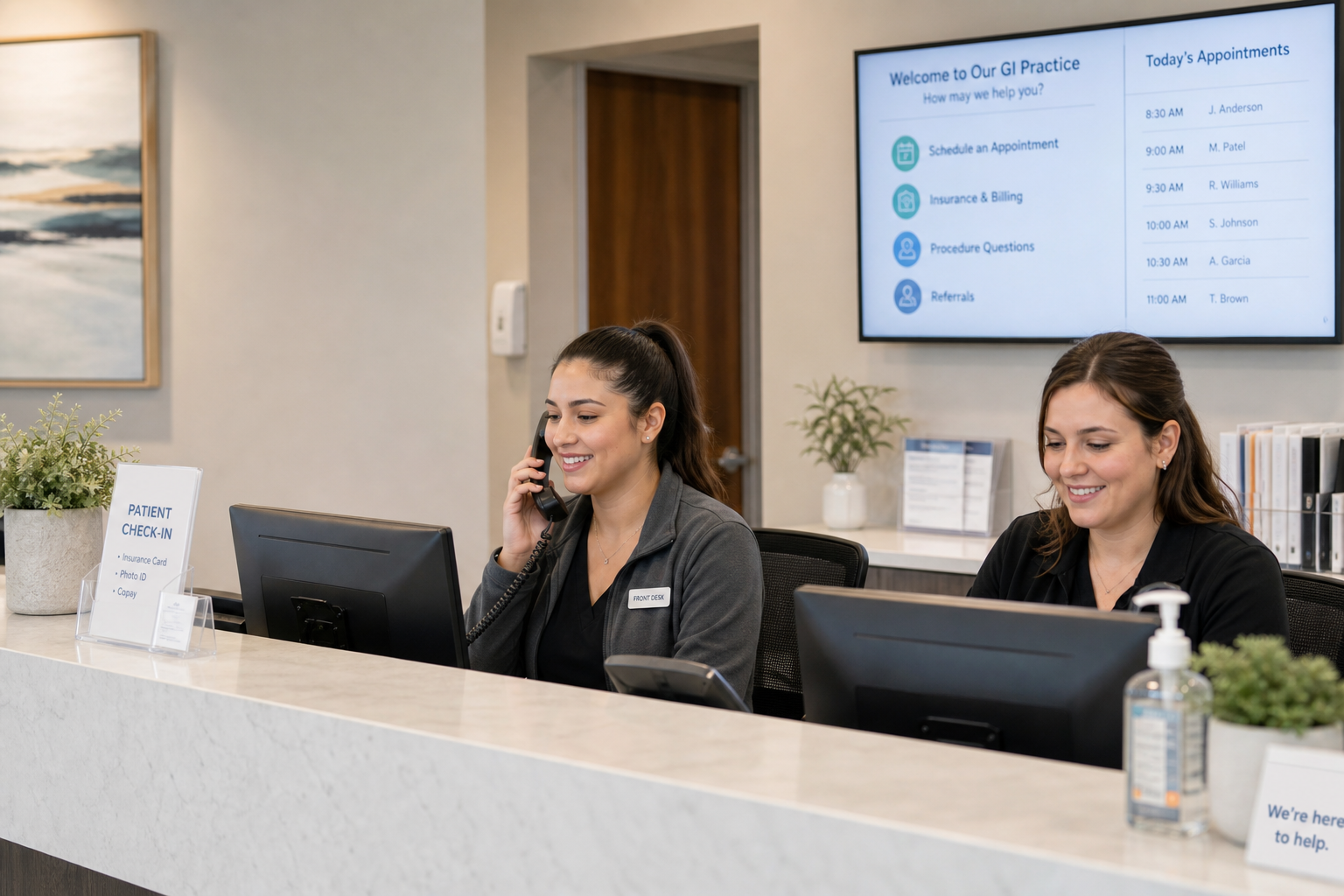
Compare 4 voice AI vendors for GI practices on colonoscopy scheduling, benefits verification, and prior auth calls. See which ones stop at booking.

Compare 5 AI voice agents for ENT and allergy practices. See which handle scheduling and the payer calls for prior auth and benefits checks.

Best AI agents for orthopedic practices compared on prior auth, outbound payer calling, and billing. Only 1 vendor resolves 60%+ of calls end-to-end.


