


Report: The $108 Billion AI Opportunity for Specialty Practices
New research quantifies four ways AI can help specialty practices reach more patients, and get paid for the care they deliver—with an annual opportuni
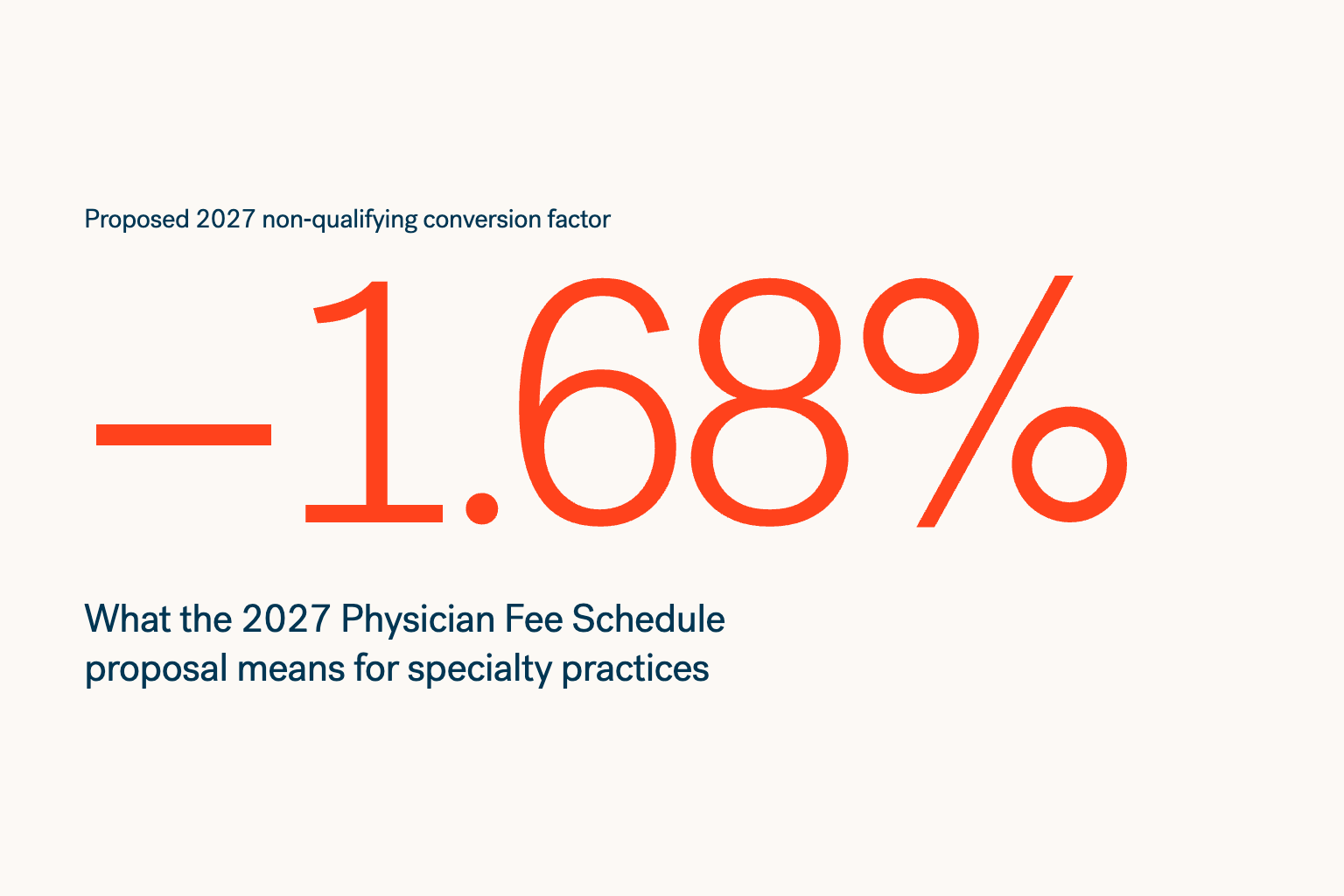
On July 14, 2026, the Centers for Medicare & Medicaid Services (CMS) proposed its calendar year 2027 Medicare physician fee schedule. Comments closed September 14. CMS is expected to publish the final rule in early November. For practice administrators, the proposal sets a planning baseline: Medicare rates will likely fall slightly, and CMS wants to change how it pays for practice expense.
CMS now sets two conversion factors, one for clinicians in qualifying advanced alternative payment models (APMs) and one for everyone else. According to the CMS proposed rule fact sheet, the proposed 2027 qualifying APM conversion factor is is $33.17, down 1.19% from $33.57. The proposed non-qualifying factor is $32.84, down 1.68% from $33.40.
Most specialty practices will fall under the lower, non-qualifying factor.
The main driver is statutory. Public Law 119-21 gave physicians a one-year 2.50% increase for 2026, and it expires at year end. Statutory updates of +0.75% (qualifying) and +0.25% (non-qualifying) and an estimated +0.53% adjustment for work RVU changes offset part of it. The full text is in CMS-1848-P and the Federal Register notice.
CMS also proposes to phase out part of the practice expense methodology tied to specialty practice expense per hour data from 2007 or earlier. CMS would remove it over a two-year transition and add a ‘PE stabilizer’ to limit short-term swings in payment. CMS says the longer goal is cost data that is more objective, routinely updated, and auditable.
CMS is also seeking comment on whether the facility and non-facility site-of-service payment differential is still appropriate, particularly for physicians employed by a hospital or health system. Practices with a mix of employed and independent sites should watch this item.
A 1% to 2% change in Medicare rates is small next to other revenue leakage. Prosper AI's 2026 Growth Report estimates an annual opportunity of $125,000 per physician, an 11% revenue increase, from four areas AI can address. The report's five takeaways summarize each one.
These are Prosper AI estimates from our report, and the gap varies by specialty. The report estimates the total revenue gap per full-time physician at $210K in dermatology, $114K in orthopedics, and $107K in gastroenterology. To see where your practice falls, use the Specialty Practice Revenue Growth Calculator. Pick your specialty and physician count, and it splits the estimate across the four levers.four levers.
1. Phones. Prosper AI's CallIQ research, a phone access study of nearly 2,000 specialty practices across 29 states, found 18% of calls go unanswered during office hours, and the after-hours missed-call rate reaches 81%. Among callers who reach someone, 20% wait on hold for more than five minutes. The report values captured demand at $44.8K per physician per year, 36% of the total.
2. Patients who do not come back. Per the report, only 54% of patients due for a follow-up visit return on schedule. Prosper AI estimates that re-engaging the rest is worth $37.4K per physician annually, or 30% of the opportunity. Reminders help, but they don’t reach the 6% of patients who never come back on their own. More on that in our guide to AI voice-enabled patient engagement for specialty practices.
3. Denials. The report puts the average first-submission denial rate at 10%, rising up to 22% in orthopedics and 16% in gastroenterology. Front-end errors cause about 45% of denials, and the report values fixing them with pre-visit benefit checks at $28.5K per physician per year, 23% of the opportunity. When rates drop, each denied claim costs a larger share of margin.
4. Patient balances. Per the report, patients pay 36% of the cost of their care on average, and 55% in dermatology. Nearly 8% of what patients owe goes unpaid, and practices collect only 39% of patient balances at the time of service. The values estimates recovering the patient responsibility at $14.1K per physician per year.
CMS may change these figures in the final rule. Specialty-level impacts depend on your code mix and site of service. Prosper AI's opportunity estimates are averages across specialty practices and will differ for your practice.
Discover how healthcare teams are transforming patient access with Prosper.
New research quantifies four ways AI can help specialty practices reach more patients, and get paid for the care they deliver—with an annual opportuni

Select your specialty and enter your number of physicians to estimate your practice's annual revenue opportunity, broken down across 4 levers.

Specialty healthcare practices leave an estimated $125K per physician uncaptured each year. See the 5 takeaways from Prosper AI’s 2026 Growth Report.


