




Why Do 45% of Claim Denials Start at the Front Desk? A Prevention Guide for Specialty Practices
45% of claim denials start at the front desk. See what preventing them is worth per physician, by specialty, and how to catch errors before the visit.
Patient responsibility (also called a patient balance or patient-due balance) is the share of a bill a patient owes after insurance: deductibles, coinsurance, copays and self-pay. Patients now pay 36% of specialty care costs, and Prosper AI's 2026 Growth Report values recovering unpaid balances at $14,100 per physician a year.
A balance that isn't collected at the front desk turns into a statement, then a second statement, then a third. By then the patient has questions about the charge, and a statement can't answer them.
Nearly 8% of what patients owe goes unpaid, according to the Growth Report. Recovering it is the smallest of the 4 revenue levers, and it grows every time patients take on more of the bill. For a 20-physician practice, it's worth about $282K a year for care the practice already delivered.
Patients pay an average of 36% of the cost of their care at specialty practices, and 55% in dermatology, according to Prosper AI's 2026 Growth Report. The figures come from more than 5 million calls Prosper AI has completed with providers and payers.
That share includes every dollar insurance doesn't cover:
Copays are the easy part. Deductibles and coinsurance often aren't final until the claim is processed, which is why most of the balance gets billed after the visit.
The pressure shows up beyond billing too. In an August 2026 MGMA Stat poll, 32% of medical groups reported more no-shows than in 2025, and the poll tied the rise to higher costs for patients.
Nearly 8% of what patients owe goes unpaid according to Prosper AI's 2026 Growth Report. Most of the rest gets collected late, after rounds of statements and staff follow-up.
The gap opens at the front desk. In an MGMA Stat poll, practices reported collecting about 72% of copayments at the time of service, but only 26.83% of other patient-due balances. Everything left over moves into the billing queue, where each balance means more statements, more calls and a higher chance it's never paid.
It's getting harder, too. In a 2025 survey cited in the Growth Report, 29% of medical practices said recovering outstanding patient balances had become more difficult over the past year, compared with 26% that saw improvement.
Recovering unpaid patient balances is worth an estimated $14,100 a year for the average specialty physician, according to Prosper AI's 2026 Growth Report. That's 3.2% of the $445K in patient-paid revenue a physician brings in:
This is revenue for care you already delivered. There's no new patient to acquire and no extra visit to schedule, only a balance to explain and collect.
Here's the estimated opportunity per full-time physician by specialty, from the same model run against each specialty's MGMA benchmarks:
Now multiply by headcount. A 20-physician dermatology group is looking at about $480K a year from patient balances alone, before you count missed calls, overdue follow-ups or preventable denials.
▶ Use our calculator to estimate your own revenue opportunity by incorporating AI
Because a patient who hasn't paid usually has a question first, and statements and portals can't answer it. Why do I owe this? Didn't my insurance cover it? Can I pay over time?
A statement tells the patient what they owe. It can't explain what insurance paid, walk through the deductible or set up a payment plan. A portal can take a payment, but only from a patient who logs in already ready to pay. So the questions go to the billing office by phone, and the billing office is working the same aging list it was last month.
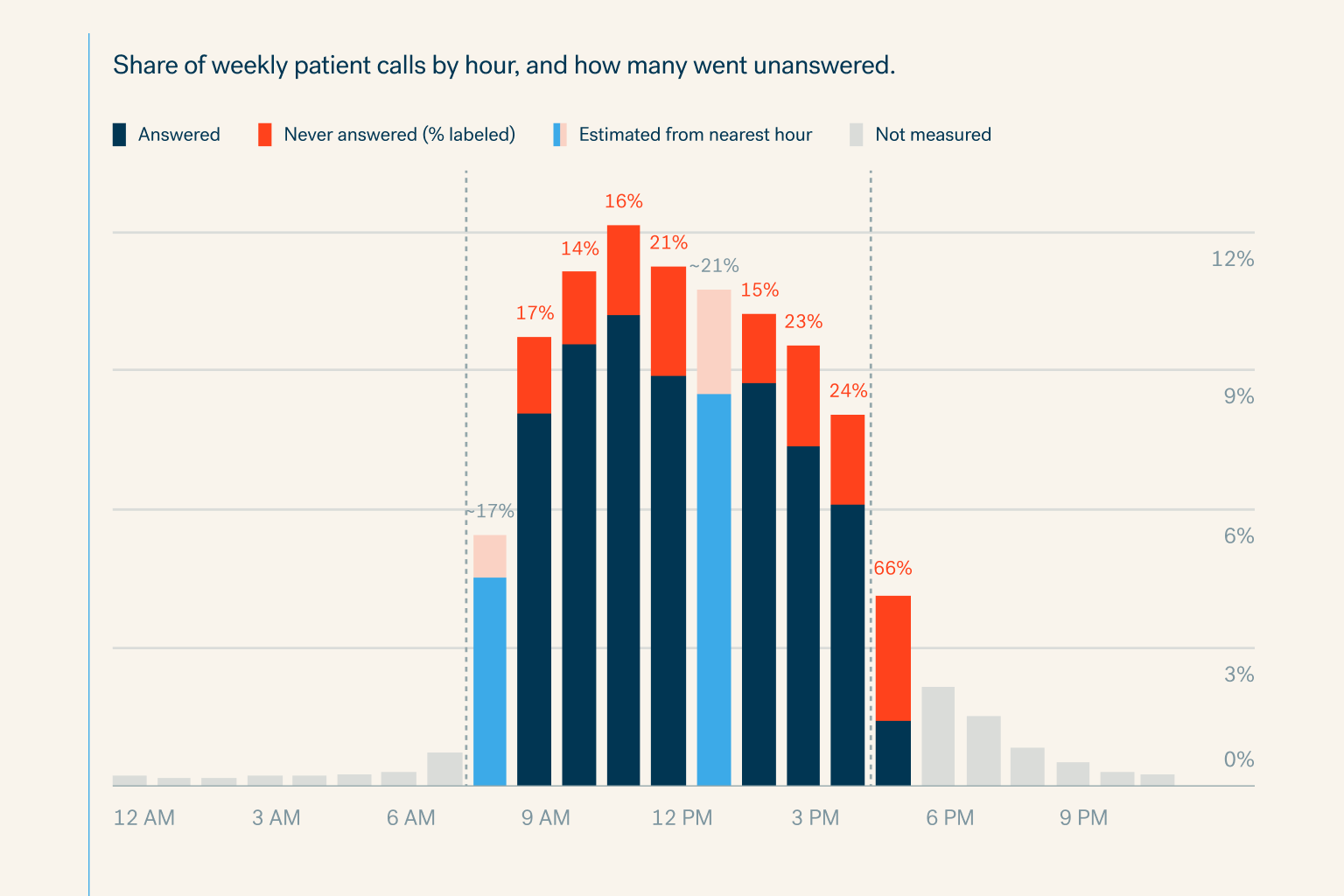
Staff calls work when someone has time to make them. At most specialty practices, the people who could make those calls are also covering a front desk that already misses 18% of inbound calls during office hours.
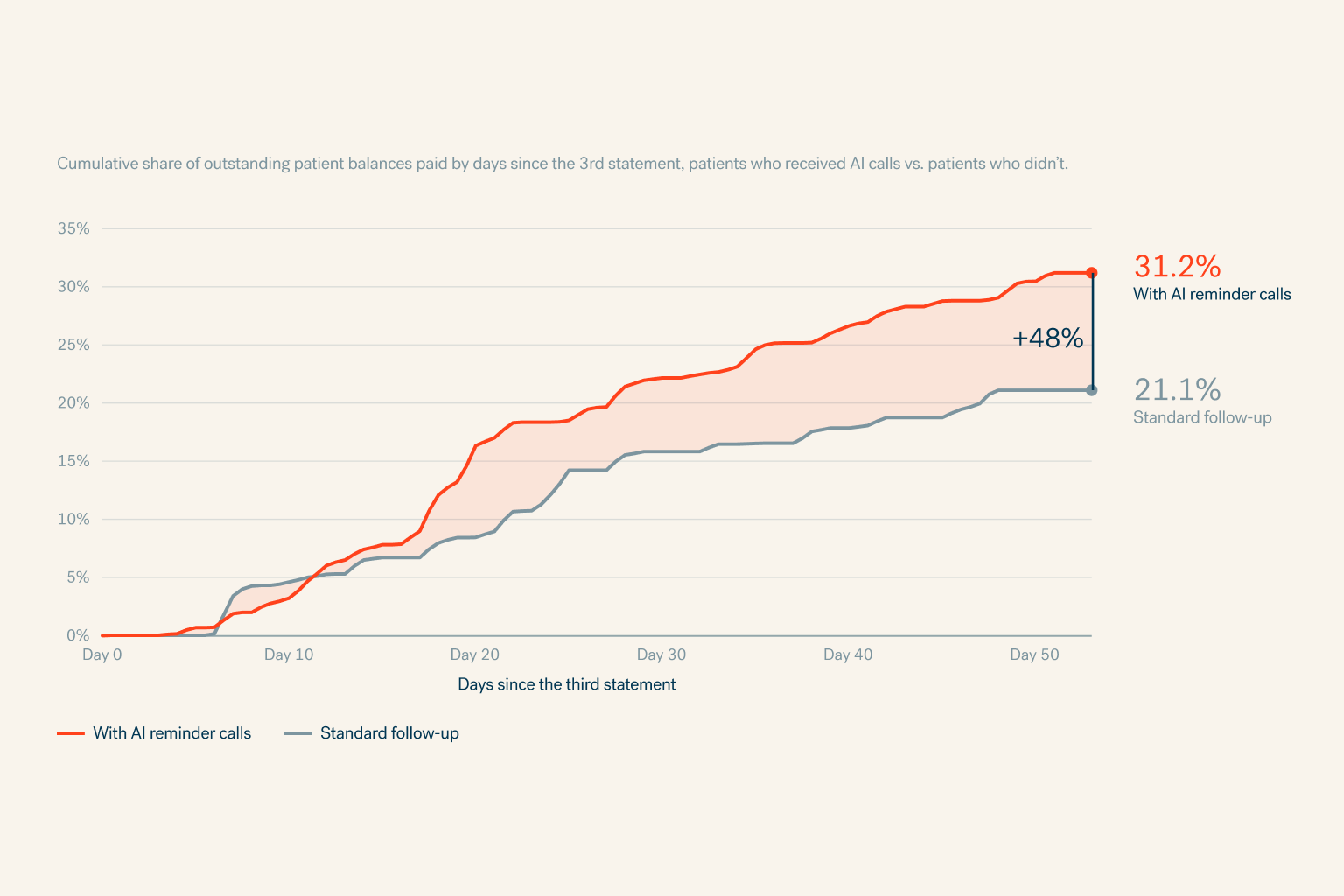
They pay more of what they owe. At one multi-location dermatology practice, AI reminder calls recovered 48% more outstanding patient balances than the practice's standard follow-up, according to Prosper AI's 2026 Growth Report.
The practice ran a randomized comparison. Households whose balances had reached a third billing statement got either AI reminder calls or the usual statements and follow-up. The calls explained the balance, answered questions about charges and insurance, and offered a payment link, a payment plan or a transfer to the billing team.
How to read these numbers. One multi-location dermatology practice, anonymized. Households were randomly assigned once their balance reached a third statement. Figures are the cumulative share of outstanding balances paid over about 50 days after that statement. Source: Prosper internal data, published in the 2026 Growth Report.
The approach that collects the most answers the patient's questions about the charge and offers a way to pay in the same conversation. Here's how the 4 common approaches compare:
The second row decides it. A patient with an unanswered question about their bill tends to wait, and every week a balance ages makes it harder to collect.
The best patient billing outreach software for a multi-location specialty group explains each balance using claim and benefits data, answers the patient's questions and offers a way to pay on the same call. Check these 6 things before you shortlist:
Tell patients their cost before the visit, collect what you can at check-in, and call before a balance ages into its third statement. Here's how to set it up in 5 steps:
Start with balances that have reached a second or third statement at one location, measure the recovery rate against your usual follow-up, then roll out the same rules everywhere.
Together, the 4 levers in Prosper AI's 2026 Growth Report add up to an estimated $125,000 in additional revenue per physician a year. Each one also feeds the next.
The link between them is the appointment itself. When a visit is booked with coverage confirmed and the patient's cost shared upfront, the claim is less likely to be denied, and the Growth Report finds patients who know their costs are more likely to show up and pay after the visit. A practice that's easy to reach and clear about cost also stands out to new patients, which brings the cycle back to Lever 1.
What is patient responsibility in medical billing?
Patient responsibility is the part of a medical bill a patient owes after insurance pays its share. It includes deductibles, coinsurance, copays and self-pay charges for services the plan doesn't cover.
How much of their care do patients pay for at specialty practices?
Patients pay an average of 36% of the cost of their care at specialty practices, and 55% in dermatology, according to Prosper AI's 2026 Growth Report.
What percentage of patient balances go unpaid?
About 7.9% of what patients owe goes unpaid, according to Prosper AI's 2026 Growth Report. Practices collect about 72% of copays at the time of service but only 26.83% of other patient-due balances, according to an MGMA Stat poll.
Which specialty has the most patient balance revenue to recover?
Dermatology, at an estimated $24,000 per physician a year, according to Prosper AI's 2026 Growth Report. Ophthalmology follows at $15,000, then primary care at $14,000, OB/GYN and orthopedics at $13,000 each, and gastroenterology at $12,000.
How can practices collect more patient balances?
Share the patient's estimated cost before the visit, collect copays and known balances at check-in, and call patients before a balance reaches its third statement. At one multi-location dermatology practice, AI reminder calls recovered 48% more outstanding balances than standard follow-up.
Can AI call patients about their balance?
Yes. Prosper AI calls patients about outstanding balances, explains the charges, answers questions about insurance, and offers a payment link, a payment plan or a transfer to your billing team.
Is AI patient billing outreach HIPAA compliant?
It can be, and you should ask every vendor for proof. Prosper AI is HIPAA-compliant, SOC 2 Type II certified, and signs a BAA with every customer.
Prosper AI calls patients about their balances, explains what insurance paid, answers their questions and offers a payment link or plan, with a transfer to your billing team when a person needs to step in. Estimate your revenue opportunity →
The research behind this post comes from Prosper AI's 2026 Growth Report, which sizes all 4 revenue levers by specialty. Read Lever 1: missed calls, Lever 2: patient recall and Lever 3: preventable denials.
Want to hear a billing call? Book a demo →
Discover how healthcare teams are transforming patient access with Prosper.
45% of claim denials start at the front desk. See what preventing them is worth per physician, by specialty, and how to catch errors before the visit.
Only 54% of follow-up patients return on schedule. See what late and lost patients are worth per physician and how voice AI brings them back.
Specialty practices miss 18% of patient calls in office hours and 81% after hours. See the cost per physician and how voice AI books every call.


