




Report: The $108 Billion AI Opportunity for Specialty Practices
New research quantifies four ways AI can help specialty practices reach more patients, and get paid for the care they deliver—with an annual opportuni

OB/GYN scheduling software is a category of patient access tools built to handle the specific call mix of an OB/GYN practice — prenatal scheduling, insurance questions, postpartum follow-ups, and after-hours calls — that general-purpose scheduling tools often only cover half of. That gap matters more in OB/GYN than in most specialties: no-show rates average 18% and climb to 28% for high-risk visits, and a missed slot here can mean a delayed prenatal check or a lost IVF cycle window, not just a routine reschedule.
Most vendor pages compare features in isolation; this ranking scores each tool against the full OB/GYN call mix, from scheduling through insurance and after-hours coverage, so the comparison reflects what a practice actually experiences across a billing cycle, not just a demo. We ranked six tools against the criteria that actually matter for OB/GYN call volume and stakes.
Scheduling software built for OB/GYN practices handles the appointment workflows that general-purpose tools often miss, like booking prenatal visits across trimesters, managing recurring postpartum checkups, and routing new patients to the right provider based on gestational age or insurance. Understanding AI patient scheduling helps clarify what to look for when vetting these tools.
At its core, OB/GYN scheduling software connects patient intake, calendar management, and EHR data so front desk staff spend less time on coordination and more time on exceptions that genuinely need a human.
OB/GYN no-show rates average 18% and climb to 28% for high-risk and specialty subsets. One 151,435-appointment health system audit found 26.5% of scheduled visits went unfilled, costing over 10,000 provider hours a year. New-patient wait times now average 42 days, up 79% since 2004 — the largest increase of any specialty tracked.
OB/GYN practices handle calls that stretch well beyond calendar management. Prenatal care cadence appointments, sensitive reproductive health inquiries, and insurance verification tied to gestational age raise the administrative stakes considerably. A scheduling tool that covers half the call types may look adequate in a demo and fall short by month two.
We ranked tools against eight criteria:
Narrow-scope tools carry above-average front-desk risk in OB/GYN. When a practice's call mix includes insurance plan restrictions, gestational routing rules, and sensitive inquiry types, a tool that only handles scheduling leaves a large share of daily volume unresolved.
The best overall OB/GYN scheduling software resolves the full call mix, not just the calendar — scheduling, insurance verification, and after-hours coverage — since that's where most narrow-scope tools leave gaps for OB/GYN front desks to absorb manually. We ranked six options below from strongest to narrowest coverage.
Prior authorization is widely reported as a top driver of OB/GYN administrative burden, which is why a tool that only handles the calendar leaves the more time-sensitive half of the problem to staff. Prosper AI goes further than most scheduling tools by handling the full call surface: appointment bookings, insurance verification, prior auth, after-hours calls, and more—using voice AI customized for OB/GYN practices.
When a patient calls to schedule a prenatal visit, confirm a postpartum follow-up, or check on a referral, Prosper AI handles the conversation end-to-end, resolving over 60% of inbound calls in production based on Prosper AI's customer deployment data.
What sets it apart for OB/GYN practices
OB/GYN front desks field a specific mix of calls: new OB registrations, high-risk pregnancy follow-ups, gynecology scheduling, and insurance verification for maternity benefits. ACOG's updated prenatal care guidance recommends a higher-touch cadence that adds scheduling complexity most general tools aren't built for. Prosper handles each of these without routing patients through a phone tree. It integrates directly with EHR and PMS systems to read and write appointment data, verify insurance eligibility, and send reminders with two-way confirmation so patients can confirm, cancel, or reschedule directly from the message.
Staff still handle exceptions, complex triage, and clinical questions. Prosper takes on the volume that was previously tying up the front desk for hours each day.
▶ Case Study: How Prosper AI instantly resolves 50% of patient calls for Northeast OB/GYN
Artera is a patient communication tool built around messaging, appointment reminders, and two-way texting across SMS, email, and web chat.
What it offers:
Good for: Practices whose main need is reducing confirmation calls through messaging and reminders.
Limitation: Focuses on messaging workflows only. Does not handle inbound phone calls, prior auth, or benefits verification, so front desk staff still own those call types manually.
Bottom line: See a full Prosper AI vs Artera comparison for a deeper breakdown.
Assort Health is an AI-powered scheduling tool built for high-volume specialty practices, focused on patient self-scheduling and slot optimization.
What it offers:
Good for: Practices looking to reduce scheduling errors and front-desk call volume through self-scheduling.
Limitation: Largely a scheduling point solution. Handles the calendar well but leaves prior auth, benefits verification, and after-hours call handling to staff.
Bottom line: A solid fit if self-scheduling and slot optimization are the only front-desk pain points. See a full Prosper AI vs Assort Health comparison for a deeper breakdown.
Hello Patient is a patient communication and scheduling tool built for specialty practices. Its AI agent, Mia, handles inbound calls, text, and chat around the clock, covering scheduling, rescheduling, and routine patient questions.
What it offers:
Good for: Practices whose main need is reminders and self-scheduling, not full inbound/outbound call handling.
Limitation: Hello Patient's AI agent handles patient-facing billing conversations — explaining balances and facilitating payment — but does not perform payer-side RCM work such as claims submission, denials management, or outbound payor calling.
Bottom line: Practices with high call volume often find they need additional tools to cover what Hello Patient leaves unhandled. See a full Prosper AI vs Hello Patient comparison for a deeper breakdown.
Founded in 2017 in property management, EliseAI entered healthcare in 2023. Its architecture pairs an LLM for speech generation with a workflow engine that enforces linear call flows instead of goal-driven conversation management.
What it offers:
Good for: Practices with low-variance scheduling workflows and no requirement for RCM or payer-facing call handling.
Limitation: Linear call flows can break down on mid-call topic pivots, off-script insurance questions, and the complex multi-turn conversations common in prenatal and high-risk OB calls. Scripted-workflow tools generally reach an all-inbound resolution ceiling of roughly 25-40%.
Bottom line: Adequate for predictable scheduling patterns, but architecture and deployment variance tend to leave gaps for practices with high call complexity or RCM requirements. See a full Prosper AI vs EliseAI comparison for a deeper breakdown.
Luma Health markets its voice AI product as "Spark." In practice, it's an SMS and text workflow tool with voice AI that has limited documented production deployment.
What it offers:
Good for: Practices whose primary need is reducing no-shows through SMS reminders for simple appointment types.
Limitation: SMS-first tools typically lack EHR write-back and outbound voice. SMS deflection rates in the 15-25% range are not the same as end-to-end call resolution.
Bottom line: A workable starting point for SMS-based no-show reduction, but OB/GYN practices needing end-to-end scheduling, insurance, and billing handling will find it falls short. See a full Prosper AI vs Luma Health comparison for a deeper breakdown.
How do I choose between Prosper AI, EliseAI, and Assort Health for my OB/GYN practice?
Start by mapping your actual call mix across three months of data. If your volume is limited to predictable appointment scheduling, Assort Health or EliseAI may be adequate. If your front desk also handles insurance verification, billing inquiries, referral status, and after-hours calls, Prosper AI is the only option on this list with documented production coverage across that full range, resolving over 60% of inbound calls end-to-end based on Prosper AI's customer deployment data.
What should I test before selecting any OB/GYN scheduling software?
Call a live customer number for each vendor you are vetting and test three things: whether the agent can answer questions it was not scripted for, whether it can follow a caller who changes topics mid-call, and whether it handles a mid-call language switch. These tests take 10 to 15 minutes per vendor and expose capability gaps that demos typically do not show.
Is Prosper AI a good fit for smaller OB/GYN practices or independent clinics?
Prosper AI is built for outpatient groups with 5+ locations. Independent single-site practices may find the product's scope exceeds their current call volume, and tools like Hello Patient or Artera may offer a lower-friction entry point for reminder and messaging workflows. Practices with 5+ locations and high mixed call volume are a stronger fit.
How much do OB/GYN no-shows cost in lost revenue and provider time?
No-show rates in OB/GYN average around 18%. One 12-month audit of a health system's OB/GYN department, covering 151,435 scheduled appointments, found 26.5% went unfilled by no-shows or cancellations that were never backfilled, costing over 10,000 provider hours a year. The dollar cost varies by practice size and payer mix, but the hours lost to unfilled slots are a fixed, recurring cost regardless of specialty pricing.
Why are OB/GYN wait times increasing, and can scheduling software help?
New-patient OB/GYN wait times now average 42 days, up 33% since 2022 and 79% since 2004, the largest percentage increase of any specialty tracked. The main driver isn't scheduling inefficiency. It's a genuine physician shortage (roughly 93.4% of demand currently met, and worsening) combined with hospital OB-unit closures reducing available capacity. Scheduling software can't fix a supply problem. What it can do is absorb the rising call volume that comes with it: filling cancelled slots faster, reducing the no-shows that make wait times worse, and freeing staff to handle the exceptions that actually need a human.
Prosper AI builds voice AI agents for OB/GYN practices that cover inbound scheduling, insurance eligibility, prior authorization, billing inquiries, and outbound payer calls in a single automated workflow, resolving both the patient-facing call and the payer-facing follow-up in one system.
In a six-vendor RFP, Prosper AI hit 60%+ end-to-end call resolution in production, compared to roughly 30% for other vendors. Most practices are live in 3 weeks, with no custom coding and no disruption to staff, and integrate with 80+ EHR and practice management systems.
Book a demo with Prosper AI to see what full-coverage resolution looks like on your actual call mix.
Discover how healthcare teams are transforming patient access with Prosper.
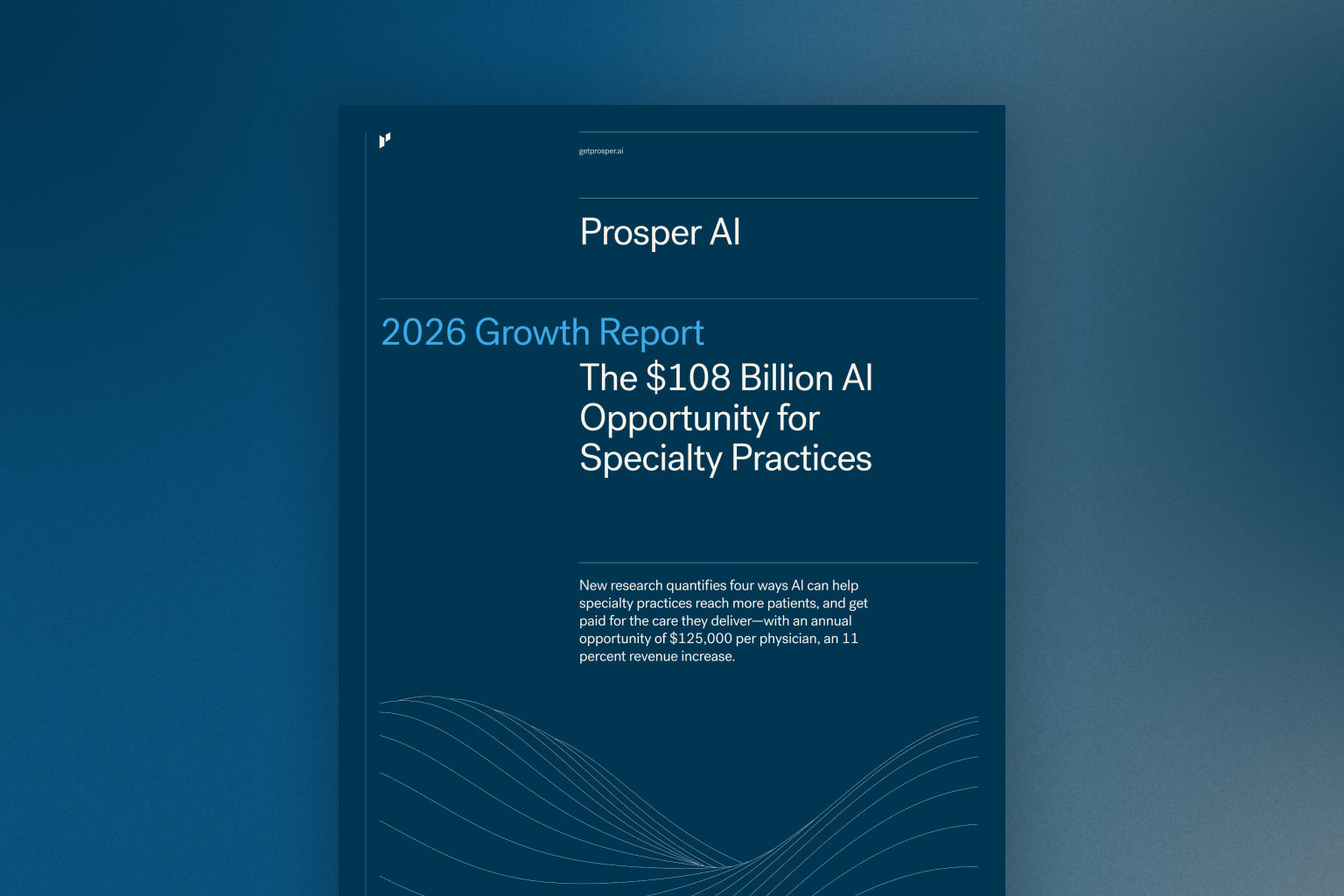
New research quantifies four ways AI can help specialty practices reach more patients, and get paid for the care they deliver—with an annual opportuni
Select your specialty and enter your number of physicians to estimate your practice's annual revenue opportunity, broken down across 4 levers.
Specialty healthcare practices leave an estimated $125K per physician uncaptured each year. See the 5 takeaways from Prosper AI’s 2026 Growth Report.


