




Report: The $108 Billion AI Opportunity for Specialty Practices
New research quantifies four ways AI can help specialty practices reach more patients, and get paid for the care they deliver—with an annual opportuni

When you demo an AI voice tool that only automates scheduling, you're solving maybe 30% of your front desk call volume. The rest still hits your team: insurance questions, prior auth status, prescription routing, billing calls. If Assort Health left those gaps visible during your eval, you're not alone. This breakdown covers Assort Health pricing, alternatives, and what full call containment actually looks like when the tool goes beyond the calendar.
Tldr:
Assort Health is an AI-powered voice agent built for healthcare organizations looking to reduce inbound call volume to their front desk staff. The product focuses on automating patient-facing phone interactions, including appointment scheduling, reminders, and basic intake tasks, by handling those calls before they reach a human. AI voice platforms for healthcare vary widely in scope and call coverage.
The core workflow relies on AI voice tech to interpret patient requests over the phone and respond in a way that resolves the interaction without staff involvement. Assort targets ambulatory practices and health systems that are dealing with high call volume and limited administrative capacity.
For practices reviewing vendors mid-cycle, Assort typically positions itself as a call containment tool with some scheduling depth. However, coverage across the full administrative call mix, including billing questions, prior auth status, and benefits verification, varies depending on the implementation.
Assort Health covers scheduling and basic patient communication, but many practices find those boundaries limiting once they look at their full administrative call volume. Most scheduling-focused tools handle a fraction of the calls that hit a front desk, leaving staff to manually process prior auth requests, benefits verification, billing questions, and appointment management tasks that fall outside the scheduling workflow.

There are a few common reasons practices start looking elsewhere:
If any of those gaps match what you're seeing, the alternatives below are worth a close look.
Assort Health alternatives vary widely in scope. Some tools handle scheduling; others focus on billing or patient outreach. The right fit depends on the call types your team fields most often and how much of that volume you need to contain without staff intervention.
Here are three alternatives worth considering:
The distinction worth paying attention to is call containment coverage. A tool that resolves scheduling but hands off billing or insurance calls still leaves a large share of front desk volume unaddressed. Prosper AI is built to cover that full call surface, so staff are handling exceptions instead of routine requests across every call type.
Assort Health is a healthcare AI company focused on automating patient access workflows. Their core product is an AI voice agent designed to handle inbound and outbound patient calls, with a particular focus on scheduling and appointment management.
Assort Health tends to target mid-sized specialty practices and health systems looking to reduce front desk call volume, particularly around scheduling-heavy workflows. Their positioning skews toward practices where appointment booking makes up a large share of inbound call traffic.

Most vendors in this space, including Assort Health, cover scheduling and reminders well. Where they tend to fall short is the broader administrative call surface: benefits verification, prior auth, and inbound call containment go unautomated.
Prosper AI handles all of those workflows within a single system. With 60%+ end-to-end call resolution in production, it covers roughly twice the call volume that narrow-scope tools typically reach. Staff still handle exceptions and clinical judgment calls; Prosper takes the high-volume routine work off the queue.
Prosper AI was built for high-volume ambulatory practices and health systems that need more than a scheduling tool. Where many AI voice solutions stop at appointment booking, Prosper handles the full patient access call mix: scheduling, benefits verification, prior auth status, billing inquiries, and prescription refill routing.
In production deployments, Prosper resolves 60%+ of inbound calls end-to-end, without transferring to staff. That's roughly 2× the deflection rate of narrower vendors. For a front desk fielding hundreds of calls daily, that gap is measurable in staff hours recovered.
Prosper integrates directly with major EHR and PMS systems, writing data back automatically without routing staff to update records manually. Routine calls get handled; staff handle exceptions.
If Assort Health's scope or pricing leaves gaps in your call coverage, Prosper AI is worth a close look.
Consider looking at alternatives if your practice fields substantial call volume beyond appointment scheduling (such as benefits verification, prior auth status checks, billing inquiries, or prescription refill routing) and Assort Health leaves those call types to staff. If your reported resolution rates stay below 40% or EHR integration gaps create manual reconciliation work, it's worth testing broader-scope solutions that cover more of your actual call mix.
Focus on end-to-end call coverage across your real administrative call surface, beyond scheduling deflection rates alone. Ask vendors what percentage of benefits verification, prior auth status, and billing calls they resolve without staff intervention, and confirm EHR write-back capability for those workflows. Most narrow-scope tools handle 30 to 40% of total inbound volume because they automate scheduling but hand off everything else; tools covering the full call mix can reach 60%+ resolution in production.
Most scheduling-focused alternatives, including Assort Health, do not automate benefits verification or prior auth status calls; those workflows stay with staff. Prosper AI covers both: it checks benefits electronically through payer APIs for ~80% of cases and makes outbound calls to insurance payers for the remaining ~20%, completing the workflow end-to-end without manual intervention. This scope difference explains much of the deflection gap between scheduling tools and full patient-access platforms.
Yes. Call any vendor's live customer numbers during business hours and test three things: knowledge handling (can it answer questions it wasn't scripted for?), conversation state (can it follow you when you change topics mid-call?), and adaptive behavior (does it handle interruptions or language switches?). This 10 to 15 minute test surfaces whether the system is scripted or generative before you invest in a formal demo or pilot.
Discover how healthcare teams are transforming patient access with Prosper.
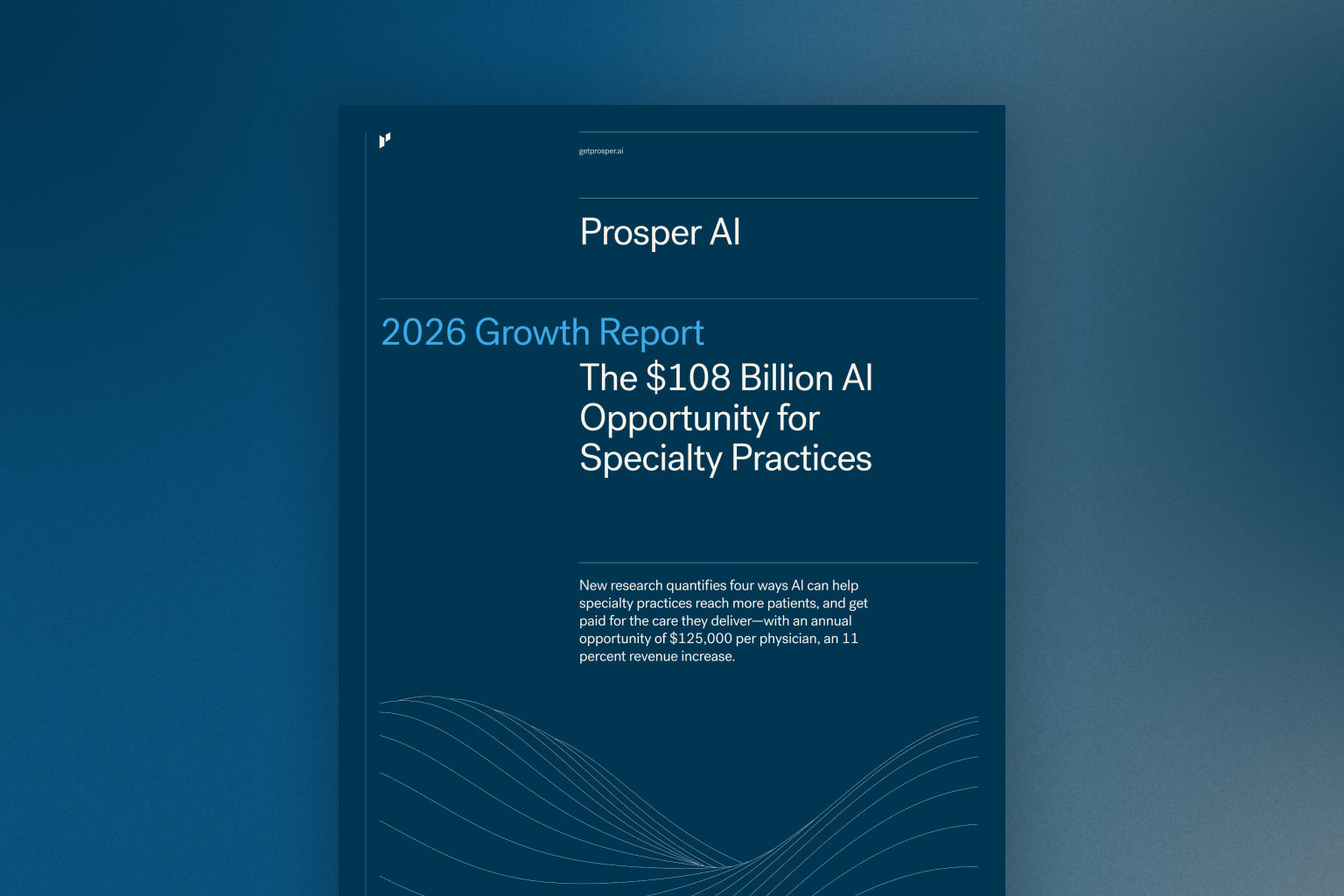
New research quantifies four ways AI can help specialty practices reach more patients, and get paid for the care they deliver—with an annual opportuni
Select your specialty and enter your number of physicians to estimate your practice's annual revenue opportunity, broken down across 4 levers.
Specialty healthcare practices leave an estimated $125K per physician uncaptured each year. See the 5 takeaways from Prosper AI’s 2026 Growth Report.


