Patient scheduling software is a category of healthcare technology that coordinates appointment booking, reminders, and eligibility checks across phone, portal, and AI voice channels. The best tools add EHR write-back and HIPAA-grade security, and a few, including Prosper AI, extend that automation into payer-facing calls like prior auth and benefits verification.
Patient access is in the spotlight as new patient wait times in major US metros now average 31 days, up from 26 days in 2022, making the right scheduling stack essential. It is how practices protect revenue, reduce staff burnout, and deliver a modern patient experience.
TL;DR
AI-voice-first tools (Prosper AI, athenahealth's Marketplace agents, CareCloud's stratusAI) answer and book calls without staff — best if phone volume and abandonment are your main pain point.
EHR-native schedulers (athenahealth, NextGen, Tebra) run inside a single system of record — best if you want one vendor, one login, no integration risk.
Communications-first platforms (Solutionreach, PracticeQ) layer reminders and self-booking onto whatever EHR you already have — best for fast, low-disruption rollout.
Go-live ranges from same-day (SimplePractice) to ~11 weeks (athenahealth) — timeline should factor into vendor choice as much as feature set.
Pricing splits two ways: flat per-provider subscriptions (SimplePractice, PracticeQ) vs. usage- or collections-based quotes (Prosper AI, athenahealth, CareCloud RCM).
Only a handful extend past scheduling into payer-side calls (prior auth, benefits verification) — worth checking explicitly if RCM automation matters to you, since most tools on this list are patient-facing only.
What is patient scheduling software? Definitions and scope
Patient scheduling software coordinates the who, when, and where of visits across channels, including phones, portals, and AI voice agents. The best patient scheduling software unifies online self scheduling, call center workflows, automated reminders, eligibility checks, and EHR integration so staff do not retype data and patients get instant confirmations.
Native integrations with major EHRs like Epic, athenahealth, NextGen, ModMed, and eClinicalWorks, so appointments, insurance, and demographic data sync automatically without staff re-entering anything
Insurance and referral workflows, eligibility verification and referral tracking so patients are cleared before the visit
Analytics and QA, real time dashboards for abandonment, show rates, conversion, and payer mix
Access equity controls, language options, phone plus digital pathways for patients who do not use portals
If you want a voice first option that plays nicely with Epic, athena, Cerner, and more, consider AI voice agents from Prosper AI. See how it works and book a demo at Prosper AI.
HIPAA and security essentials for scheduling tools
Security posture is not negotiable. Ask vendors to show proof of risk analysis, encryption, access controls, and incident response. Review our HIPAA‑compliant AI assistant buyer’s guide.
HIPAA Security Rule requires an accurate and thorough risk analysis and documented safeguards across confidentiality, integrity, and availability.
Federal rules require payers to stand up APIs for patient access, and ONC information blocking rules expect timely access to electronic health information. Scheduling vendors should align with these data sharing norms.
Proposed updates in 2026 would make multi factor authentication and encryption mandatory for ePHI, which strengthens expectations for third party software.
Real world risk is rising, the Change Healthcare cyberattack impacted about 192.7 million people, the largest healthcare data breach on record. Vet vendor supply chains and data flows.
Enterprise buyers should look for SOC 2, SSO, zero data retention with LLM providers, and on premises options where needed. The best patient scheduling software will meet or exceed these guardrails.
Traditional rules based vs AI driven scheduling
Rules engines match templates to visit types and are predictable, but they miss context and require constant maintenance. AI driven scheduling adds natural language and intent understanding, learns provider preferences, navigates payer phone trees, and can book or rebook without staff.
Where phones still dominate, AI voice agents can answer instantly, avoid IVR mazes, and keep lines open for complex cases. Pair that with online scheduling and smart reminders to capture both digital and phone first patients. If you want a single platform for AI voice plus online scheduling, explore Prosper AI. The goal is not hype. The goal is to assemble the best patient scheduling software for your mix of specialties, payers, and patient demographics.
Adoption challenges and change management
Common blockers
Template complexity and provider preferences that make rules brittle
Staff skepticism about AI and fears about job impact
Fragmented data between EHR, practice management, call system, and CRM
Security review and legal review timelines
What works
Start with one high volume line of business (ex. OB/GYN annuals or dermatology acne visits), prove the win, then expand
Involve schedulers early, let them test and tune prompts, rules, and escalation paths
Use two reminder timing and offer easy reschedule to reduce no shows across every channel
Measure outcomes weekly, abandonment, show rate, time to appointment, and publish a scoreboard
How to choose, a step by step selection method
Define problems precisely. Long hold times, abandoned calls, open slots, high no show rate, or slow prior steps such as eligibility.
Map systems. Document your EHR version, practice management, call platform, portal, clearinghouse.
List must haves. Use the checklist above and add specialty rules.
Shortlist five vendors that integrate natively with your stack. Confirm they can push and pull in your EHR, which most US hospitals and physicians now use.
Run a time boxed pilot. Pick one specialty, set a four week target, and track conversion, show rate, and staff time saved.
Validate security. Request SOC 2, BAA, SSO, encryption, disaster recovery, and incident playbooks aligned to HIPAA.
Approve training and rollout. Plan change management and publish quick wins.
Follow this process and you will identify the best patient scheduling software for your environment, not just the flashiest demo.
Pricing and ROI snapshot
Pricing varies by model. Expect subscription and usage pricing for online self scheduling, voice AI, and outreach. ROI typically comes from three buckets.
Staff efficiency. Automation reduces back and forth phone time so staff can handle exceptions and clinical tasks.
If your practice needs an option that bundles AI voice, online booking, reminders, and EHR writes, evaluate Prosper AI. The best patient scheduling software should pay for itself quickly once you remove hold time and manual data entry.
Implementation best practices
Start with clean templates and rules. Align visit types, durations, eligibility steps, lead times, and reopen waitlists automatically.
Pair online booking with phone automation. Americans still use phones widely, which means you capture more demand if the phone experience is instant.
Use two touch reminders and offer one tap reschedule to cut no shows.
Add access analytics to your weekly dashboard. Include new patient time to appointment, abandonment, show rates, and fill rate.
Train staff on exception handling and escalation so AI plus humans work in tandem.
Looking for a fast start with AI voice agents and EHR integrations already built, see Prosper AI.
Vendor
EHR integrations
HIPAA / security
Go-live time
Pricing model
Prosper AI
80+ integrations including athena, ModMed, eCW, Veradigm, NextGen
Building on the features and trends discussed above, this section spotlights the 15 platforms that are setting the pace for patient scheduling in 2026. We grouped them because they pair real-time online booking, automated reminders and waitlists, deep EHR integrations, multi-location support, and rigorous compliance to tackle access, no-shows, and staffing complexity at scale. Use this list to quickly compare leaders on usability, interoperability, scalability, and measurable ROI before diving into the individual picks.
Prosper AI brings always‑on voice automation to the front door of your practice, handling booking, rescheduling, cancellations, and intelligent call routing without making patients wait. It’s a natural fit for multi‑location specialty groups and health systems that need after‑hours coverage and lower abandonment, sitting alongside your EHR/PM to improve patient access while preserving compliance and reliability.
Scheduling & patient access highlights
24/7 AI voice scheduling with real‑time EHR/PM write‑back.
After‑hours and overflow coverage; IVR replacement with strong call containment.
Waitlists/recalls to fill openings and re‑engage inactive patients.
Reminders, confirmations, and two‑way SMS intake to reduce no‑shows.
Demographics and insurance capture, eligibility checks, and multilingual support.
Telehealth links and virtual visit workflows; pre‑visit payer‑call automation.
Integrations, compliance & deployment: Integrates with Epic, athena, and NextGen via APIs/SFTP; HIPAA with BAA, SOC 2, SSO; cloud or on‑prem; typical go‑live in 3 weeks.
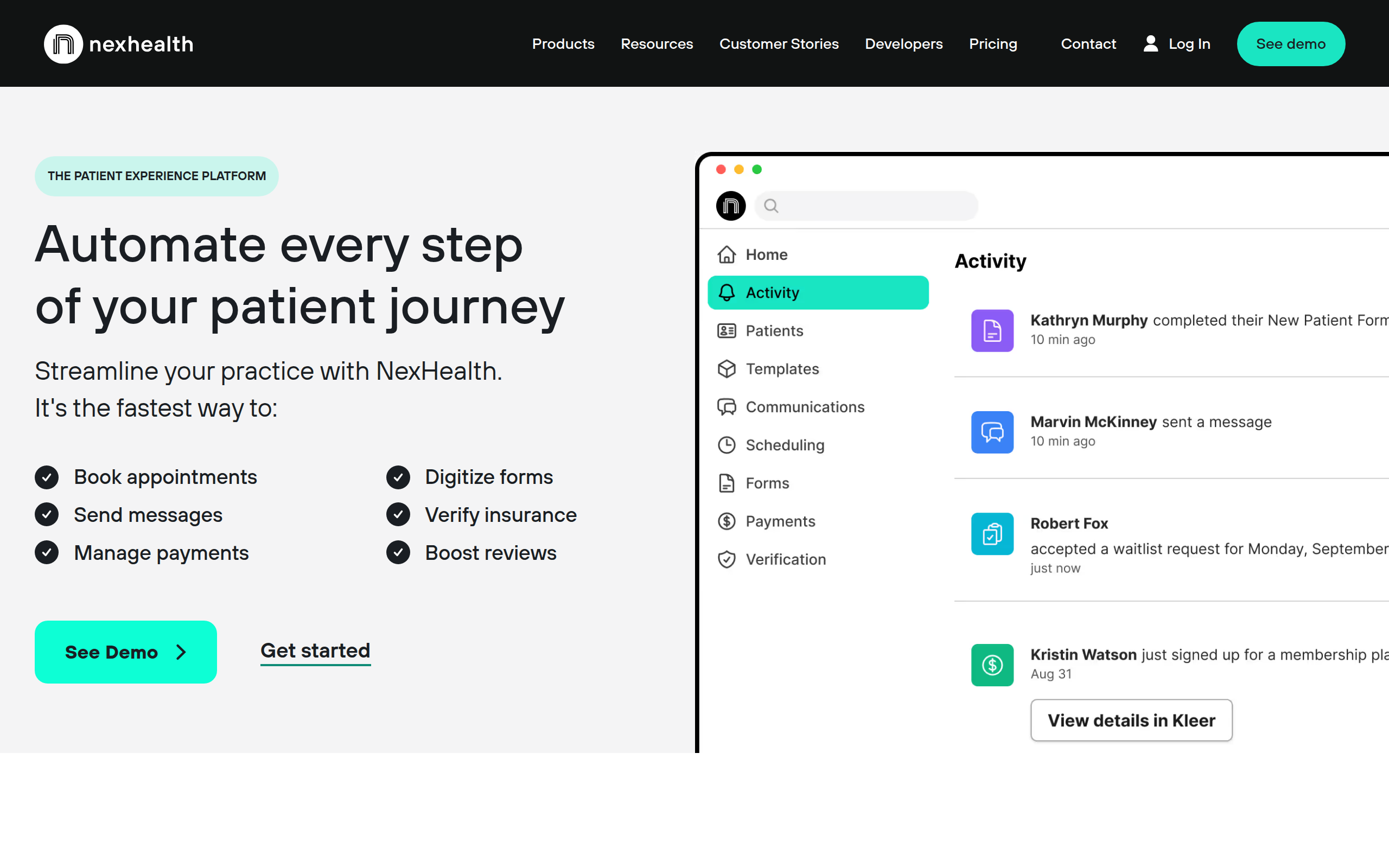
NexHealth turns your website, Google listing, and messages into a 24/7 front desk, making it easy for patients to self‑book and confirm while your staff focuses on care. It’s especially strong for multi‑location dental groups and clinics that want seamless online scheduling layered onto existing EHR/PM systems.
Scheduling & patient access highlights
Real‑time online self‑booking from website, SMS, email, social, QR, and Google; availability sync prevents double‑booking.
Reserve with Google drives 10–20% more bookings.
Multi‑provider/location rules, templated time slots, and appointment‑type mapping.
Waitlist automation with one‑click backfill; 1‑Click Recalls re‑engage patients.
Luma Health’s Patient Success Platform weaves scheduling into every touchpoint, from self‑service booking to AI‑assisted call deflection, so patients find the right slot faster and staff spend less time chasing confirmations. It’s built for health systems and specialty groups that need robust EHR‑integrated, 24/7 access.
Scheduling & patient access highlights
Online self‑booking with guardrails and real‑time slot display.
Smart waitlists auto‑fill cancellations via targeted SMS offers.
Two‑way reminders to confirm, cancel, reschedule with EHR write‑back.
Two‑way SMS, chat, intake forms, and mobile check‑in.
AI concierge for call deflection; Google appointment booking support.
No‑app telehealth links with step‑by‑step guidance.
Integrations, compliance & deployment: Integrates with Epic, Oracle Health, athena, NextGen via APIs/SFTP; HIPAA BAA, SOC 2, HITRUST, SSO; AWS SaaS; go‑live in weeks (on‑prem options available).
Proof & pricing snapshot
Outcomes: ~40% reduction in no‑shows; 20–25% call deflection.
Customers: health systems, IDNs, FQHCs; 100M+ patient reach.
Dexcare centralizes access across service lines so patients can find the right care, whether virtual or in‑person, without running into dead ends. Designed for large multi‑hospital systems and academic medical centers, it unifies self‑service scheduling and demand routing to shrink time‑to‑care and ease call‑center load.
Scheduling & patient access highlights
Online self‑booking with live EHR availability across all locations.
Provider‑agnostic and named‑provider flows pool capacity system‑wide.
NLP search and reason‑for‑visit routing match patients to best‑fit care.
Digital intake, insurance capture, and identity matching at booking.
Two‑way SMS, reminders, and no‑show reduction tools.
Integrated telehealth with queueing and redirection to on‑demand.
Integrations, compliance & deployment: Integrates with Epic and major EHRs via REST APIs/SDKs; OAuth2/SSO; HIPAA with BAA and HITRUST on AWS; typical go‑live 8-16 weeks.
Proof & pricing snapshot
Outcomes: 3x net‑new patients; access five days faster; 99% satisfaction.
Customers: Providence, Kaiser Permanente, Mass General Brigham, URMC.
Experian Health layers enterprise‑grade scheduling on top of your digital and call‑center channels, guiding both patients and agents through complex rules with consistency. It’s a strong fit for health systems that want unified access, faster booking, and fewer abandoned calls.
Scheduling & patient access highlights
24/7 self‑booking with decision support and routing logic.
Enterprise calendars and templates with provider matching.
Automated reminders, smart campaigns, and embedded self‑schedule links.
Referral scheduling to in‑network specialists; priority access controls.
Mobile intake, pre‑registration, and text‑based no‑show reduction.
Integrations, compliance & deployment: Integrates with Epic and major EHR/PMs via APIs/SFTP; HIPAA with BAA, SOC 2, HITRUST, SSO; cloud deployment; Experian‑managed go‑live.
Proof & pricing snapshot
Outcomes: 50% faster scheduling; 89% show rate; 32% growth.
Customers: health systems, health plans, large physician groups.
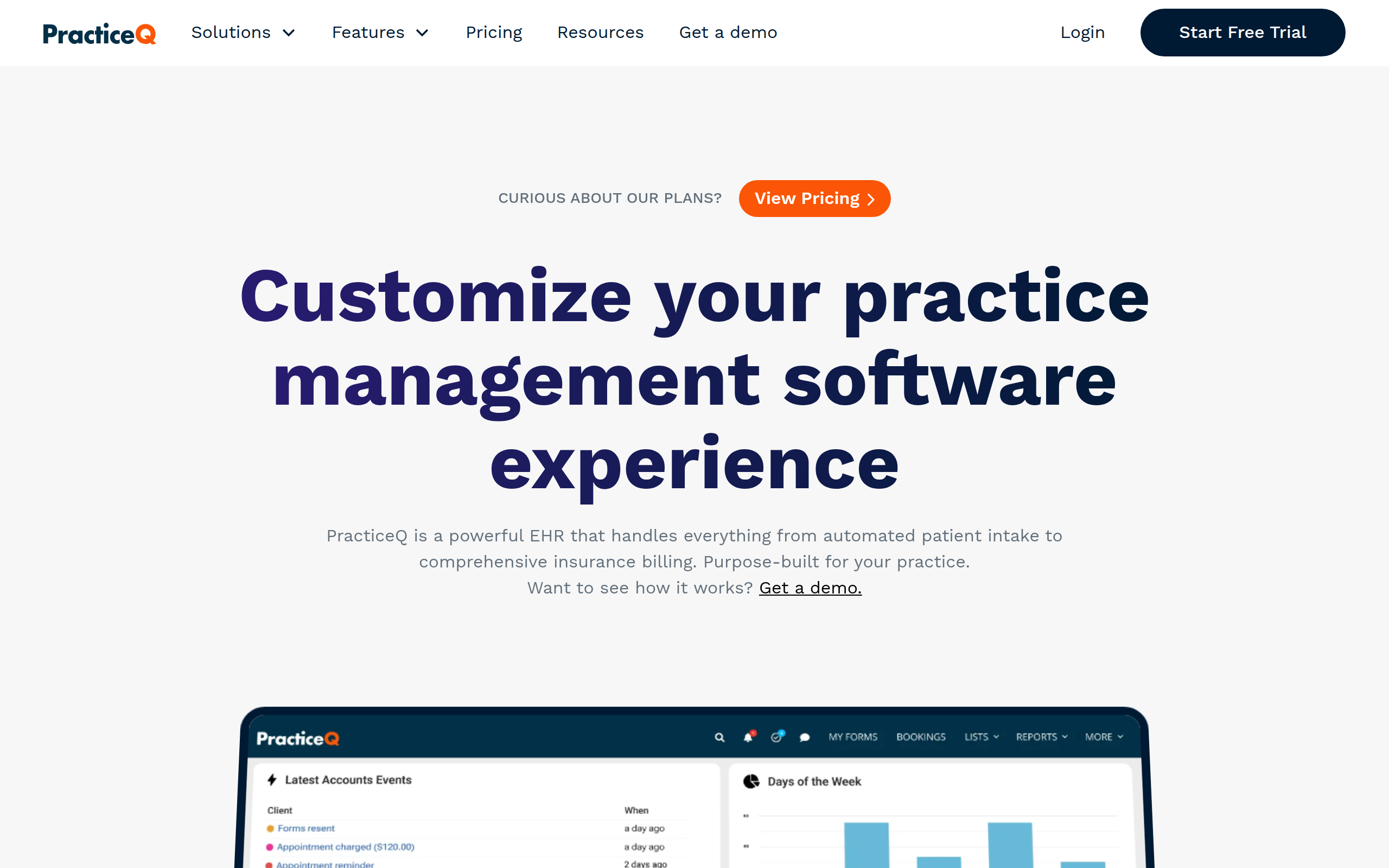
PracticeQ (from IntakeQ) blends online booking, forms, and payments into a streamlined access experience that patients actually complete. Outpatient specialty and behavioral health clinics get an EHR/PM‑embedded scheduler that extends coverage after hours and reduces phone back‑and‑forth.
Scheduling & patient access highlights
Online self‑booking via widget/portal with rules, prescreeners, and prepay.
Family appointments, time‑zone handling, and card‑on‑file convenience.
Multi‑provider/location calendars; Scheduling Helper surfaces next openings.
Permissions, color‑coding, and templates for fast slotting.
Automated email/SMS/voice reminders with two‑way confirm/cancel.
Day‑of digital check‑in links; waitlist EasyFill backfills cancellations.
Telehealth links for Zoom/Meet; intake auto‑sends on booking.
Integrations, compliance & deployment: Integrates with athenahealth, RevolutionEHR, Rupa, Fullscript, Google/Outlook, Zoom/Meet, Stripe/Square via REST APIs/webhooks; HIPAA with BAA, 2FA; cloud SaaS; onboarding typically in 1-2 weeks.
Proof & pricing snapshot
Adoption/outcomes: 10,000+ practitioners; reminders, self‑booking, and EasyFill reduce no‑shows and cancellations.
Pricing: Starter $54.90; Pro $79.90 per user monthly; popular with psychiatry and med spas.
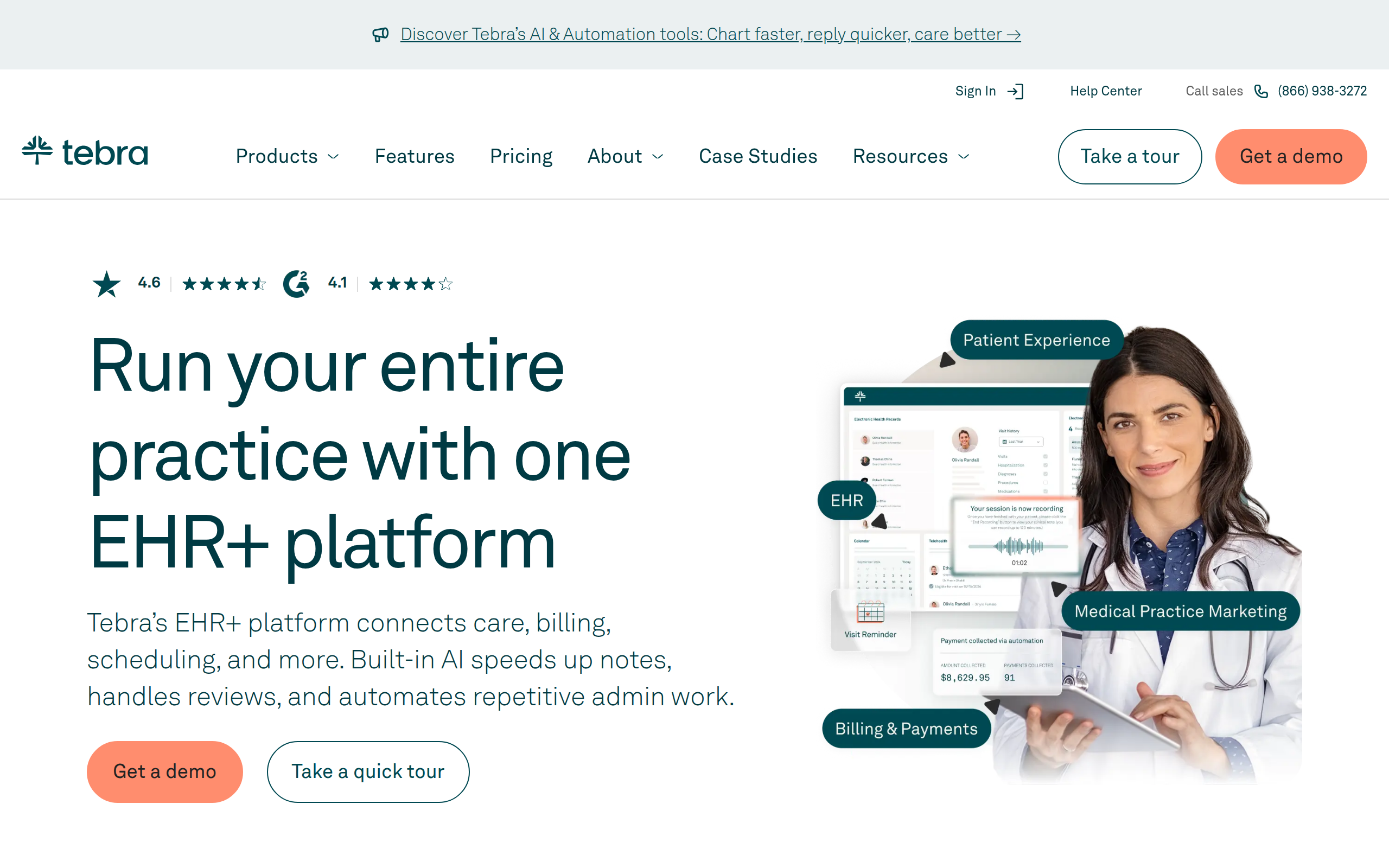
Tebra (Kareo + PatientPop) gives independent, multi‑location practices a modern self‑scheduling front end tied directly to their EHR calendar. Patients can book anytime; staff gain tighter templates, fewer no‑shows, and integrated intake, all under a BAA.
Scheduling & patient access highlights
Online self‑booking by reason, provider, location, or telehealth.
Embeddable widgets and shareable links for site, email, and SMS.
Templated calendars, recurring rules, color‑coding, and policy controls.
Multi‑provider and group appointments; “find availability” accelerates placement.
Automated reminders with status updates; two‑way SMS and call‑to‑text.
Digital intake merges to chart; telehealth links with reminders.
Integrations, compliance & deployment: Native with Tebra EHR/PM and Telehealth; APIs, CCDA/HL7, SFTP; HIPAA with BAA, FIPS‑validated encryption, 2FA; SaaS; go‑live ~45 days.
Phreesia embeds scheduling into intake and engagement so patients complete the right steps at the right time, and staff spend less time on the phone. It’s ideal for multi‑location groups and health systems that want after‑hours self‑service with tight EHR write‑back.
Scheduling & patient access highlights
Online self‑booking with configurable guardrails and templates.
Central Appointments Hub spans multi‑location and telehealth visits.
Multi‑provider calendars, reschedule/cancel flows, and staff tasking.
Automated reminders/confirmations reduce no‑shows and abandonment.
VoiceAI answers, books, triages, and routes inbound calls.
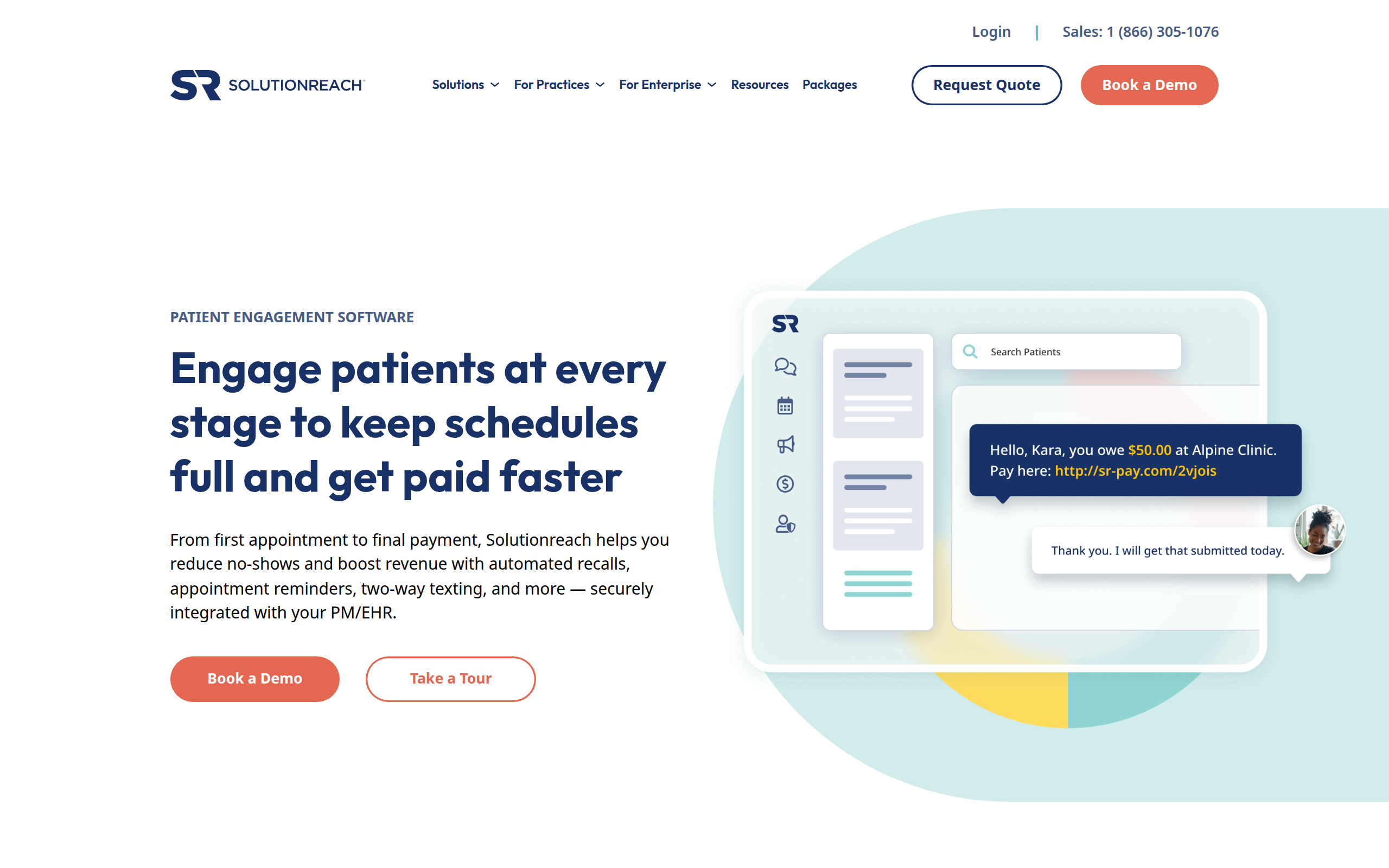
Solutionreach is a communications‑first platform that turns texts and reminders into completed appointments. For ambulatory medical, dental, and vision groups, including DSOs, it delivers after‑hours access, PM/EHR write‑back, and SMS‑first responsiveness that keeps schedules full.
Scheduling & patient access highlights
24/7 online self‑booking with real‑time availability and PM/EHR write‑back.
Automated text/email reminders with confirm, cancel, and reschedule.
Two‑way HIPAA‑aware SMS (with images) and conversation history.
Digital intake, mobile check‑in, and insurance capture.
Telehealth links for scheduled or on‑demand video visits.
Waitlists, recalls, re‑engagement, analytics, and GoTo Connect pop‑ups.
Integrations, compliance & deployment: Integrates with 400+ PM/EHRs via SyncAssure, telehealth platforms, and GoTo Connect; Reporting API; HIPAA with BAA; cloud SaaS; go‑live within one week.
SimplePractice is a favorite among behavioral health providers because it makes intake and scheduling effortless for both solo clinicians and growing groups. With real‑time availability, client‑friendly booking, and integrated telehealth, it streamlines access without sacrificing control.
Scheduling & patient access highlights
Online self‑booking with service controls, prescreeners, and card‑on‑file holds.
Embeddable appointment‑request widget (Plus plan) for website booking.
Availability templates and location‑aware in‑person/telehealth blocks.
Multi‑provider calendars with clinician filters and color‑coding.
Client waitlists plus email, text, and voice reminders.
Integrated telehealth and calendar sync to Google, Apple, Outlook.
Integrations, compliance & deployment: Built‑in telehealth and payments; sync to Google, Apple, Microsoft 365; no public API; HIPAA/BAA, HITRUST; cloud‑only; same‑day go‑live (assisted migration in 1–3 days).
Proof & pricing snapshot
Outcomes: up to 50% fewer no‑shows.
Customers: solo and group behavioral health clinics.
AdvancedMD connects online booking, reminders, and two‑way messaging to a powerful PM/EHR calendar, so independent and multi‑location groups can offer 24/7 access without creating more work. The result: fewer holds, fewer no‑shows, and better use of every slot.
Scheduling & patient access highlights
Online self‑booking via portal and optional Zocdoc sync.
Two‑way SMS plus AI chatbot for scheduling and triage.
Digital intake, kiosk check‑in, eligibility, and telehealth links.
Integrations, compliance & deployment: Native PM/EHR/telehealth suite with Zocdoc connector; FHIR/SMART and open APIs; HIPAA with BAA, SSO/MFA; AWS secure cloud; typical go‑live 4–6 weeks.
Proof & pricing snapshot
Outcomes: ~30% no‑show reduction; 80% eligibility time savings.
Customers: 70,000+ ambulatory providers across specialties.
Pricing: quote‑based bundles with online estimator and discounts.
athenahealth centralizes scheduling inside athenaOne, giving patients portal‑ and app‑based self‑service while staff orchestrate capacity across locations and specialties. It’s a strong fit for multi‑specialty ambulatory groups and enterprise networks.
Scheduling & patient access highlights
Online self‑booking and rescheduling via portal and athenaPatient app.
Multi‑provider/location calendars, templated slots, and series scheduling.
Automated reminders, recalls, and targeted outreach.
AI waitlists fill cancellations; Marketplace voice agents help contain calls.
Two‑way messaging, digital intake, and robust SMS through partners.
Embedded athenaTelehealth links for seamless virtual visits.
Integrations, compliance & deployment: Native with athenaOne EHR/PM/telehealth; Epic/Cerner via REST APIs, HL7, C‑CDA, SFTP; HIPAA with BAA, HITRUST, SSO; multi‑tenant cloud; typical go‑live ~11 weeks.
NextGen’s scheduling spans self‑service, rules‑driven templates, and enterprise calendar coordination, ideal for mid‑size to large ambulatory groups already on NextGen Enterprise. Patients book anytime while PM/EHR keeps operations tightly aligned.
Scheduling & patient access highlights
Online self‑booking with real‑time PM write‑back and Book‑on‑Google support.
Rules‑based, templated blocks by provider, location, and visit type.
DrChrono wraps an easy online booking experience around a flexible EHR/PM calendar and OnPatient portal, so midsize ambulatory groups can offer around‑the‑clock access without sacrificing control or compliance.
Scheduling & patient access highlights
Online self‑booking widget with configurable hours and visit types.
OnPatient portal plus telehealth links for seamless video visits.
Multi‑provider/location calendars and Availability Search across resources.
Appointment Profiles/templates standardize durations, codes, and forms.
Automated email/SMS/phone reminders, confirmations, and status updates.
Follow‑up recalls, secure messaging, and optional two‑way SMS.
Integrations, compliance & deployment: Integrates with Zocdoc and labs via REST APIs/webhooks or SFTP; HIPAA with BAA, SOC 2, SAML SSO; SaaS; go‑live around 60 days.
Proof & pricing snapshot
Scale: 32M+ patients; 1.2M+ monthly bookings; #1 mobile EHR.
Customers: ambulatory specialties and multi‑office groups.
Pricing: quote‑based tiers with integrated payments; usage overages may apply.
CareCloud unifies scheduling across PM, EHR, and telehealth so multispecialty groups can offer smooth self‑service and keep templates full. Breeze powers the patient‑facing experience, while Central coordinates calendars and reminders on the back end.
Scheduling & patient access highlights
Online self‑booking and appointment requests via Breeze.
Multi‑provider/multi‑location calendars with templates and drag‑and‑drop.
Automated reminders, two‑way SMS updates, and recare outreach.
Mobile digital intake, insurance verification, and express check‑in.
AI voice scheduling with stratusAI Agent for 24/7 call containment.
Waitlists and backfill via QueueDr; auto‑sent telehealth links.
Integrations, compliance & deployment: Native across Central, Charts, and Live; HL7/APIs/SFTP; HIPAA with BAA, SOC 2, SSO; cloud; typical go‑live 4–11 weeks.
Pricing: subscription/enterprise quote; RCM available at 3%–7% of collections.
Conclusion, pick for fit, not hype
The market is crowded and evolving fast. Anchor your choice to measurable access and revenue outcomes, proven integrations, and security. Use pilots and a clear playbook to de risk the rollout. With wait times rising and consumer expectations tilting digital, the best patient scheduling software is the one that meets patients where they are and frees staff to focus on care. Ready to see AI voice and online scheduling working together, start with a quick demo from Prosper AI.
FAQ
What makes the best patient scheduling software for a multi specialty group?
Look for granular templates per specialty, real time eligibility, AI voice for phones, and native EHR connections. Patient demand is split between phones and digital, so cover both.
How much can reminders really reduce missed appointments?
Does patient scheduling software also handle prior authorization and benefits verification?
Some platforms, like Prosper AI, extend beyond patient-facing booking into payer-facing calls, checking benefits or prior auth status directly with insurers. This is less common than patient scheduling features and varies by vendor. Check each platform's payer-call capabilities specifically.
Do we need EHR integration to see value?
Yes, integration reduces manual work and errors. Nearly 9 in 10 office based physicians and most hospitals use certified EHR technology, so connecting your scheduler is essential.
How do security and privacy factor into vendor selection?
Require a documented risk analysis, encryption, access controls, and incident response. Watch for proposed rules that would make multi factor authentication and encryption mandatory.
Will AI voice replace staff?
No. It handles repetitive booking and holds so staff can focus on exceptions and higher value tasks. The best patient scheduling software uses AI to extend team capacity rather than replace it.
What is the fastest way to shortlist vendors?
Define outcomes, confirm EHR compatibility, and run a four week pilot with one specialty. Use the outcomes in this guide and choose the best patient scheduling software for your metrics.
How does rising wait time change our priorities?
With average new patient waits now at 31 days, prioritize speed to appointment, conversion, and rebooking. Tools that reduce friction across phone and digital will win.
Where can we see AI voice scheduling in action?
If you want to evaluate voice agents for phones and online booking together, check out Prosper AI.
We use cookies and similar technologies to help personalise content, tailor and measure ads, and provide a better experience. By clicking OK or turning an option on in Cookie Preferences, you agree to this, as outlined in our cookie Policy.
Cookies are small text that can be used by websites to make the user experience more efficient. The law states that we may store cookies on your device if they are strictly necessaryfor the operation of this site. For all other types of cookies, we need your permission. This site uses various types of cookies. Some cookies are placed by third party services that appear on our pages.
Thank you! Your submission has been received!
Oops! Something went wrong while submitting the form.