




The Best AI Voice Agents for Ophthalmology Practices in 2026
The 7 best AI voice agents for ophthalmology practices. Find platforms with ModMed & Nextech integrations, prior auth support, and patient automation.
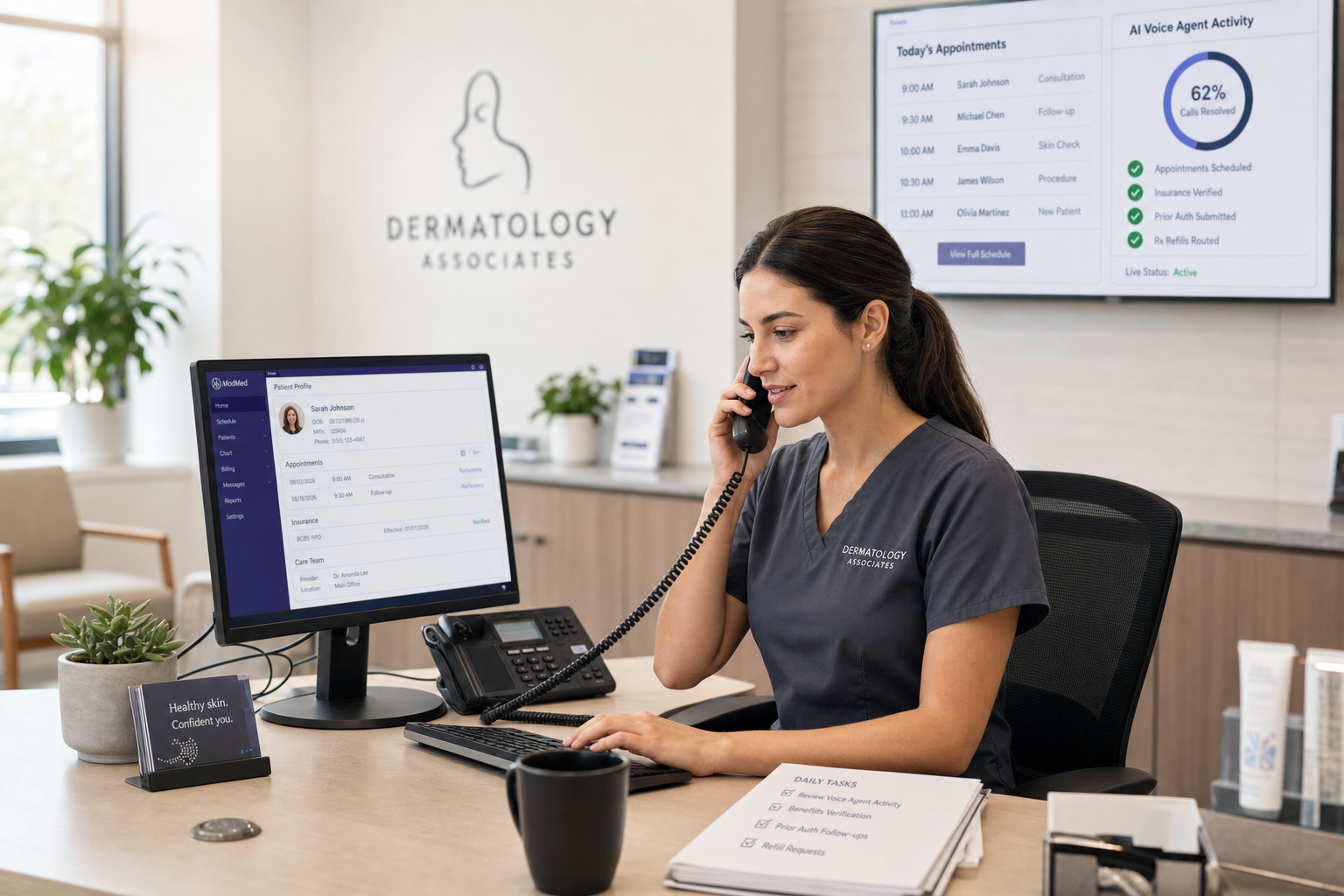
An AI voice agent for ModMed dermatology practices is a conversational AI system that answers patient calls, handles scheduling, benefits verification, and prior authorization, and writes outcomes directly back into ModMed's EHR. Most vendors automate only one of those call types and leave the rest for staff to handle manually. This guide compares five vendors, including Prosper AI, Hyro, EliseAI, Artera, and Hello Patient, on how much of that full call mix each one actually resolves end-to-end.
For ModMed users, that means the agent works inside Modernizing Medicine's dermatology EHR and practice management workflows, not alongside them as a disconnected layer.
In a ModMed dermatology context, these agents typically handle scheduling, appointment reminders, medication refill routing, and insurance verification calls that would otherwise queue at the front desk.

In a ModMed dermatology context, these agents typically handle scheduling, appointment reminders, medication refill routing, and insurance verification calls that would otherwise queue at the front desk.
Ranking AI voice agents for a ModMed dermatology practice requires looking past generic call-handling scores. We weighted each tool across five criteria that reflect how dermatology front desks actually operate.
The table below maps each tool against the criteria that matter most for a ModMed dermatology practice, so you can see coverage gaps at a glance without piecing them together from vendor websites.
Prosper AI is built for the workflows that consume dermatology front desks: scheduling follow-ups after Mohs procedures, handling refill requests for tretinoin or antibiotics, answering insurance questions for biologic authorizations, and routing urgent skin concern calls appropriately. Its integration with ModMed means it reads and writes directly to the EHR, so appointment confirmations, cancellations, and patient-reported symptom notes don't sit in a queue waiting for staff to manually enter them.
Where many AI voice tools stop at scheduling, Prosper handles the full call mix. In production environments, Prosper resolves 60%+ of inbound calls end-to-end without staff involvement. For a busy dermatology practice fielding hundreds of calls weekly, that's a real reduction in front desk load, not a rounding error.
What Prosper AI handles in a ModMed dermatology context
Prosper AI won't replace clinical judgment on triage calls, and it's designed to escalate to staff when a call falls outside its configured scope. The AI handles volume; your team handles exceptions.
▶ Case Study: How Preferred Dermatology scaled to 54% more appointments without adding staff
Hyro is a conversational AI voice agent built for health systems, with ModMed listed among its supported EHR integrations. It handles appointment scheduling and basic patient inquiries, routing calls through a voice interface that connects to ModMed's scheduling layer.
For dermatology practices considering Hyro, the scope tends to stop at scheduling. Benefits verification, prior auth support, and billing-related call types largely fall outside what Hyro automates, meaning staff still field much of the inbound call mix manually.
Practices with high volumes of insurance and RCM-related calls may find the coverage gap noticeable.
EliseAI is a conversational AI voice agent built for multifamily housing, covering leasing inquiries, tour scheduling, and resident follow-ups. It has since expanded into healthcare, offering appointment scheduling and basic patient communication workflows.
For dermatology practices on ModMed, the fit is limited. EliseAI was not built around EHR-native integrations for specialty clinics, and its scheduling logic does not account for procedure-specific booking rules common in dermatology, such as biopsies, excisions, or phototherapy protocols. Practices often find themselves bridging gaps manually where the system cannot resolve call types beyond basic appointment booking.
Artera positions itself as a patient communication solution, with messaging and outreach tools built around multi-channel engagement. It handles appointment reminders, recalls, and broadcast messaging across SMS, email, and web.
Where it tends to fall short for dermatology practices on ModMed is in live call handling. Artera's strength is asynchronous messaging, not inbound voice. Practices fielding high volumes of appointment and prescription refill calls still rely on staff to pick up the phone, which limits how much front-desk burden the tool actually removes.
Hello Patient is a patient communication company that helps practices automate appointment reminders, recalls, and patient messaging. Hello Patient's AI agent, Mia, handles inbound voice calls including scheduling and patient questions.
Where it has less depth is payer-facing work — insurance verification, prior authorization, and outbound payor calling are not part of its scope.
Prosper AI is built for the call types that dominate dermatology front desks: appointment scheduling, insurance verification, prior auth status checks, and post-visit follow-ups. Unlike narrow-scope tools that stop at the calendar, Prosper AI handles the full administrative call surface and writes outcomes directly back into ModMed, so nothing lands in a staff queue that AI already resolved.
In production, Prosper AI reaches 60%+ end-to-end call resolution. That means the majority of routine calls never reach a staff member.
How do I choose the right AI voice agent for my ModMed dermatology practice?
Start by mapping your actual call mix over three months to understand what percentage of calls are scheduling versus billing, insurance verification, and refill requests. Then confirm the vendor offers read-and-write integration with ModMed, beyond read-only access. Test vendors by calling their live customer numbers to hear how they handle off-script questions and mid-call topic changes.
What call types can AI voice agents actually handle in a dermatology practice?
AI voice agents can resolve appointment scheduling and rescheduling, prescription refill intake, insurance eligibility verification, prior authorization status checks, and routine billing inquiries. Clinical triage calls, complex insurance appeals, and urgent patient concerns typically require staff intervention and should escalate to a human.
Which AI voice agent works best for dermatology practices with high RCM volume?
Practices with high prior authorization, benefits verification, or billing call volume need an agent that covers the full call mix beyond scheduling. Prosper AI handles scheduling, insurance verification, prior auth inquiries, and billing calls within one system, while tools like Hyro and EliseAI stop at scheduling and leave RCM-related calls to staff.
What's the difference between AI voice agents and traditional IVR systems?
IVR systems route callers through rigid menu-driven prompts and cannot handle conversational language or adapt to off-script questions. AI voice agents use conversational AI to understand spoken intent, handle mid-call topic changes, and complete full workflows like scheduling or benefits verification without forcing callers through preset menus.
How long does it take to implement an AI voice agent with ModMed?
Implementation timelines for ModMed integrations typically range from three to six weeks, depending on the vendor's existing integration depth and your practice's workflow complexity. Practices should confirm whether the vendor has a production ModMed connector already built or if implementation requires custom middleware that adds time and risk.
Are AI voice agents for ModMed dermatology HIPAA-compliant?
A HIPAA-compliant AI voice agent should offer a signed Business Associate Agreement (BAA), encrypted storage and transmission of PHI, and an audit trail for every call and EHR write. Ask vendors directly for their BAA and SOC 2 status rather than assuming compliance from a marketing page.
Prosper AI build voice AI agents that cover inbound scheduling, insurance eligibility, prior authorization, billing inquiries, and outbound payer calls in a single automated workflow—one system for both sides of the phone.
In a six-vendor RFP, Prosper AI hit 60%+ end-to-end call resolution in production, compared to roughly 30% for other vendors. Most practices are live in 3 weeks, with no custom coding and no disruption to staff, and integrate with 80+ EHR and practice management systems.
Book a demo with Prosper AI to see what full-coverage resolution looks like on your actual call mix.
Discover how healthcare teams are transforming patient access with Prosper.

The 7 best AI voice agents for ophthalmology practices. Find platforms with ModMed & Nextech integrations, prior auth support, and patient automation.

Our September 2026 FQHC voice agent comparison covers Medicaid verification, payer calls, prior auth, and multilingual support across five tools.

AI front desk automation for multi-site groups: EHR write-back, full call coverage, HIPAA compliance, and realistic timelines. September 2026.


