




Best Voice AI for Gastroenterology Practices: 4 Options Compared (2026)
Compare 4 voice AI vendors for GI practices on colonoscopy scheduling, benefits verification, and prior auth calls. See which ones stop at booking.

Your front desk is drowning in calls, and you're comparing AI scheduling assistants in healthcare to pull volume off the queue. But most of the tools you've seen handle appointment booking and little else, which means billing questions, prior auth status checks, and insurance verification still land on your team. If you're wondering why call containment stays low even after deploying one of these systems, it's because they're built to solve one workflow and leave the rest to humans. Here's how six platforms compare when you measure them against the full administrative call surface, beyond the calendar alone.
TLDR:
AI scheduling assistants are voice and digital agents that handle patient communications end-to-end, from inbound scheduling calls and insurance verification to outbound reminders and follow-ups, without requiring staff to pick up the phone. The problem they solve is structural: call abandonment rates in healthcare run around 7-10% on average, meaning patients hang up before anyone answers. That's a volume problem, and hiring rarely keeps pace with it.

Generative AI platforms with native EHR integration, like Prosper AI, cover the full administrative call surface, including billing inquiries, prior auth coordination, and benefits checks, alongside the calendar. Framing them as appointment booking tools undersells what the category can actually do for a practice's operations, especially when API integrations automate workflows across systems.
Every solution here was assessed against publicly available capability information, with the goal of determining what actually scales across a full call mix.
The criteria:
A tool that resolves scheduling calls but routes billing and insurance questions back to staff is still leaving most of the administrative call surface to humans. These criteria reflect what health systems need when the requirement is full call-mix coverage.
Prosper AI goes well beyond scheduling. It handles the full inbound call surface: appointment booking, rescheduling, cancellations, benefits verification, prior auth status checks, referral intake, and billing questions. Most AI scheduling tools stop at the calendar. Prosper resolves over 60% of inbound calls end-to-end in production, roughly twice the containment rate of narrower tools.
The coverage is broad because the architecture is. Prosper connects directly to your EHR or PMS, writes appointment data back automatically, and checks insurance eligibility in real time during the call, powered by EHR-based insurance verification. Staff handle exceptions. Prosper handles volume.
Most scheduling tools hand off anything outside a booking flow to staff. That means prior benefits verification, payor calls, and billing questions still hit your front desk. Prosper AI handles those too, automatically.
Hyro is a conversational AI tool built for health systems, focused on web chat and call deflection through a knowledge management layer it calls "Knowledge Graph." The tool lets administrators update FAQs and policy information in one place, with those updates reflecting across chat and voice channels.
Where Hyro tends to fall short is call coverage depth. The system handles common informational queries well, but scheduling workflows that require EHR write-back, insurance verification, or multi-step intake logic often hit its ceiling. Health systems reviewing Hyro frequently report needing to layer in additional tools to cover what it leaves unresolved.
Hyro fits best as a web chat and basic call deflection layer for larger health systems that already have scheduling infrastructure in place and need to reduce inbound inquiry volume without automating end-to-end scheduling workflows.
EliseAI started as a leasing and property management tool, and its healthcare scheduling features reflect that origin. The product can handle appointment booking and some patient messaging, but it was built for a different industry.
For healthcare operations teams vetting AI scheduling assistants, that gap shows up in the details. EliseAI lacks native EHR write-back, meaning confirmed appointments often require manual entry by staff. Insurance verification and prior auth workflows are not part of the product. Call containment rates for clinical call types tend to be lower than tools built for healthcare.
It may work for practices with light scheduling needs, but health systems with complex call mixes will likely find the coverage too narrow.
Artera is a patient communication tool built around messaging, care coordination, and post-visit follow-up. It connects with many EHR systems and gives care teams a shared inbox to manage outreach across channels.
Where it fits well: practices that want to reduce no-shows through automated reminders and two-way texting, particularly in high-volume outpatient settings.
The scheduling functionality is more limited. Artera handles reminders and confirmations well, but self-scheduling and inbound call handling largely fall outside its scope. Staff still field most appointment requests directly.
For teams vetting an AI scheduling assistant for healthcare use, Artera covers the outbound communication layer but leaves inbound call volume on the front desk.
Hello Patient is an AI scheduling assistant built for healthcare, with a focus on patient-facing appointment booking across specialty and primary care settings. It connects to major EHR systems and lets patients self-schedule, reschedule, and cancel without staff involvement. For a deeper comparison of patient self scheduling software options, review the full feature set that separates scheduling layers from full access automation.
Where it stands out is real-time slot availability synced directly to the EHR, reducing double-bookings that frustrate both staff and patients.
Hello Patient works well for practices that want scheduling and communication handled end to end without heavy IT lift, though its scope stops at the payer — benefits verification, prior authorization, and outbound payor calling are not part of what it does.
Assort Health focuses on AI-driven scheduling for specialty care, helping patients self-schedule through conversational flows that connect to existing EHR systems. It handles appointment booking, waitlist management, and some follow-up reminders across specialty and surgical settings.
The tool works well for practices that want patients to self-serve online without calling in. That said, its scope is narrow: it covers the scheduling surface and little else, leaving benefits verification, prior auth, and billing-related calls to staff.
For teams assessing breadth of call coverage, Assort handles one slice of patient access instead of the full intake and RCM workflow.
The tools in this list differ in what they actually automate. This table maps each against the criteria that separate full call-mix coverage from scheduling-only tools.

A few rows here tend to separate vendors quickly. Outbound payor calling and insurance verification reflect whether a tool handles work beyond the patient-facing call queue. Billing and RCM rows reveal which tools treat scheduling as the whole job. Most do.
Prosper AI goes well beyond scheduling. While many AI scheduling assistants stop at the calendar, Prosper AI handles the full patient access call mix: scheduling, rescheduling, cancellations, prior auth status checks, benefits verification, and billing inquiries, all within a single system.
Most narrow-scope tools cover roughly 50% of inbound call types, and even then only resolve about 60% of those. That means 30% total call containment. Prosper AI regularly achieves 60%+ end-to-end resolution in production across the full call surface.
Prosper AI also writes directly back to your EHR and PMS, so nothing lives outside your system of record.
Scheduling-only tools leave most of your administrative call volume untouched. Prosper resolves 60%+ of calls end-to-end because it handles what happens after the appointment is booked: insurance verification during the call, billing questions, prior auth checks, and automatic EHR write-back. If you need full call-mix coverage instead of partial automation, start with Prosper.
Start by mapping your actual call mix over 90 days to understand what percentage is scheduling versus billing, insurance, prior auth, and clinical inquiries. Then assess whether each vendor can handle your full call surface or only scheduling calls. A tool that resolves 70% of scheduling calls but none of your billing or insurance volume might deliver only 30-35% total containment if scheduling represents half your inbound volume.
The call complexity differs between practice types:
Most scheduling-focused tools cannot. They stop at the calendar and route insurance questions back to staff. Prosper checks eligibility in real time during the call through payer APIs, and when those fail, makes outbound calls directly to insurance companies to complete verification without staff involvement. This coverage gap separates full patient-access platforms from appointment booking tools.
The answer varies by vendor. Some transfer immediately to staff with no context, forcing patients to repeat themselves. Others route calls to voicemail or ticket queues. Prosper writes detailed EHR notes for any escalated call and provides staff with full conversation context when a transfer is required, so follow-up happens without patients repeating their information.
Implementation timelines range from 3 weeks to several months depending on the vendor's architecture and your EHR setup. Prosper integrates with 80+ EHR systems and launches in roughly 3 weeks through a phased rollout: configuration and testing in weeks 1-2, limited live coverage expanding over weeks 3-6, then continuous optimization. Vendors requiring custom engineering per workflow or EHR often extend timelines well beyond that.
Discover how healthcare teams are transforming patient access with Prosper.
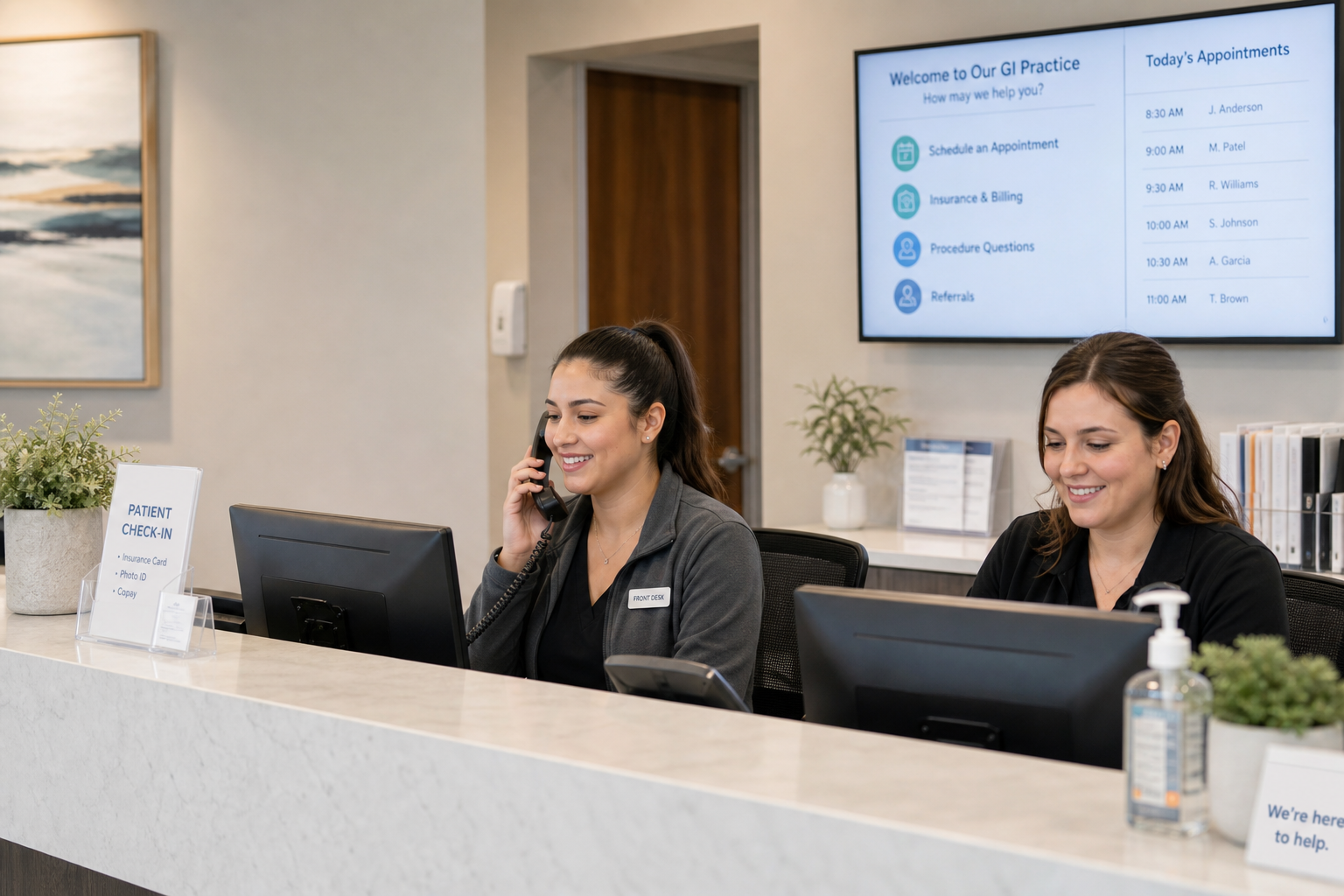
Compare 4 voice AI vendors for GI practices on colonoscopy scheduling, benefits verification, and prior auth calls. See which ones stop at booking.

Compare 5 AI voice agents for ENT and allergy practices. See which handle scheduling and the payer calls for prior auth and benefits checks.

Best AI agents for orthopedic practices compared on prior auth, outbound payer calling, and billing. Only 1 vendor resolves 60%+ of calls end-to-end.


