




Best AI Agents for Orthopedics: September 2026
Best AI agents for orthopedic practices compared on prior auth, outbound payer calling, and billing. Only 1 vendor resolves 60%+ of calls end-to-end.

If voice AI only answers calls but leaves the calendar entry to staff, you haven't saved much time. Voice AI appointment scheduling that integrates with your EHR handles the full loop: it confirms the appointment over the phone and writes it directly into your schedule with the right provider, time, and insurance details attached. No clipboard handoff, no manual re-entry, no lag between the call ending and the booking appearing in your system.
TLDR:
Voice AI appointment scheduling uses AI to handle the full scheduling conversation over the phone, from collecting patient information to confirming a booked slot, without staff involvement. Unlike IVR systems that force rigid menu trees, voice AI understands spoken requests, asks clarifying questions, and resolves the call in a single interaction.
The practical difference shows up in call containment. IVR systems typically deflect simple tasks but fail on anything outside a narrow script. Voice AI can handle scheduling, rescheduling, cancellations, and waitlist requests across varying patient phrasings and mid-conversation changes.
When a patient calls to book an appointment, voice AI handles the conversation end to end. It greets the caller, confirms identity, checks availability against live scheduling rules, and books the slot directly into the EHR or PMS without staff involvement.
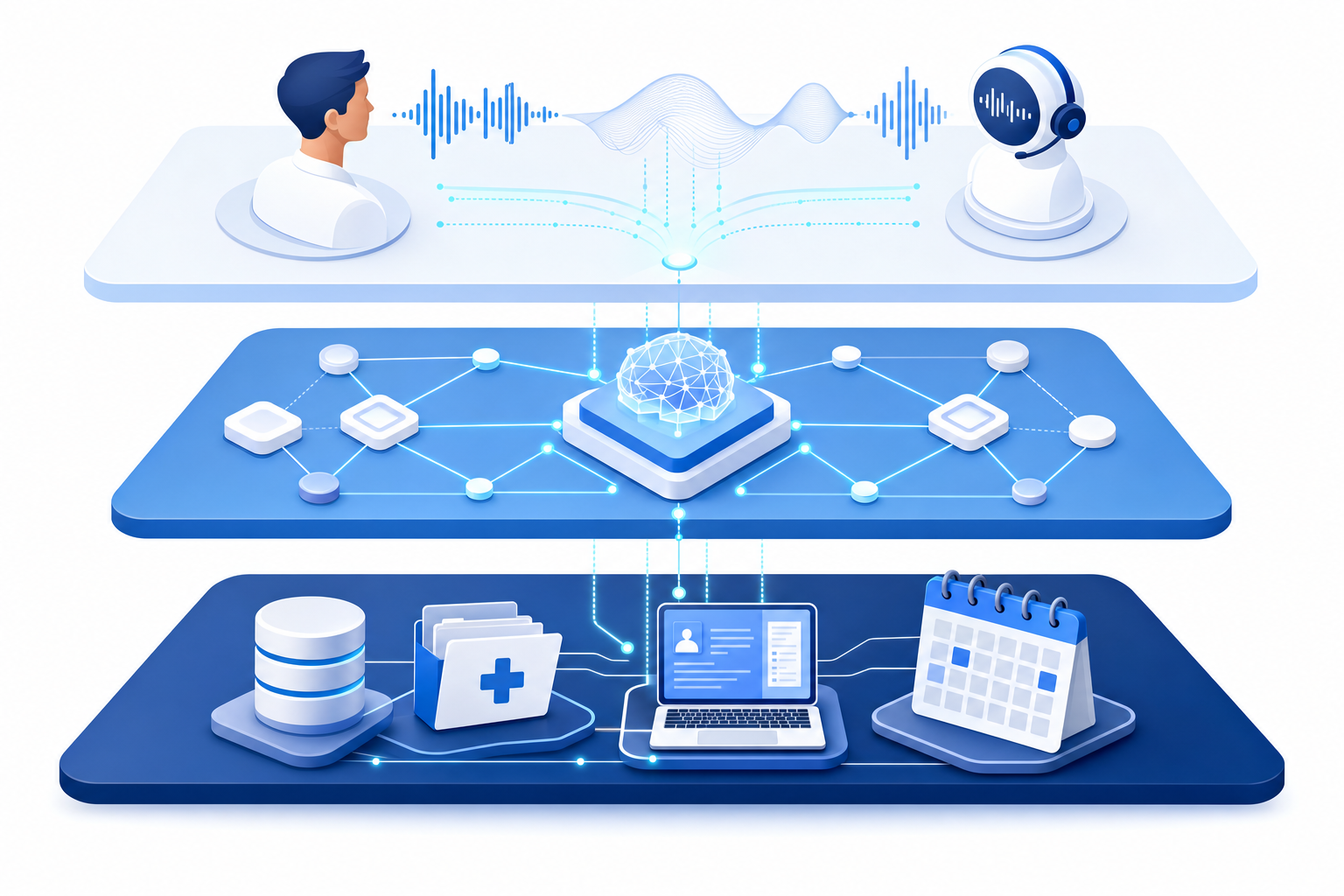
The process runs on a few layers working together:
Most calls resolve in under two minutes. Staff only see the completed booking in their schedule.
Scheduling calls are one of the highest-volume, lowest-complexity tasks a front desk handles — yet they consume staff time that could go toward exceptions, referrals, and patients who need a real conversation. Many practices field hundreds of calls a day, and a large share of those are routine: new patient appointments, follow-ups, and cancellations.
Voice AI handles that volume without adding headcount. For practices watching labor costs climb, that math is straightforward.
Online scheduling portals let patients book 24/7, but they can't handle questions, verify insurance, or adapt when something goes wrong. IVR systems route calls through menus but rarely resolve anything on their own. Voice AI does what both miss: it holds a real conversation, pulls live calendar data, confirms eligibility, and books the appointment in one interaction.
| Online scheduling | IVR | Voice AI | |
|---|---|---|---|
| Handles open-ended questions | No | No | Yes |
| Books appointments autonomously | Yes | No | Yes |
| Verifies insurance in real time | No | No | Yes |
| Available 24/7 | Yes | Yes | Yes |
Most scheduling tools stop at the calendar. That leaves rescheduling, cancellations, and insurance questions back on staff.
Voice AI handles a wider range of scheduling tasks than many evaluators expect. Appointment booking, rescheduling, and cancellations are well within reach. So are insurance verification lookups, waitlist management, and basic pre-visit intake questions.
That said, limits exist. Complex clinical triage, multi-step prior auth exceptions, and calls requiring genuine judgment still belong with staff. The honest framing: voice AI covers high-volume routine work well, freeing staff for the cases that actually need a human.
The coverage gap often comes down to scope. Many scheduling-focused tools handle the calendar and little else, leaving billing questions, benefits verification, and after-hours calls back on the front desk. Broader-scope voice AI handles more of that call mix, but no vendor automates everything.
Answering a scheduling call is only half the job. If the appointment doesn't land in the EHR with the right provider, slot, and insurance details attached, staff still have to touch it.
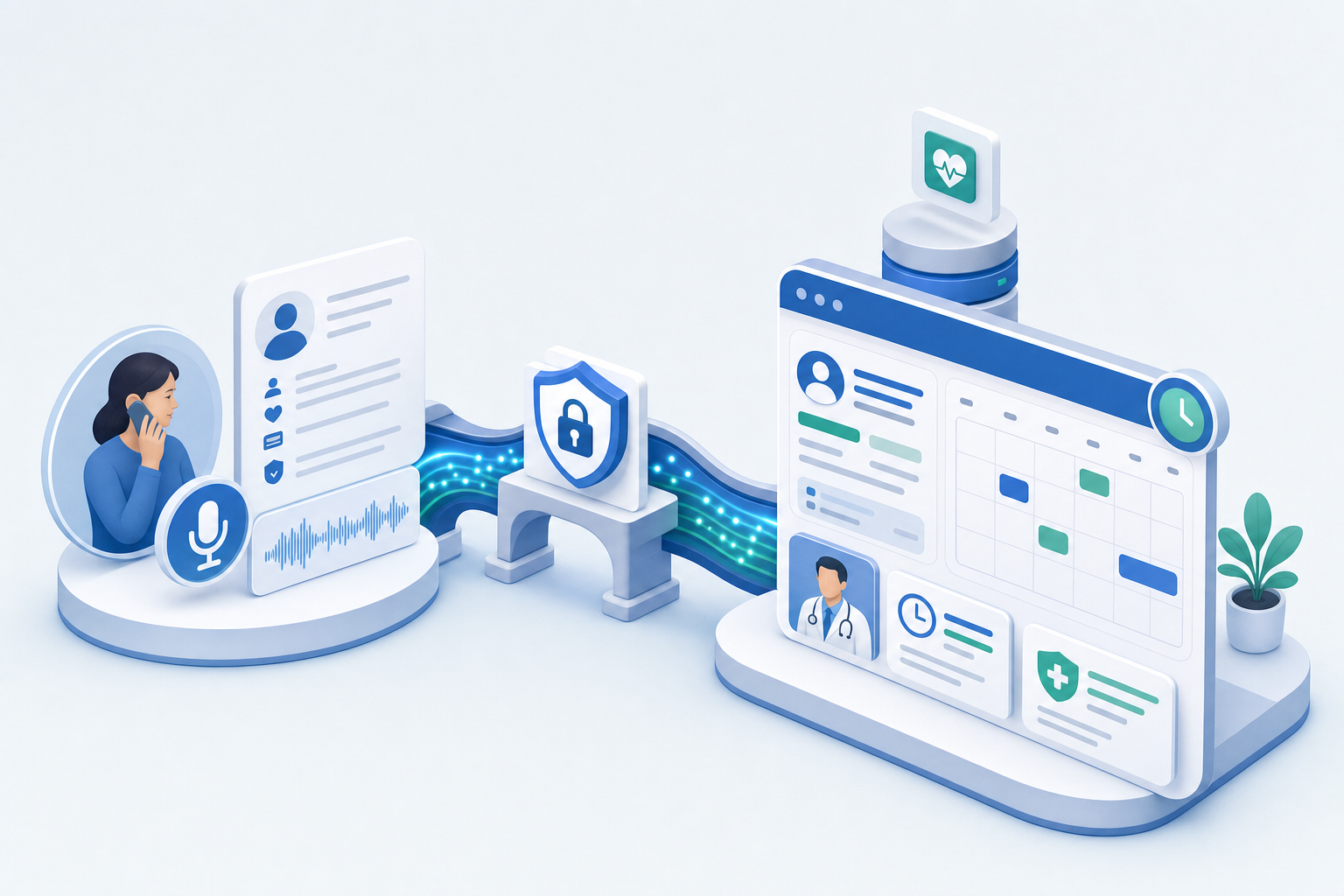
Voice AI with EHR write-back closes that loop. No clipboard hand-off, no re-keying, no lag between the call ending and the calendar updating. The appointment exists in the system the moment the call does.
Most narrow-scope scheduling tools stop at intent capture. They confirm a time verbally but leave EHR write-back to staff, which means the front desk still carries the administrative load for every call the AI "handled."
Any voice AI system handling patient scheduling must meet HIPAA requirements without exception. That means end-to-end encryption for call recordings and transcripts, Business Associate Agreements (BAAs) with every vendor in the data chain, and strict controls over where protected health information (PHI) is stored and accessed.
Before signing with any vendor, practices should confirm the system logs only what's needed, retains data for the minimum required period, and supports audit trails for compliance review. Many voice AI vendors offer HIPAA-compliant infrastructure, but compliance coverage can vary widely across tiers and contract types, so vetting the specifics matters.
Most deployments follow a pattern worth knowing before you sign anything.
Six metrics give operations leaders a clear read on whether voice AI is earning its place or just answering phones.
| Metric | What it measures | What strong performance looks like | |
|---|---|---|---|
| Call resolution rate | Calls fully resolved without staff transfer | 60%+ of total inbound volume | |
| Appointment completion rate | Scheduling-intent calls that end in a booked slot | A reasonable target is 80%+ of scheduling volume; compare against your pre-deployment baseline | |
| Average handle time | End-to-end call duration | Under two minutes for routine bookings | |
| Staff transfer rate | Calls escalated to a human | Tracked against your pre-deployment baseline | |
| Patient satisfaction | Post-call feedback on the interaction experience | Measured per call type, including unresolved calls | |
| Schedule utilization | Reduction in unfilled slots and no-show recovery rate | Compared against a defined pre-deployment period |
Ask every vendor for resolution rate broken out by call type. A blended number that folds in simple FAQ calls can look strong while masking poor performance on scheduling and insurance calls, which is where the real volume sits.
Prosper AI handles the full appointment scheduling call surface, beyond the calendar entry. When a patient calls to book, the voice AI confirms insurance eligibility, checks the right provider based on specialty and availability, and writes the appointment directly into the EHR, all within a single call.
Most scheduling tools stop there. Prosper continues into the revenue cycle: benefits verification, prior auth support, and billing inquiries are handled in the same voice infrastructure. That coverage matters because scheduling and billing calls often come from the same patients.
Practices using Prosper report 60%+ end-to-end call resolution in production, meaning staff handle exceptions, not routine volume.
Your front desk doesn't need another tool that answers calls but leaves the calendar work to staff. What separates narrow-scope vendors from end-to-end coverage is whether rescheduling, cancellations, and insurance verification stay in the AI conversation or get punted back to humans. Voice AI appointment scheduling that closes the loop, writing appointments into your EHR without manual steps, shows its value in the first week, and the call volume your staff stops fielding proves the math.
IVR systems route calls through rigid menu trees but rarely resolve anything on their own, while voice AI holds a full conversation, pulls live calendar data, and books the appointment in one interaction. IVR breaks when callers go off-script; voice AI understands natural requests and handles mid-conversation changes without transferring to staff.
Yes, when the system has EHR and payer integration. Voice AI can check benefits eligibility in real time during the scheduling conversation and confirm insurance details before booking the appointment — the caller never waits on hold for staff to verify coverage.
If your practice fields several hundred scheduling calls per week and staff time on routine bookings is keeping them from handling exceptions or complex cases, the math typically works. Practices seeing high call abandonment rates or struggling with after-hours coverage also see immediate returns from deployment.
Most deployments go live within three to six weeks, though full optimization can take an additional four to six weeks as the system learns your call mix. Integration setup happens first, then configuration of scheduling rules and appointment types, followed by a calibration period where call handling accuracy improves with real call volume.
Yes. Voice AI writes confirmed appointments directly into your EHR or PMS through backend integrations, not browser-based tools that would require JavaScript. The appointment lands in your schedule the moment the call ends, with no manual entry required from staff.
Discover how healthcare teams are transforming patient access with Prosper.

Best AI agents for orthopedic practices compared on prior auth, outbound payer calling, and billing. Only 1 vendor resolves 60%+ of calls end-to-end.

The 7 best AI voice agents for ophthalmology practices. Find platforms with ModMed & Nextech integrations, prior auth support, and patient automation.

Our September 2026 FQHC voice agent comparison covers Medicaid verification, payer calls, prior auth, and multilingual support across five tools.


