




The Best AI Voice Agents for Ophthalmology Practices in 2026
The 7 best AI voice agents for ophthalmology practices. Find platforms with ModMed & Nextech integrations, prior auth support, and patient automation.
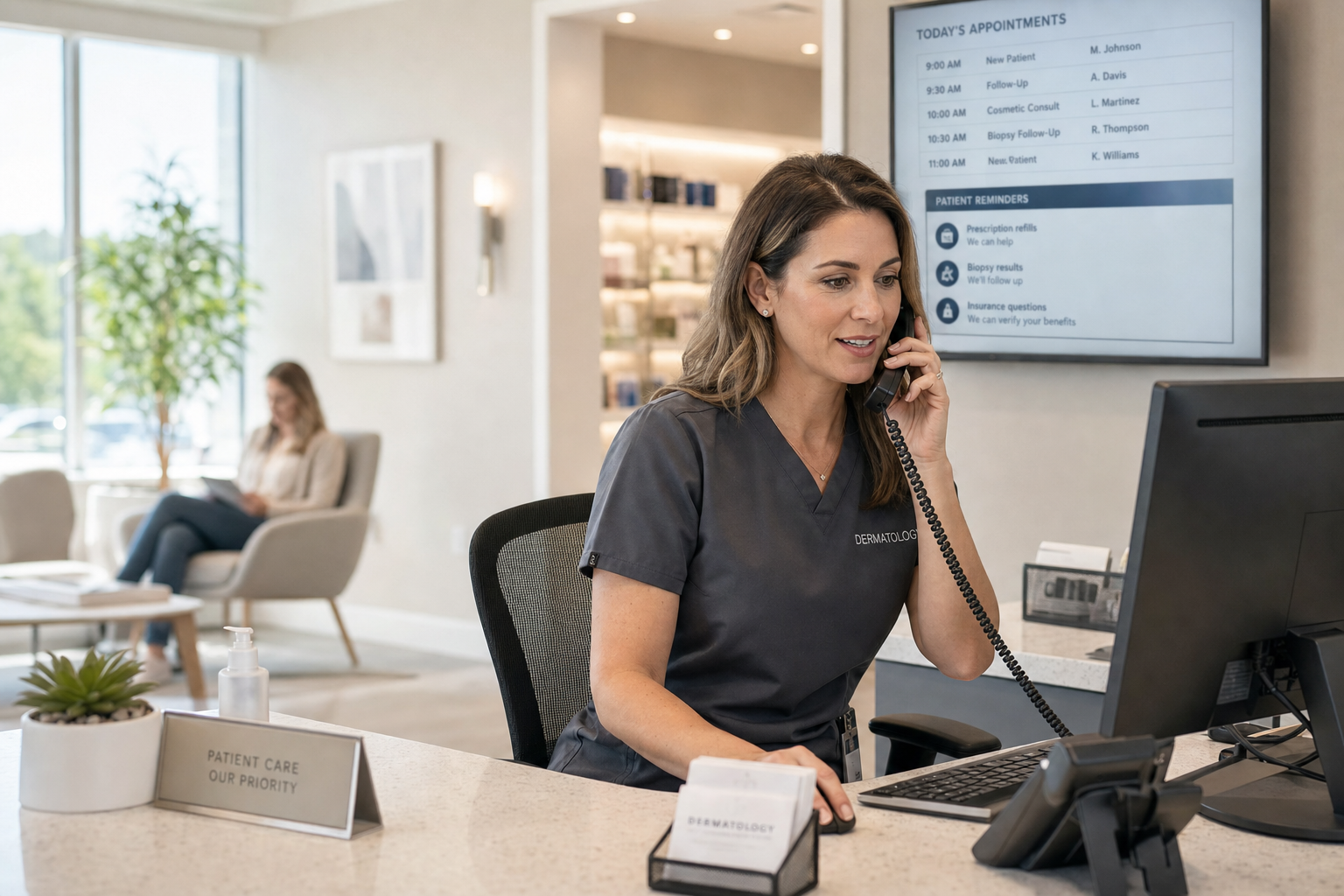
Voice AI for dermatology practices is a category of conversational AI agents that handle patient calls end-to-end — scheduling, benefits verification, prior authorization, and refills — instead of just booking appointments. The stakes are real: dermatology no-shows run 12%–31%, and physicians lose ~13 hours a week to prior auth denials.
If you've demoed a voice AI vendor that only handles appointment scheduling, it doesn't touch the majority of what your derm front desk actually does. Billing questions, refill routing, insurance verification, and biopsy follow-up calls still land on staff, which means you're automating one workflow and leaving the rest manual.
Dermatology practices face wider call variety than single-condition specialties — scheduling, refills, cosmetic inquiries, biopsy follow-ups, and insurance checks all land on the same front desk. The access strain is measurable: average new-patient wait time is 36.5 days nationally, up 50% since 2004, and no-show rates range from 12% to 31% depending on clinic type.
Patients call to schedule new-patient appointments, request prescription refills, ask about cosmetic procedures, follow up on biopsy results, verify insurance coverage, and get directions to satellite offices. Each call type carries different routing logic, different urgency, and different staff skill requirements.
A few structural factors drive call load in dermatology specifically:
Most narrow-scope scheduling tools handle the calendar piece and leave the rest to staff. In a derm practice, that means the majority of call types still land on a human.
▶ Case Study: See how Preferred Dermatology scaled to 54% more appointments without adding staff
Dermatology front desks field a predictable mix of calls: appointment requests, prescription refill questions, referral coordination, insurance checks, and post-procedure follow-up. Voice AI for handles the bulk of these without a staff member picking up the phone.
Here is what that looks like in practice:
Staff still handle exceptions, clinical questions, and anything requiring judgment. The AI covers the repeatable, high-volume work that currently consumes most of the front desk's day.
Most vendors stop at the patient side of the call. Prosper AI also places the payer-facing call — the same call that costs the average derm practice $83,200 a year in PA denials — so the loop closes on both ends without a staff member picking up either phone.
Call abandonment is one of the quietest revenue leaks in a dermatology practice. When a patient hangs up before reaching staff, that appointment often never gets booked. For high-demand services like Mohs surgery consultations, cosmetic procedures, or new patient acne visits, a missed call can mean weeks of empty calendar slots.
Long wait times compound the abandonment problem: the average new-patient dermatology wait is now 36.5 days, and Medicaid patients wait roughly 13 days median versus 7 for BCBS/Medicare patients booking the same visit type. Every abandoned call adds to that backlog rather than shortening it.
Dermatology practices with busy front desks often see call abandonment rates climb during peak hours, when staff are occupied with check-ins, insurance verifications, or post-visit billing questions. Patients who can't get through frequently call competitors or simply delay care, making healthcare call center automation a revenue protection measure.
The downstream effect shows up in revenue: fewer completed bookings, lower patient retention, and reduced lifetime value per patient. For multi-location derm groups, these losses compound across sites.
Legacy IVR systems route calls through rigid decision trees: press 1 for appointments, press 2 for billing. When a patient deviates from the script, the system fails. Conversational voice AI works differently. It interprets free-form speech, follows the patient's actual intent, and resolves the request without forcing callers into predetermined menus.
The gap in practice is measurable. Industry benchmarks put IVR end-to-end resolution at fewer than 20% of calls — most callers either drop out of the menu tree or wait for a human. Prosper reaches 60%+ end-to-end resolution in production, meaning the call closes without a staff member ever picking up.
The resolution rate a voice AI system can achieve depends entirely on how many workflows it can own. A narrow-scope tool that handles only appointment scheduling will cap out at whatever percentage of your call mix is scheduling-related. Billing questions, referral status, medication refills, and pre-procedure instructions make up the rest. A system that can't touch those workflows leaves the majority of calls on staff.
Demos rarely reflect production reality. A voice AI agent can schedule appointments flawlessly in a sandbox environment, then fail the moment it needs to write back to your actual EHR.
The integration question worth asking every vendor: does the system read from and write to your EHR bidirectionally, or does it only pull data and hand off to staff for updates? Read-only connections mean your front desk still manually enters what the AI collected. That erases much of the call volume reduction you're evaluating for.
For dermatology practices, the relevant EHR write-back capabilities include appointment creation, cancellation, and rescheduling directly in the EHR, insurance capture and eligibility verification updates, and patient demographic updates without staff re-entry.
Practices running EHRs like ModMed, athenahealth, Epic, or eClinical Works should confirm that any vendor has certified, production-tested connections with those specific systems, not just API access in theory.
Any voice AI must meet HIPAA technical safeguards — full stop. For dermatology practices, that means evaluating vendors on encryption standards, data retention policies, and audit trail capabilities before anything else.

Well-architected voice AI systems handle this through several layers:
Dermatology groups evaluating vendors should also ask about SOC 2 Type II certification, which signals that a vendor's security controls have been independently audited over time rather than just assessed at a single point. Voice agent testing requires SOC 2 alongside HIPAA compliance. This matters more than a vendor's self-reported compliance claims.
The short version: security architecture is a vendor selection filter, not an afterthought. A voice AI that handles call volume well but can't produce a signed BAA and audit logs on request is not a viable option for any HIPAA-covered practice.
Prior authorization is a quiet drain on dermatology practices: physicians spend roughly 13 hours a week on PA, file about 39 requests a year, and see roughly one-third denied — costing the average practice an estimated $83,200 a year in lost revenue.
That burden sits on the payer-facing side of the phone, which scheduling-only tools never touch.
Leading dermatology groups measure voice AI performance across three layers: call containment rate, first-call resolution for prior auth, and staff hours recaptured per week. Together these show whether calls actually resolved, not just whether they were answered.
The numbers that matter most reflect whether patients got answers, whether staff workload actually dropped, and whether revenue-cycle steps like prior auth and benefits verification completed without manual intervention.
Most derm groups worth benchmarking against track performance across three layers:
Call volume reduction alone tells an incomplete story. A voice AI that deflects 80% of calls but misroutes a third of them creates more cleanup work than it removes. The more useful benchmark pairs containment rate with task completion rate: did the call resolve, or did it just disappear?
Dermatology-specific workflows add complexity here. Cosmetic scheduling often involves multi-step consultations and deposit collection. Medical derm calls frequently involve insurance verification for procedures like biopsies or excisions. Any performance review should account for how well the system handles those call types specifically, not just aggregate volume.
Yes. Modern voice AI systems handle the full call mix in dual-focus derm practices, including scheduling cosmetic consultations, routing medical appointment requests, verifying insurance coverage for procedures like biopsies, and collecting deposits for elective services — all within the same workflow.
Voice AI interprets free-form patient speech and resolves requests end-to-end, while IVR systems force callers through rigid menu trees that break when patients deviate from the script. In production, voice AI reaches 60%+ resolution rates; IVR systems typically contain under 20% of calls without escalation.
Groups should confirm the vendor provides a signed Business Associate Agreement (BAA), end-to-end encryption for all call audio and transcripts, role-based access controls for call review, automatic PHI redaction from logs, and SOC 2 Type II certification proving audited security controls over time.
Appointment creation, cancellation, and rescheduling; insurance capture and eligibility verification updates; patient demographic changes; and biopsy follow-up documentation all require bidirectional EHR integration. Read-only systems leave staff manually entering what the AI collected, erasing most productivity gains.
Call containment rate matters more when evaluating quality of resolution. A system that deflects 80% of calls but misroutes a third creates more cleanup work than it removes. Pair containment rate with task completion rate to confirm calls actually resolved rather than just disappeared from the queue.
Yes, if it's built for it. Most vendors only handle the patient side: booking, refills, reminders. Dual-sided voice AI also places the payer-facing call, checking benefits and confirming prior auth status, so both ends of the workflow close without staff picking up either phone.
About 13 hours a week per physician. Derm practices file roughly 39 PA requests a year, and each one eats into time that could go to patients instead of hold music with a payer.
Roughly $83,200 a year for the average practice. About a third of PA requests get denied, and every denial means rework, delayed procedures, or revenue that never gets collected.
Prosper AI build voice AI agents for dermatology practices that cover inbound scheduling, insurance eligibility, prior authorization, billing inquiries, and outbound payer calls in a single automated workflow—one system for both sides of the phone.
In a six-vendor RFP, Prosper AI hit 60%+ end-to-end call resolution in production, compared to roughly 30% for other vendors. Most practices are live in 3 weeks, with no custom coding and no disruption to staff, and integrate with 80+ EHR and practice management systems.
Book a demo with Prosper AI to see what full-coverage resolution looks like on your actual call mix.
Discover how healthcare teams are transforming patient access with Prosper.

The 7 best AI voice agents for ophthalmology practices. Find platforms with ModMed & Nextech integrations, prior auth support, and patient automation.

Our September 2026 FQHC voice agent comparison covers Medicaid verification, payer calls, prior auth, and multilingual support across five tools.

AI front desk automation for multi-site groups: EHR write-back, full call coverage, HIPAA compliance, and realistic timelines. September 2026.


