




Best AI Voice Agents for ENT (2026 Guide)
Compare 5 AI voice agents for ENT and allergy practices. See which handle scheduling and the payer calls for prior auth and benefits checks.

The front desk is the front door to your healthcare practice. Every missed call is a missed appointment, a delayed payment, or a frustrated patient. With staffing shortages and rising patient expectations, managing phone volume has become a critical challenge. A modern medical call answering service isn’t just about picking up the phone; it’s about improving patient access, streamlining revenue cycle management, and giving your team the breathing room to focus on in-person care. This guide breaks down what to look for in a service and how to choose the right partner for your practice.
A medical call answering service is a specialized solution designed to handle patient and payer phone calls on behalf of a healthcare provider. Traditionally, these were live agent call centers that took messages after hours. Today, the landscape has evolved significantly.
Modern solutions, particularly those powered by AI, act as a direct extension of your practice. Instead of just taking messages, they can perform complex tasks like scheduling appointments, verifying insurance benefits, and answering billing questions. Advanced platforms like Prosper AI use voice AI agents trained specifically on healthcare workflows, allowing them to handle a high volume of calls with speed, accuracy, and 24/7 availability. This transforms the medical call answering service from a simple overflow tool into a core operational asset.
The best services go far beyond basic message taking. They should be able to manage a wide range of administrative tasks that consume your staff’s time.
Key capabilities to look for include:
Patient Scheduling and Reminders: Handling inbound requests to book, reschedule, or cancel appointments. Some services can even proactively call patients on a waitlist or run reengagement campaigns, which has been shown to increase appointments by over 20%.
Billing Inquiries and Payments: Answering common questions like “why was I billed for this” and securely processing patient payments over the phone.
Insurance and Benefits Verification: Placing outbound calls to payers to verify patient eligibility and benefits. This is a huge time saver, with AI solutions often delivering results with 99% accuracy in under two hours.
Prior Authorization Follow Up: Checking the status of prior authorizations to prevent delays and denials that impact patient care and revenue.
Claim Status Checks: Calling payers to follow up on claims older than 30 days, freeing up your billing team for more complex denial management.
Prescription Refill Requests: Managing routine refill requests and routing them to the appropriate clinical staff.
Switchboard and Call Routing: Acting as a conversational front door to your practice, intelligently routing callers to the right person or department without a confusing phone tree.
In healthcare, security is not optional. Any medical call answering service you consider must be built on a foundation of HIPAA compliance. Simply stating they are “HIPAA compliant” isn’t enough.
Look for specific evidence of their security posture:
Business Associate Agreement (BAA): The service must be willing to sign a BAA, a legal contract that obligates them to protect your patients’ protected health information (PHI).
SOC 2 Type II Certification: This independent audit verifies that a company has strict internal controls over time for security, availability, processing integrity, confidentiality, and privacy.
Data Encryption: All data, both in transit over the internet and at rest on servers, should be encrypted using strong standards like AES 256.
Secure Data Handling: For AI platforms, inquire about their data retention policies. Leading providers like Prosper AI have zero day retention agreements with their AI model partners, meaning your data is not stored or used for training.
A standalone answering service creates more work than it saves. To be truly effective, the solution must integrate directly with your existing technology stack, particularly your Electronic Health Record (EHR) or Practice Management (PM) system.
Seamless integration allows the service to write information directly back into your systems. For example, when an AI agent schedules an appointment, it should appear on your provider’s calendar in Epic, athenahealth, or Cerner instantly. A top tier medical call answering service should offer native integrations with dozens of major platforms and provide flexible connection options like APIs or secure file transfers for custom setups.
Quality and reliability are paramount. When evaluating a service, ask about their operational standards and how they measure success.
Accuracy: What is their accuracy rate for capturing information like patient demographics or benefits details? Aim for services that can demonstrate 99% or higher accuracy, often verified by automated quality assurance on every call.
Uptime: Look for a Service Level Agreement (SLA) that guarantees uptime. A 99.9% uptime SLA is a strong industry standard.
Speed to Value: How long does it take to get started? Modern platforms can often launch a pilot in just a few days with simple data uploads and achieve full integration in about three weeks.
Support: Who will you talk to when you have a question? Look for partners that provide a dedicated manager to oversee your account and help you optimize performance.
Selecting the right partner involves looking beyond a list of features. You need a solution that aligns with your practice’s specific needs, patient population, and long term goals.
Define Your Primary Problem: Are you trying to reduce patient hold times, lower staff burnout, or capture more revenue? A provider focused on RCM tasks may be a better fit than one that only handles scheduling.
Evaluate Their Healthcare Focus: A generic answering service won’t understand the nuances of speaking with payers or navigating complex clinical workflows. Choose a partner built exclusively for healthcare.
Request a Demonstration: Ask to see the technology in action. A live demo is the best way to understand the patient experience and the backend analytics you’ll have access to. See how a modern medical call answering service can transform your operations.
Check for Social Proof: Look for case studies and testimonials from practices similar to yours. For example, a Northeast GI group with over 100 providers was able to handle more than 50% of its scheduling volume with AI agents in just a few weeks.
Understand the Technology: Is it a team of live agents, a simple IVR, or a sophisticated AI platform? AI voice agents offer unmatched scalability, consistency, and cost efficiency, often reducing operational costs by 40% or more.
Pricing for a medical call answering service can vary widely. Common models include:
Per Minute: You pay for the exact time an agent spends on the phone.
Per Call: A flat fee for each call handled, regardless of duration.
Subscription: A fixed monthly fee for a certain number of calls or minutes.
Usage Based: Advanced AI platforms often use a consumption model where pricing depends on the volume and complexity of the workflows being automated.
When calculating the total cost, remember to factor in the return on investment. A good service should pay for itself by increasing appointments, improving collections, and reducing the need to hire additional full time staff.
Selecting the right communication partner is essential for maintaining patient trust and ensuring HIPAA compliance in an increasingly digital healthcare landscape. This curated list highlights the industry leaders for 2026, evaluated based on their technological innovation, reliability, and specialized medical expertise. These organizations stand out for their ability to streamline administrative workflows while providing compassionate, 24/7 support to patients.
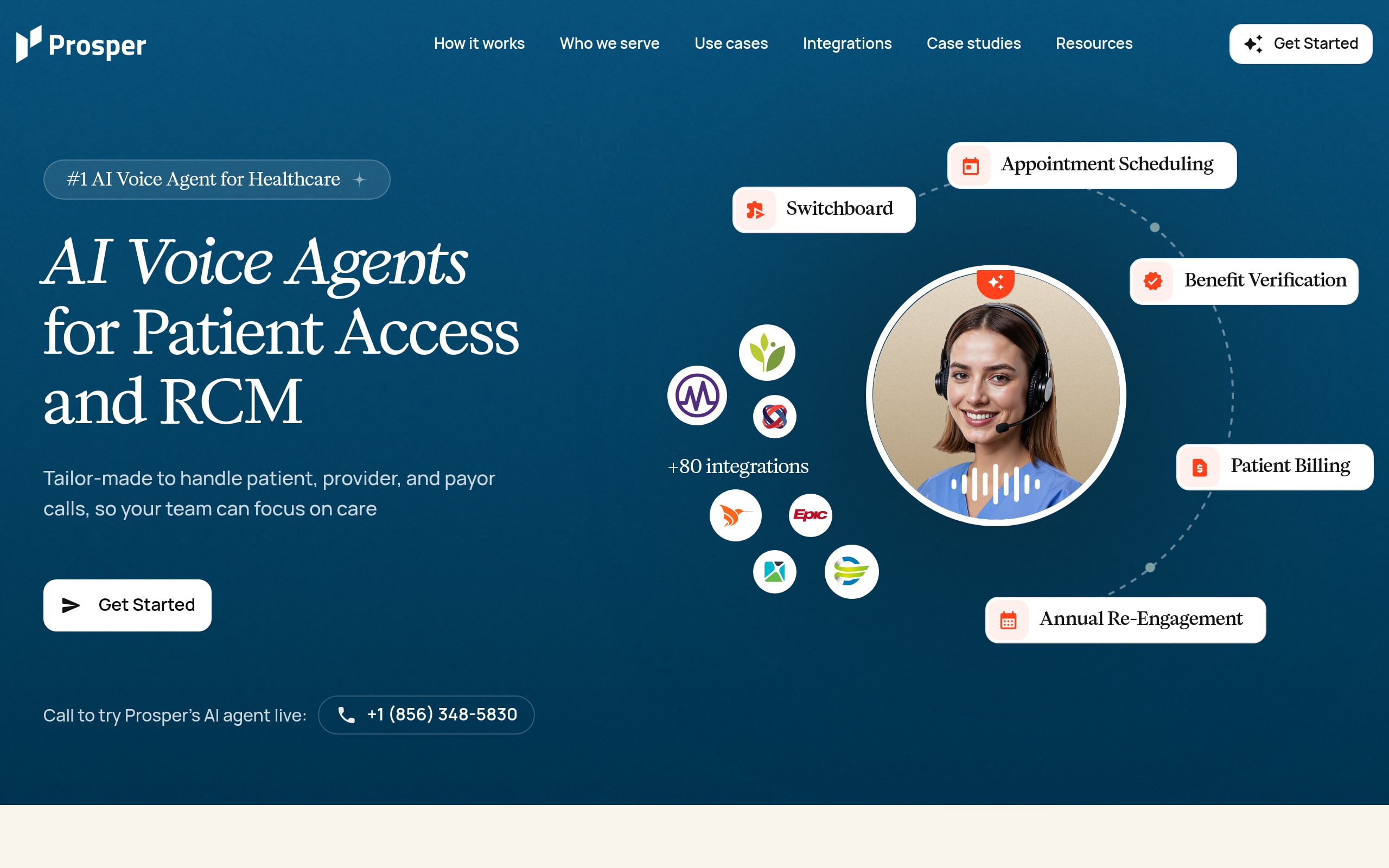
Prosper AI replaces the traditional call center with an AI-native, HIPAA-compliant voice agent built for healthcare. It autonomously manages inbound and outbound patient interactions across access and revenue workflows, delivering near-instant pickup, high containment, and meaningful reductions in administrative cost.
24/7/365 autonomous coverage for after-hours, overflow, and holidays
Real-time, bidirectional scheduling: book, reschedule, cancel via EHR sync
Urgent routing with warm transfers honoring on-call and escalation protocols
Billing Q&A, balance collection, and insurance verification
Proactive outreach for reminders, gap-closure, and post-visit follow-up
Multilingual (English/Spanish), transcription, and sentiment analysis
Compliance & integrations: HIPAA/HITECH with BAA; SOC 2 Type II; AES-256/TLS 1.3; full audit trails. Deep read/write with Epic, Cerner, Athenahealth, eClinicalWorks, and NextGen via HL7/FHIR/APIs to sync appointments and documentation in real time.
Best for high-volume specialty groups and mid-market systems seeking automation-first access. Pricing is usage-based (per-minute or per-encounter) with tiers. Watchouts: No licensed nurse triage; clinical advice remains with clinicians.
MedConnectUSA is a medical-only, US-based live answering service that acts as an empathetic extension of your front desk. Prioritizing human connection over automation, it focuses on after-hours support, emergency dispatch, and intake to preserve patient trust and reduce abandonment.
24/7/365 live coverage for after-hours, weekends, and holidays
Urgent escalation with customizable protocols and warm transfers
Appointment scheduling and registration in your existing systems
Automated on-call schedule management via a web portal
Bilingual support (Spanish) with interpretation services
Secure PHI messaging with encrypted delivery and audit trails
Compliance & integrations: HIPAA/HITECH with BAA; SOC 2 Type II; end-to-end encryption; PHI retention controls. Interoperability via HL7/FHIR/APIs with Epic, Athenahealth, and eClinicalWorks enables read/write for notes and appointment booking.
Best for small-to-midsize practices wanting high-touch, live-agent service. Pricing is tiered usage starting around $150–$250/month. Watchouts: No AI-driven cost compression; no licensed nurse triage.
PatientCalls delivers healthcare-only, US-based live-agent support around the clock, blending compassionate interaction with secure dispatch. The goal: contain urgent calls, streamline intake, and keep clinicians focused on true emergencies.
24/7/365 after-hours and overflow call handling
Protocol-driven routing with escalation and warm transfers
Appointment scheduling, intake, and cancellations
Real-time on-call management via proprietary portal
Multilingual support (Spanish + 200+ languages)
Secure PHI messaging via MiSecure app and SMS
Specialty scripting for pediatrics, hospice, and home health
Compliance & integrations: HIPAA with BAA; HITECH; end-to-end encryption; call recording and audit trails. Integrates with Athenahealth and eClinicalWorks via HL7/APIs for read/write of appointments, notes, and task creation. 99.9% uptime SLA.
Best for small-to-midsize practices and hospice agencies valuing personal touch. Pricing typically $75–$150/month based on usage. Watchouts: No clinical nurse triage; EHR write-back may incur custom fees.
Call 4 Health operates as a clinical-grade extension of medical offices, pairing trained agents with RN-led protocols. Its hybrid approach is designed for high-acuity needs, especially nurse triage and emergency dispatch, while preserving warmth and reducing clinician burnout.
24/7/365 medical answering with terminology-trained agents
RN-led clinical nurse triage using gold-standard protocols
Full-cycle scheduling and reminders with EHR writeback
Intelligent urgent routing and physician warm transfers
Multilingual support (Spanish + 200+ languages)
SMS/email follow-ups and resilient disaster recovery
Analytics and quality assurance dashboards
Compliance & integrations: HIPAA/HITECH with BAA; SOC 2 Type II; 256-bit encryption; robust audit trails. HL7/FHIR API connectivity to Epic, Cerner, Athenahealth, and NextGen supports real-time bi-directional writeback for appointments, notes, and tasks.
Best for health systems and large groups needing nurse triage and risk mitigation. Pricing is custom (per-minute/encounter). Watchouts: Higher cost profile than AI-only tools.
WellReceived is a medical-only virtual reception service that favors human empathy for patient intake and scheduling. It’s built to stop missed opportunities and lighten staff load with reliable, HIPAA-compliant coverage for practices of all sizes.
24/7/365 live answering for after-hours and overflow
Real-time scheduling and cancellations via EHR connections
Urgent escalation and warm transfers per custom protocols
Patient intake and prequalification to screen criteria
Bilingual (Spanish) support to expand access
Secure, HIPAA-compliant mobile app for message dispatch
Specialty-tailored scripting by provider and schedule
Compliance & integrations: HIPAA/HITECH with BAA; TLS encryption; call recordings and audit trails. Writeback into Athenahealth, DrChrono, AdvancedMD, Nextech, Modernizing Medicine, and Jane App lets agents place appointments and notes directly into the chart.
Best for small-to-midsize practices that prize empathetic service. Pricing starts ~ $150–$300/month with usage tiers. Watchouts: No licensed nurse triage; per-minute costs can outpace AI at very high volumes.
Dexcomm brings a boutique, live-agent-first experience to medical answering, aiming to replace impersonal IVRs with trained specialists. With 24/7 empathy and protocol-driven urgency, it’s crafted for patient retention and reliable clinical escalation.
24/7/365 live medical answering for after-hours and overflow
Urgent escalation with protocol-based warm transfers
Appointment scheduling, rescheduling, and intake
Dynamic on-call portal for real-time rotation updates
Native Spanish and 200+ language translation
HIPAA-secure messaging with read receipts
Hospice and home health workflow specialization
Compliance & integrations: HIPAA/HITECH; SOC 2 Type II; 256-bit encryption; audit trails and recordings. Bi-directional writeback with Epic, Athenahealth, and NextGen via HL7/FHIR/APIs supports agent-entered notes and tasks in the EHR.
Best for mid-to-large practices and hospice teams needing dependable dispatch. Pricing is usage-based, often $200–$400/month to start. Watchouts: No RN-led clinical triage.
Ambs Call Center pairs seasoned receptionists with selective automation to deliver round-the-clock medical access. Since 1932, it has focused on accurate routing, zero abandonment, and specialty-aware workflows to curb patient leakage.
24/7/365 live medical reception for after-hours and overflow
Web-based on-call management with instant roster updates
Appointment scheduling and intake via direct EMR access
Urgent escalation, clinical protocols, and warm physician transfers
miSecureMessages for encrypted PHI delivery
Multilingual agents and professional interpretation
Hybrid SMS/voice reminders to cut no-shows
Compliance & integrations: HIPAA/HITECH with BAA; SOC 2 Type II; 256-bit encryption; full audit trails and call recording. Read/write via HL7/APIs or secure RDP into Epic, Cerner, and Athenahealth for appointments and note updates.
Best for mid-sized practices and systems needing high-touch clinical accuracy. Pricing is usage-based (base fee + per-minute). Watchouts: Premium live-agent model; not an automation-only IVR.
Physician Answering Service is a doctor-first, HIPAA-trained live agent solution designed to reduce errors and elevate bedside manner over the phone. With US-based operators and white-glove workflows, it keeps complex on-call operations running smoothly.
24/7/365 after-hours and overflow coverage
Intelligent on-call dispatch via real-time digital calendars
Scheduling, rescheduling, and intake within practice schedulers
Urgent escalation and STAT patching for critical cases
Encrypted mobile apps and portals for secure messaging
Multilingual support including native Spanish
Custom intake scripts aligned to clinical guidelines
Compliance & integrations: HIPAA/HITECH with BAA; SOC 2 Type II; AES-256; MFA. Bidirectional integration with Epic, Cerner, and Athenahealth via API/HL7/SFTP enables agents to document notes and trigger tasks in-chart. 99.99% uptime.
Best for surgical groups and mid-sized practices with complex on-call needs. Pricing typically $150–$300/month plus per-minute. Watchouts: No nurse triage or medical advice; higher cost than bot-only tools.
TriageLogic delivers URAC-accredited, RN-led triage supported by decision software to standardize symptom assessment and curb unnecessary ER visits. It augments after-hours coverage with clinical confidence and documented dispositions.
24/7/365 nurse triage using Schmitt-Thompson protocols
Integrated scheduling with read/write into PM/EHR systems
Automated escalation to on-call via secure SMS or paging
RPM support with outreach on out-of-range vitals
Multilingual support across 200+ languages
Analytics dashboards for volumes, dispositions, and QA
Compliance & integrations: HIPAA/HITECH with BAA; SOC 2 Type II; 256-bit encryption; full audit trails. HL7/FHIR/API connections to Epic, Cerner, Athenahealth, and NextGen support read/write of triage notes, vitals, and appointments.
Best for mid-to-large systems and ACOs needing clinical oversight and liability protection. Pricing is volume-based or per-provider. Watchouts: Higher cost than non-clinical services; may exceed needs of small practices.
Answering Service Care (ASC) runs a dedicated Medical Desk with live agents, using AI for smart routing while keeping empathy at the forefront. It’s engineered to capture after-hours demand, reduce churn, and elevate patient experience.
24/7/365 after-hours, holiday, and overflow management
Urgent escalation with dynamic routing and warm transfers
HIPAA-compliant scheduling directly into practice calendars
Multilingual support including native Spanish
Customized intake workflows by specialty or protocol
Encrypted SMS/email for secure patient messaging
Real-time portal for recordings, logs, and QA
Compliance & integrations: HIPAA/HITECH with BAA; SOC 2 Type II; end-to-end encryption; SSO. Integrates with Epic, Cerner, Athenahealth, and eClinicalWorks via API/HL7/SFTP for bi-directional writeback of appointments and records, plus RCM exports.
Best for small-to-midsize practices and hospice/behavioral health seeking high-touch access. Pricing is usage-based, often $80–$150/month to start. Watchouts: No RN-led triage; advanced RCM integrations may require custom work.
Switching to a new call handling system requires a thoughtful rollout.
Phased Go Live: Start with one or two key workflows, like appointment reminders or after hours coverage. This allows your team to get comfortable with the new process before expanding.
Staff Training: Ensure your team understands what calls the service will handle and how to access reports and analytics. The goal is to make their jobs easier, not more complicated.
Patient Communication: Briefly update your on hold messaging to let patients know what to expect. A smooth, professional experience will build trust from the very first call.
Ongoing Optimization: A great partner will work with you to refine scripts and workflows over time. With no code customization tools, your own operations team can often make adjustments without needing engineers.
Choosing a medical call answering service is a strategic decision that impacts patient satisfaction, staff morale, and your bottom line. While traditional services can offer basic coverage, modern AI powered platforms provide a scalable, secure, and deeply integrated solution that actively improves your practice’s performance. By prioritizing HIPAA compliance, EHR integration, and a clear return on investment, you can find a partner that not only answers your calls but also helps your organization grow.
Ready to see how AI can eliminate phone tag and reduce administrative burden for your practice? Explore the next generation of patient and payer communication with Prosper AI. For a deeper overview, read our AI-powered healthcare contact center guide.
What is the difference between a virtual receptionist and a medical call answering service?
A virtual receptionist typically performs a broader range of administrative tasks, often including email management and outbound calling projects. A medical call answering service is highly specialized, focusing specifically on handling inbound and outbound phone calls for healthcare workflows like scheduling, benefits verification, and billing with deep EHR integration.
How much does a medical call answering service cost?
Costs can range from a few hundred dollars a month for basic after hours coverage to several thousand for a fully integrated, AI powered platform managing high call volumes. Pricing is usually based on call volume, minutes used, or the complexity of the automated tasks.
Are AI powered answering services HIPAA compliant?
Yes, reputable AI services built for healthcare are fully HIPAA compliant. They will sign a BAA and have robust security measures like SOC 2 Type II certification, end to end data encryption, and strict data retention policies to protect patient information.
Can an answering service integrate with my EHR system?
Absolutely. Integration is a key feature of any modern medical call answering service. Top providers like Prosper AI offer native connections to over 80 major EHR and PM systems, including Epic, Cerner, and athenahealth, to ensure data flows seamlessly.
How quickly can I set up a new answering service?
Implementation times vary. A simple after hours service can be set up in a day. A more advanced AI solution with EHR integration can often be live in as little as three weeks, with some pilot programs starting in just a few days using batch data uploads.
What kind of reporting and analytics should I expect?
You should expect detailed dashboards that provide near real time insights into call volume, call outcomes, abandonment rates, patient satisfaction, and task completion rates. AI platforms can even provide accuracy scores and quality assurance metrics for every single call handled.
Discover how healthcare teams are transforming patient access with Prosper.

Compare 5 AI voice agents for ENT and allergy practices. See which handle scheduling and the payer calls for prior auth and benefits checks.

Best AI agents for orthopedic practices compared on prior auth, outbound payer calling, and billing. Only 1 vendor resolves 60%+ of calls end-to-end.

The 7 best AI voice agents for ophthalmology practices. Find platforms with ModMed & Nextech integrations, prior auth support, and patient automation.


