




Best AI Agents for Orthopedics: September 2026
Best AI agents for orthopedic practices compared on prior auth, outbound payer calling, and billing. Only 1 vendor resolves 60%+ of calls end-to-end.

Most practices run some version of wave scheduling (multiple patients at the top of the hour), modified wave scheduling (staggering arrivals across the first half of each hour), or stream scheduling (fixed slots). You might layer in cluster scheduling for similar visit types, matrix scheduling to block provider time, or open access scheduling — also called same-day scheduling — to hold capacity for walk-ins. The types of scheduling methods in healthcare are well documented, and you've probably reviewed patient appointment scheduling software options, tested the best patient scheduling software for your specialty, and read through medical appointment scheduling guidelines more than once. The method isn't the problem. The problem is that every scheduling system still depends on a human being available to take the call, check the calendar, apply your practice's rules, and write the appointment. AI patient scheduling software changes that by handling the entire booking sequence in real time — matching visit types to slot durations, checking insurance eligibility, applying scheduling techniques like modified wave logic automatically, and covering after-hours calls without adding headcount. It's not replacing your scheduling method. It's removing the manual bottleneck that keeps any method from working at scale.
TLDR:
Scheduling methods in medical offices fall into several distinct categories, each with real tradeoffs for patient flow and staff workload.
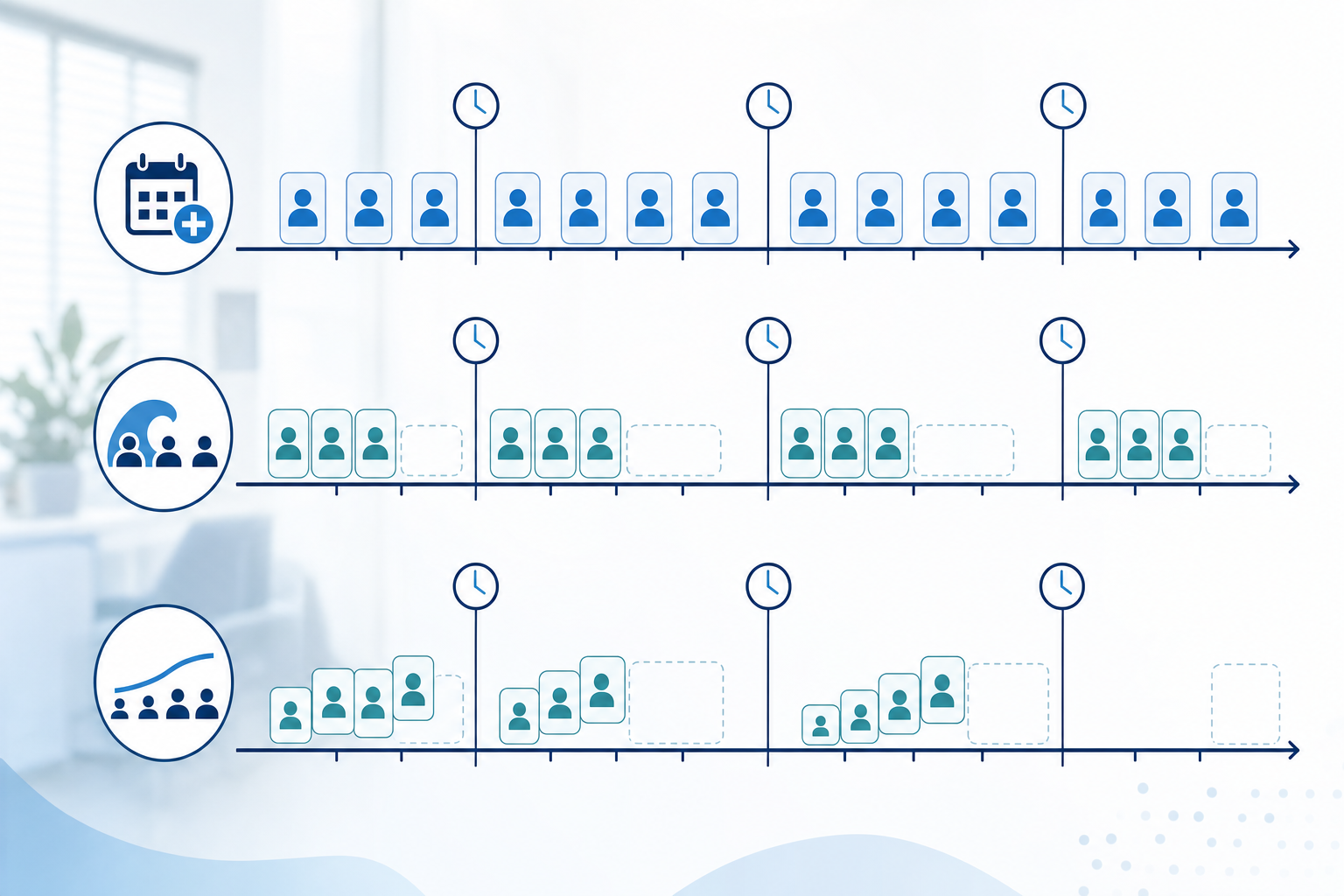
Each method suits different practice volumes, visit mix, and staffing ratios. Many practices run a hybrid, applying wave logic for high-demand mornings and stream scheduling for predictable afternoon slots.
| Scheduling Method | How Appointments Are Structured | Primary Advantage | Common Limitation |
|---|---|---|---|
| Stream scheduling | Each patient receives a fixed time slot at regular intervals throughout the day | Predictable structure for both patients and providers with clear appointment times | Little buffer for late arrivals or visits that run longer than the allocated slot |
| Wave scheduling | Multiple patients booked at the top of each hour with the second half left open | Provider works through patients in order while naturally absorbing short delays | Waiting room congestion when multiple patients arrive at the same time |
| Modified wave scheduling | Patients staggered across the first half of each hour with buffer time in the second half | Reduces waiting room pile-ups while preserving recovery buffer for throughput | Buffers erode quickly when no-shows and late arrivals cluster unpredictably |
| Cluster scheduling | Similar visit types grouped together in consecutive appointment blocks | Staff and providers stay in one workflow longer without context switching | Requires sufficient volume of each visit type to fill grouped blocks |
| Open access scheduling | Large portion of daily slots reserved for patients who call the same day | Shorter patient wait times and fewer no-shows since appointments are booked closer to the visit | High-volume days can overflow without enough buffer slots held in reserve |
| Matrix scheduling | Provider availability and blocked time mapped out before any appointments are placed | Acts as structural backbone that prevents double-booking and protects provider time | Requires ongoing maintenance as provider schedules and time blocks change |
Phone-based booking still dominates many practices, and the friction shows. Patients wait on hold, front desk staff toggle between calls and paper logs, and appointment slots fill unevenly across the day. Wave scheduling packs visits into the first half of each hour, open-access methods try to absorb same-day demand, and modified wave scheduling splits the difference — yet none of these methods solve the underlying problem: scheduling volume keeps growing while staff capacity stays flat.
Many practices still rely on manual data entry across disconnected systems, which means a rescheduled appointment can require updates in the EHR, the billing system, and a separate reminder tool — all by hand.
Wave scheduling groups multiple patients at the start of each hour, then leaves the second half open to absorb overruns. Modified wave scheduling refines this by staggering arrivals slightly within that first half, typically scheduling two or three patients at the top of the hour and one or two around the 20 or 30 minute mark.
The classic wave books, say, three patients at 9:00 a.m. with the expectation that one will run long, one will be quick, and one will average out. Modified wave softens that collision by spacing those same patients across 9:00, 9:10, and 9:20, reducing waiting room pile-ups while preserving the buffer that makes the hour recoverable.
Both methods assume providers can absorb variability across a block instead of within each slot. When volume is predictable, they perform well. When no-shows and late arrivals cluster unpredictably, the buffers erode fast.
AI scheduling tools can analyze historical visit-length data by provider, visit type, and time of day to set slot durations that reflect actual patterns instead of assumed ones. That same logic applies to wave construction: instead of a static three-patients-at-the-hour rule, the system calibrates how many patients to group and at what interval based on real throughput data.
Open access scheduling, sometimes called same-day scheduling, reserves a large portion of daily appointment slots for patients who call that day. The core idea: stop pre-booking weeks out and meet demand as it arrives.
This method works well in primary care settings where acute needs are common. Practices using open access often report shorter patient wait times and fewer no-shows, since appointments are booked closer to the actual visit.
The tradeoff is capacity planning. Without enough buffer slots, a high-volume day can overflow. Many practices run a hybrid approach, holding some slots for chronic care follow-ups while keeping others open for same-day demand.
Manual booking systems require staff to check provider availability, match visit types to appointment slots, confirm insurance eligibility, and send reminders — often across disconnected tools. AI handles that entire sequence in a single conversation, without a staff member involved. Patient self scheduling software takes this one step further by letting patients book directly through a portal or website instead of calling in, which reduces front desk calls while keeping staff control over appointment rules and slot availability.
Where manual systems rely on a human to know that a new patient diabetic visit needs 45 minutes with a specific provider type, AI applies those rules automatically at the moment of booking. Eligibility checks run in real time. Reminders go out on schedule.
The practical difference shows up in coverage: many practices can only staff phones during business hours, leaving after-hours requests unanswered until the next morning.
No-show rates can drop by up to 30% with AI reminders, and the mechanism matters more than the reminder itself. Static SMS or email tells patients when to show up. AI reminders let patients confirm, cancel, or reschedule directly within the message, removing the friction that turns an inconvenient appointment into a missed one.
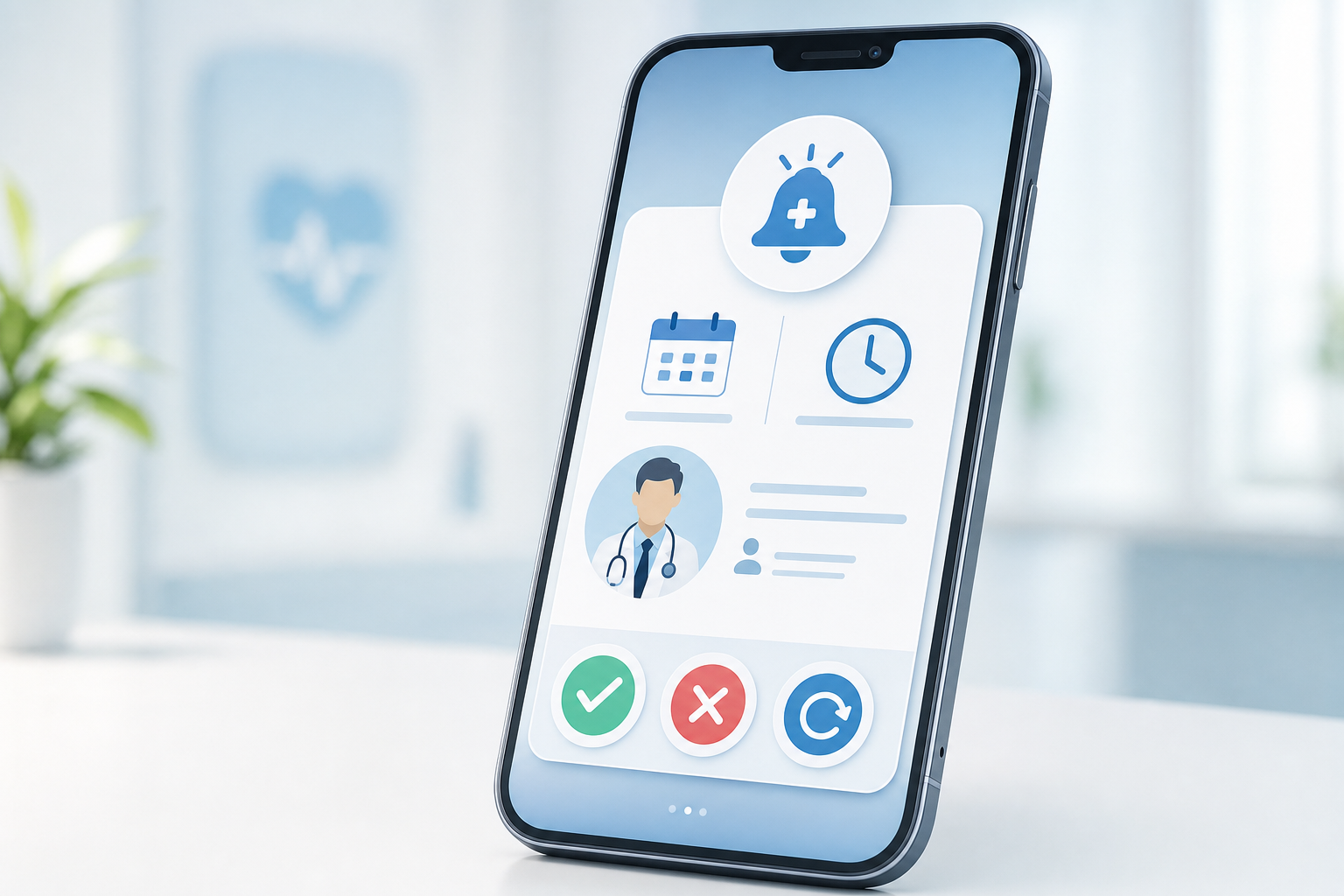
When a patient cancels, AI can immediately reach waitlisted patients to fill the slot before staff ever see the notification. That kind of real-time outreach is where manual follow-up tends to fall short: by the time a coordinator calls down a waitlist, the gap often stays empty.
Patient calls don't stop at 5 PM. Many practices lose appointment volume simply because no one is available to book after hours, and patients who can't reach someone often don't call back.
AI handles scheduling requests around the clock without adding headcount. A patient calling at 9 PM on a Sunday can book, reschedule, or confirm an appointment through the same voice experience they'd get on a Tuesday morning. No voicemail, no callback queue, no lost booking.
For practices running lean front desk teams, this coverage gap is often where appointment leakage is worst and where AI tends to show the clearest, most immediate impact.
AI scheduling handles routine, rule-based appointment booking well: standard visit types, known insurance combinations, and predictable slot availability. High call volumes with repetitive tasks are where it consistently outperforms manual front desk work.
It struggles with complexity. New patient onboarding with unusual insurance, multi-specialty coordination, or visits requiring prior auth before booking often need staff involvement. AI can flag these cases and route them, but it cannot resolve them independently.
The practical split many practices find: AI manages roughly 60% of scheduling calls end-to-end, while staff handle the exceptions that require judgment, relationship context, or clinical input.
Prosper AI handles scheduling as one piece of a broader patient access workflow, not a standalone booking tool. When a patient calls, Prosper AI's AI voice agent collects the reason for the visit, checks insurance eligibility in real time, applies your scheduling rules, and writes the appointment directly to your EHR. No staff member needs to touch the interaction.
Where most scheduling tools stop at the calendar, Prosper AI continues into the administrative work that typically follows: benefits verification, prior auth flagging, and appointment reminders. Staff handle exceptions; Prosper AI handles volume.
Prosper AI achieves 60%+ end-to-end call resolution in production, meaning the majority of scheduling calls complete without reaching the front desk.
Wave scheduling groups patients at the top of each hour to absorb variability, modified wave staggers arrivals to reduce waiting room pile-ups, and open access reserves slots for same-day demand, but all three methods still require staff to manage the booking process manually. Prosper AI automates that entire workflow, handling scheduling calls around the clock while applying your specific rules for visit types, insurance eligibility, and provider availability. Most practices see 60%+ end-to-end resolution, which means the majority of scheduling work happens without reaching the front desk. Your team handles exceptions while AI covers volume, after-hours requests, and the administrative follow-up that typically comes after an appointment is booked.
Wave scheduling books multiple patients at the start of each hour with the second half left open as a buffer, while modified wave scheduling staggers those same patients across the first 30 minutes (e.g., 9:00, 9:10, 9:20) to reduce waiting room congestion while keeping the recovery buffer. Modified wave softens the collision without losing the throughput advantage.
Yes. AI applies the same real-time availability logic to same-day slots that it does to future bookings, checking provider schedules, matching visit types, and confirming insurance eligibility during the call. Practices running hybrid models — holding some slots for chronic care follow-ups while keeping others open for same-day demand — can configure AI to enforce those rules automatically.
AI reminders let patients confirm, cancel, or reschedule directly within the message, removing the friction that turns an inconvenient appointment into a missed one. When a patient cancels, AI immediately reaches waitlisted patients to fill the slot before staff see the notification — same-day recovery that manual follow-up can't match at speed.
AI voice agents handle scheduling requests 24/7 without adding headcount — a patient calling at 9 PM on Sunday books through the same conversation they'd get Tuesday morning, with full EHR integration and eligibility checks. After-hours coverage gaps are where manual systems lose the most appointment volume and where AI shows the clearest immediate impact.
AI manages routine, rule-based booking well but struggles with complexity: new patient onboarding with unusual insurance, multi-specialty coordination, or visits requiring prior auth before scheduling. The practical split many practices find is that AI resolves roughly 60% of scheduling calls end-to-end, while staff handle exceptions requiring judgment, relationship context, or clinical input.
Discover how healthcare teams are transforming patient access with Prosper.

Best AI agents for orthopedic practices compared on prior auth, outbound payer calling, and billing. Only 1 vendor resolves 60%+ of calls end-to-end.

The 7 best AI voice agents for ophthalmology practices. Find platforms with ModMed & Nextech integrations, prior auth support, and patient automation.

Our September 2026 FQHC voice agent comparison covers Medicaid verification, payer calls, prior auth, and multilingual support across five tools.


