




Report: The $108 Billion AI Opportunity for Specialty Practices
New research quantifies four ways AI can help specialty practices reach more patients, and get paid for the care they deliver—with an annual opportuni

Dealing with health insurance can be a major headache for any medical practice. The constant cycle of checking patient coverage, sitting on hold with payers, and chasing down claim denials eats up valuable staff time and can lead to serious revenue leakage. For years, this manual, repetitive work was just a necessary evil. But today, technology offers a better way. This guide explores the world of automating patient eligibility verification, breaking down the technologies, benefits, and best practices that can transform your revenue cycle.
Before diving into the technology, let’s look at why moving away from manual checks is so critical. The front end of the revenue cycle sets the stage for everything that follows, and getting it right from the start prevents costly problems down the line.
Claim denials are a massive drain on resources. Shockingly, eligibility and registration errors are a top cause, often accounting for 24.33% of all claim denials in 2023. These aren’t complex medical coding issues; they are simple, avoidable mistakes like a typo in a policy number, an inactive policy, or a service that isn’t covered.
These denials are not just an inconvenience. By catching these issues before a patient is even seen, automating patient eligibility verification can slash denial rates. One analysis found that using automated tools reduced claim denials by approximately 20%–30% for providers. For a deeper dive into fixing downstream denials, see our “AI-automated claims management guide.”
The manual verification process is incredibly inefficient. A staff member might spend 13 minutes on average on the phone or a payer portal for a single patient. Automation can shrink that task to about four minutes on average. For a practice seeing 100 patients a day, that translates to over 18 hours of staff time saved every single day.
The financial impact is just as impressive. Studies show that switching from manual to electronic verification saves about $8.64 per transaction. Another estimate suggests automation saves $3.60 per eligibility and benefit verification transaction for providers (switching from manual to electronic). For a mid sized provider, these savings can add up to valued at greater than $30K / year. This allows you to reallocate your talented staff from mind numbing data entry to high value, patient facing work.
Automating patient eligibility verification isn’t a single solution but a collection of powerful technologies working together. Understanding these components helps you choose the right approach for your practice.
Real time eligibility verification is the gold standard. It uses a direct electronic connection to a payer’s system to get an answer on coverage in seconds. This is perfect for the point of service, like when a patient is scheduling an appointment or checking in. It stops revenue leakage by confirming coverage instantly.
For payers without these direct connections, Payer Portal and IVR Automation comes into play. Many practices have staff accessing seven or more different payer websites each week. Instead of having a human click through these portals, Robotic Process Automation (RPA) uses software “bots” to log in, enter patient data, and retrieve the information automatically. These bots can achieve a cycle time reduction of 35–50% and work around the clock.
But what about payers where the best information is only available over the phone? This is where a “Voice AI Agent for eligibility verification” becomes invaluable. These are smart, AI driven assistants that can call insurance companies, navigate their phone menus (IVRs), wait on hold, and have a natural conversation with a human representative to confirm benefits. Platforms like Prosper AI offer specialized voice agents that can capture up to 60 data points with 99% accuracy in under two hours, often at half the cost of manual calling.
Modern automation is more than just scripts; it’s powered by sophisticated AI that can understand and interpret complex information.
Medical Language Understanding: General speech recognition struggles with healthcare terms, easily confusing “hypertension” with “hypotension”. AI models trained on clinical data achieved 98% accuracy for detecting pulmonary nodules >6 mm in CT reports using a clinical NER model, ensuring critical details aren’t lost in translation.
ASR, STT, and TTS: These are the building blocks of voice AI. Automatic Speech Recognition (ASR), or Speech to Text (STT), converts spoken words into text. Text to Speech (TTS) creates a natural sounding voice for the AI to speak. Together, they allow an AI agent to have a seamless conversation.
LLMs and RAG: Large Language Models (LLMs) combined with Retrieval Augmented Generation (RAG) are a cutting edge approach. This technology allows an AI to read and understand dense payer policy documents. An assistant using this technology was able to answer policy questions with 94% factual accuracy. This helps answer tricky questions about specific coverage rules on demand.
A successful strategy for automating patient eligibility verification requires a holistic approach that integrates with your existing workflows and prioritizes accuracy and security — for examples of where this fits across the revenue cycle, explore our “use cases.”
The entire process hinges on clean data. A single wrong digit in a policy number can lead to a denial. Automation helps by eliminating manual re-keying errors.
This is why “EHR and Practice Management Integration” is crucial. A truly automated system should pull patient information directly from your EHR, run the verification, and then write the results (like coverage status, copay amounts, and authorization numbers) back into the patient’s record automatically. This creates a single source of truth and saves staff from juggling multiple systems. Leading solutions like Prosper AI offer integrations with over 80 EHR and practice management platforms, making this seamless workflow a reality. If you’re looking to eliminate data silos, you can schedule a demo to see how integrated automation works.
Handling patient information means HIPAA Compliance and a Business Associate Agreement (BAA) are non negotiable. For a practical checklist, see our “HIPAA + EHR integration guide.” Any vendor you work with must have a signed BAA, contractually obligating them to protect patient data. The penalties for violations are severe, and the average cost of a healthcare data breach has reached over $10 million. Always partner with vendors who prioritize security with certifications like SOC 2 Type II.
Finally, smart automation includes Human in the Loop Exception Handling. No system is perfect. When an AI agent encounters a situation it can’t resolve, like a confusing response from a payer, it should flag the case and escalate it to a human expert for review. This hybrid approach combines the speed of automation with the critical thinking of your experienced staff, ensuring nothing falls through the cracks.
Ultimately, automating patient eligibility verification is about improving the human experience.
When you can provide accurate Copay and Out of Pocket Estimation upfront, you build trust and financial transparency. Nearly half of patients report being confused or surprised by their medical bills, which often leads to delayed payments. By calculating and communicating a patient’s financial responsibility before their visit, you empower them and increase the likelihood of timely payment.
This also dramatically improves the “Patient Experience with Conversational AI.” Instead of waiting on hold, patients can interact with an AI agent 24/7 to schedule appointments or ask billing questions. One provider saw an 89% reduction in abandoned calls after implementing an AI agent, as shown in our “case studies.” Patients get the answers they need instantly, and your staff are freed from the phones to provide better in person care.
This is the future of the healthcare revenue cycle: a system where technology handles the tedious work, allowing humans to focus on what matters most. By embracing tools for automating patient eligibility verification, you can build a more efficient, profitable, and patient friendly practice.
Ready to see how much time and money you could save? Contact Prosper AI to learn how their voice AI agents can streamline your front office and protect your bottom line.
The biggest benefits are financial and operational. It significantly reduces eligibility related claim denials, which are a primary source of revenue loss, and it saves a massive amount of staff time, lowering administrative costs and improving employee morale.
A “Voice AI agent,” like those from Prosper AI, calls the insurance payer on your behalf. It uses speech recognition to navigate the phone menu, waits on hold, and then has a natural conversation with the payer representative to ask for and confirm benefit details, just like a human would.
Yes, provided you partner with a compliant vendor. A reputable company will sign a Business Associate Agreement (BAA), use end to end encryption, and follow all necessary security protocols (like SOC 2 Type II certification) to protect patient data.
This varies, but modern solutions are designed for rapid deployment. A platform like Prosper AI can go live in as little as a few days for simple batch processes or about 3 weeks for full EHR integration, delivering a fast return on investment.
Yes. Advanced systems use a combination of methods. They can pull data via real time connections, use RPA to scrape web portals, and deploy voice AI to call and ask clarifying questions for complex plans or missing information, ensuring comprehensive coverage.
No, it empowers them. By offloading repetitive and time consuming tasks like phone calls and data entry, automation frees your staff to focus on more valuable and engaging work, such as providing excellent in person patient service, managing complex cases, and performing high value outreach.
Discover how healthcare teams are transforming patient access with Prosper.
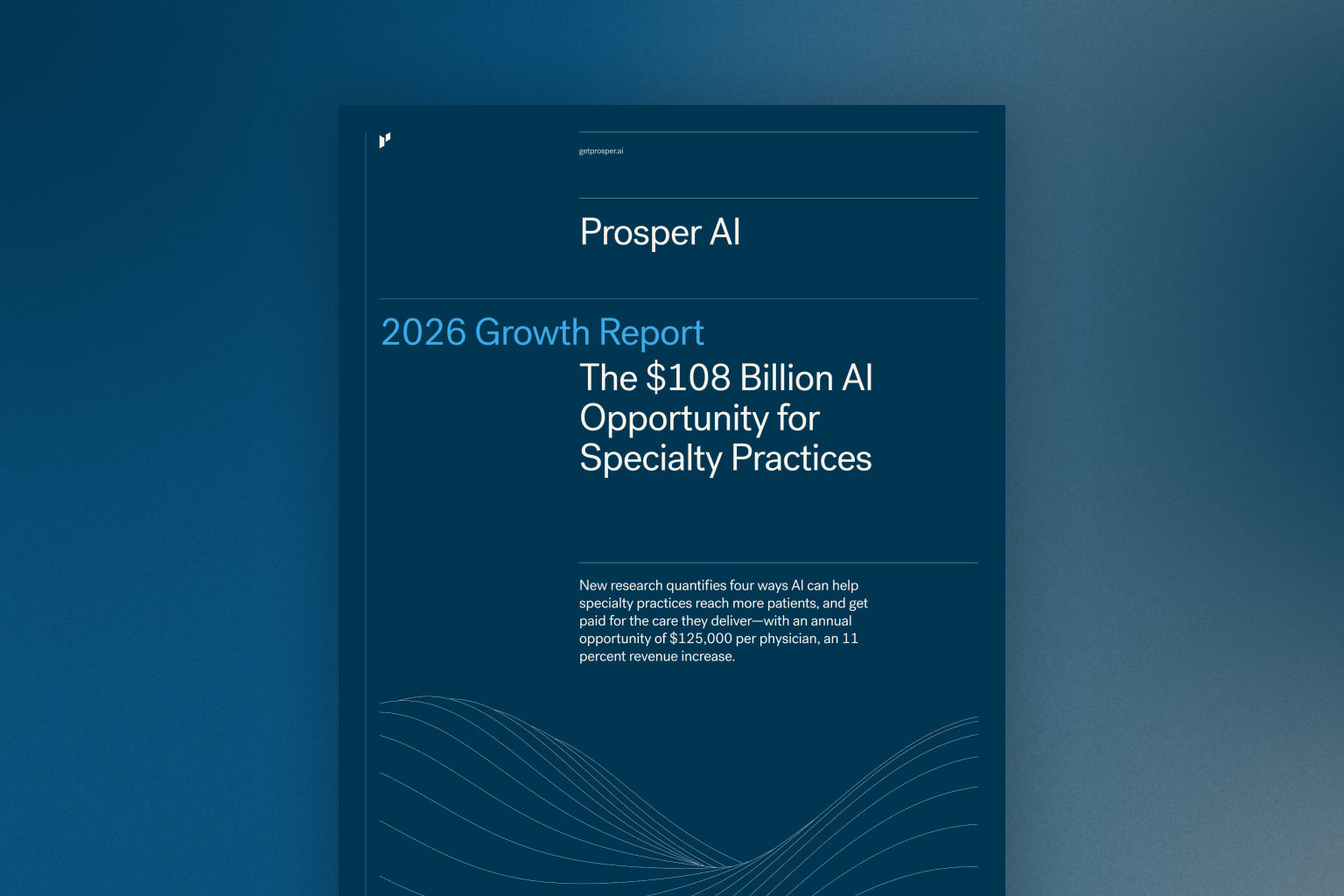
New research quantifies four ways AI can help specialty practices reach more patients, and get paid for the care they deliver—with an annual opportuni
Select your specialty and enter your number of physicians to estimate your practice's annual revenue opportunity, broken down across 4 levers.
Specialty healthcare practices leave an estimated $125K per physician uncaptured each year. See the 5 takeaways from Prosper AI’s 2026 Growth Report.


