




Report: The $108 Billion AI Opportunity for Specialty Practices
New research quantifies four ways AI can help specialty practices reach more patients, and get paid for the care they deliver—with an annual opportuni

Incorrect or outdated patient insurance information is a primary driver of claim denials, creating costly administrative rework and delaying revenue. In fact, 24% of claim denials are due to registration and eligibility. For healthcare organizations struggling with staffing shortages and tightening margins, this is a critical financial leak. Automated insurance eligibility verification is the first and most important line of defense, shifting the revenue cycle from a reactive, backend process to a proactive, front end strategy. By confirming a patient’s coverage details in real time before services are rendered, providers can drastically reduce denials, improve cash flow, and enhance the patient financial experience.
For years, front desk staff have been tasked with the repetitive, time consuming process of manual insurance verification. This typically involves navigating complex payer portals, waiting on hold for long periods, and manually transcribing benefit details, a process prone to human error. This outdated workflow creates significant bottlenecks and financial risks.
Manual verification is not just inefficient, it’s expensive. A single manual check can take on average 16 minutes (range 4 to 35 minutes) per manual eligibility and benefit verification transaction. Furthermore, the error rate for manual data entry can be as high as 15% to 20%, leading directly to claim denials that cost between $25 and $118 per claim to rework. This constant cycle of checking, waiting, and fixing contributes heavily to staff burnout and turnover.
The financial argument for switching to an automated insurance eligibility verification system is compelling. By automating this crucial first step in the revenue cycle, healthcare organizations unlock significant and measurable returns. Practices that implement automation often see their eligibility related denial rates drop, with reports showing eligibility-related denials falling from 6.8% to 2.9%.
Key performance improvements include:
Cost Reduction: Automation can lower the cost per verification from an average of $3 to $5 for a manual check to under $1. The 2023 CAQH Index estimates the medical industry can save about $10.34 per eligibility and benefit verification transaction by switching from manual to fully electronic.
Increased Staff Productivity: By eliminating hours of phone calls and manual data entry, automation frees up staff to focus on higher value, patient facing tasks. Practices have reported recovering 10 to 15 hours of staff time per week.
Faster Reimbursements: Catching eligibility issues upfront leads to a higher clean claim rate, which accelerates payment cycles and improves cash flow. Days in A/R can improve dramatically, dropping from 45 to 26 days with accurate, automated verification.
Impressive ROI: The combined savings in labor and reduced denial rework costs lead to a rapid return on investment, with many providers seeing a full ROI within a few months.
Platforms like Prosper AI are designed to deliver these outcomes by using advanced AI to handle complex healthcare conversations, ensuring verifications are not only automated but also highly accurate.
When evaluating solutions, it’s important to look beyond basic checks. A robust automated insurance eligibility verification platform should offer a suite of capabilities that address the realities of modern healthcare.
Real Time and Batch Processing: The system should be able to perform instant checks for walk in patients or last minute appointments, as well as process large batches of scheduled appointments 24 to 48 hours in advance.
Comprehensive Benefit Details: Look for a solution that pulls detailed information, not just active or inactive status. This includes specifics on copays, deductibles, coinsurance, out of pocket maximums, and benefit limitations.
Seamless EHR and PM Integration: The tool must integrate with your existing Electronic Health Record (EHR) or Practice Management (PM) system to write verified data directly into patient records, eliminating manual entry.
Exception Handling Workflows: No system is perfect. A good platform will flag accounts that require manual review and provide clear reasons, such as “coverage terminated” or “coordination of benefits needed.”
Voice AI for Complex Cases: Many verifications still require a phone call when payer portals fail. Modern platforms increasingly use AI voice agents to call payers, navigate IVRs, and get the necessary information without human intervention.
Choosing the right partner for automated insurance eligibility verification requires careful consideration. Use this checklist to guide your evaluation process.
Does the vendor have proven, native integrations with your specific EHR or PM system (e.g., Epic, Cerner, athenahealth)?
How long does a typical implementation take? Can you go live in weeks, not months?
Is the implementation process managed by the vendor, and is support readily available?
What is the vendor’s guaranteed accuracy rate? Look for SLAs of 99% or higher.
How quickly can the system return verification results? Automation should deliver results in seconds, not minutes.
Does the solution handle the full scope of front end RCM tasks, including prior authorization and patient scheduling, or is it a single point solution?
Is the platform fully HIPAA compliant, and will the vendor sign a Business Associate Agreement (BAA)?
Does the vendor hold third party security certifications, such as SOC 2 Type II?
How is patient data protected, both in transit and at rest?
Choosing a comprehensive partner can streamline your entire patient access workflow. To see how an integrated AI platform can help, discover a solution built for the complexities of healthcare.
Navigating the complexities of payer requirements requires robust technology that can handle high volumes of data with precision. The following solutions represent the most effective automated tools currently available, chosen for their ability to minimize administrative burdens and accelerate the revenue cycle. Implementing these platforms allows healthcare facilities to confirm patient benefits instantly, reducing the risk of costly billing errors.
Prosper AI’s Alex tackles the eligibility blind spot: payer phone calls. By navigating IVRs and speaking with reps, it pulls deep, nuanced benefits when portals or 270/271 are incomplete. Built for U.S. health systems, specialty practices, and RCM firms, Alex slots into scheduling and pre-registration to ensure financial clearance before service and then writes structured results back to your EHR/PM.
Capabilities at a glance
End-to-end phone/IVR automation with up to 60 datapoints (copays, deductibles, accumulators, visit limits).
Real-time and batch verification with structured write-back to EHR/PM.
Complements EDI: triggers payer calls when electronic responses lack depth.
Integrates with 80+ platforms (Epic, athenahealth, Cerner, MEDITECH).
AI-driven QA: transcript scoring, exception routing; targets 99% accuracy.
Automated, searchable audit trails for every interaction.
Measured impact
Upfront precision reduces eligibility-related denials.
Security, compliance, deployment
HIPAA/BAA, SOC 2 Type II, GDPR; AES‑256 encryption.
0‑day LLM data retention; extensive audit logging.
Cloud or on‑prem; SSO (Okta/Azure); 99.99% uptime.
Waystar centralizes eligibility and verified benefits across the patient journey, returning normalized details and alerts that prevent downstream denials. Designed for mid-to-enterprise health systems, IDNs, and multi-site specialty groups, it embeds natively in EHR/PM workflows to drive real-time checks and scheduled batches without disrupting front-desk or pre-reg teams.
Capabilities at a glance
Real-time and batch eligibility via ANSI X12 270/271.
Advanced coverage detection reveals hidden primary/secondary insurance.
1,700+ payer connections with smart failover routing.
Deep benefit depth: plan-code validation, copays, deductibles, accumulators.
Native Epic, eClinicalWorks, HST integrations with automated write-back.
Rules-driven queues and dashboards to preempt denials.
Measured impact
Security, compliance, deployment
HITRUST CSF, SOC 2 Type II, PCI-DSS; HIPAA/BAA.
Encryption and granular user audit logs.
Scalable multi-tenant cloud with unified SSO.
Experian Health streamlines eligibility with real-time and batch 270/271, enriching responses to flag bad plan codes and missing MBIs before they cause denials. Tailored for mid-to-enterprise health systems and high-volume billing firms, it integrates into Epic and Oracle Health via eCare NEXT, driving exception-based workflows that protect first-pass acceptance.
Capabilities at a glance
Real-time/batch 271 enrichment: copays, deductibles, accumulators.
900+ payer connections with redundancy to reduce outages.
Automated MBI lookups and CAQH COB Smart for primacy.
Rules/queues and Bad Plan Code alerts for exception handling.
Epic, Oracle Health integrations; HL7/X12 interfaces.
Coverage Discovery add-on to surface hidden primaries/secondaries.
Measured impact
66% denial reduction; Found an average of $30 million in coverage annually.
88% financial clearance accuracy.
60+ staff-hours saved weekly; sub‑30‑second eligibility response.
Rapid ROI from accelerated go-live and denial prevention.
Security, compliance, deployment
HIPAA/BAA; HITRUST CSF and SOC 2 Type II.
SaaS with encryption in transit/at rest and audit logs.
Centralized SSO/SAML; redundant, high-availability design.
FinThrive unifies enterprise eligibility with discovery to remove portal drudgery and surface billable coverage fast. The Access Coordinator and Insurance Verifier modules pair real-time 270/271 with automated web-capture fallback, making it a strong fit for large health systems and RCM firms needing 880+ payer reach and deep EHR connectivity.
Capabilities at a glance
Real-time/batch X12 270/271 plus automated web-capture.
880+ payer connections covering 98% of insured lives.
Detailed benefits: copays, deductibles, OOP, accumulators.
Native Epic, Oracle Health, MEDITECH integrations.
Insurance Discovery to prevent self-pay misclassification.
Centralized exception worklists with AI rules and analytics.
Measured impact
50% denial reduction; clean-claim rates to 92%.
30+ staff-hours saved weekly via automation.
Millions uncovered through KLAS-recognized discovery.
Denial response times shortened by 45 days.
Security, compliance, deployment
HIPAA/BAA; SOC 2, HITRUST, EHNAC.
SaaS with SSO/SCIM and 24/7 monitoring.
Encryption at rest/transit; high-availability SLAs.
Inovalon’s Insurance Discovery zeroes in on undisclosed primaries and secondaries (including MA and Medicaid MCOs) so self-pay is correctly classified up front. Geared to mid-to-enterprise systems, SNFs, and large physician groups, it activates at pre-registration and pre-bill to route claims accurately and accelerate first-pass payment.
Capabilities at a glance
Real-time/batch X12 270/271 with confidence scoring.
Deep benefit data: copays, deductibles, coinsurance, term dates.
Broad commercial connectivity plus CMS HETS.
Rules engine, exception queues, and registration dashboards.
Integrates with MEDITECH, PointClickCare, Qualifacts.
API-first SaaS with SFTP, HL7/FHIR, and SSO.
Measured impact
39.7% average hit rate on “uninsured” accounts.
99%+ first-pass clean-claim acceptance.
Saves ~8 minutes per verification vs. manual portals.
Noticeable A/R reduction via precise payer identification.
Security, compliance, deployment
HIPAA/BAA; CAQH CORE; EHNAC-accredited.
Secure U.S.-based cloud hosting.
Full transaction-level audit histories.
Formerly ABILITY, Inovalon Provider Cloud automates real-time and batch 270/271 with proactive reverification to catch coverage changes before service. It’s a strong fit for mid-to-enterprise systems, specialty groups, and post-acute teams (SNF, home health), embedding within Patient Access to eliminate phone and portal dependency.
Capabilities at a glance
Real-time/batch eligibility across Medicare, Medicaid, and 400+ commercial payers.
Detailed benefits: copays, deductibles, plan-level accumulators.
Automated weekly reverification (e.g., MA changes) with alerts.
Configurable worklists, exception queues, and performance dashboards.
EHR/PM integrations (MEDITECH, Qualifacts) with SSO.
Measured impact
99% first-pass acceptance and 99%+ clean-claim lift.
~12 minutes saved per verification vs. manual checks.
Material A/R and denial reductions via front-end precision.
Security, compliance, deployment
HIPAA/BAA; CAQH CORE; EHNAC-accredited.
U.S.-hosted cloud SaaS with federated SSO.
Comprehensive audit trails for PHI compliance.
Optum Coverage Insight applies analytics-driven discovery to close coverage gaps on self-pay and underinsured accounts. Built for enterprise health systems and multi-specialty groups, it activates in pre-reg and back-end A/R to surface primaries/secondaries when standard eligibility falls short, feeding normalized results right into the EHR.
Capabilities at a glance
API/batch-triggered discovery for missing/undisclosed coverage.
Real-time/batch X12 270/271 with normalized JSON benefits.
4,000+ payer connections via Optum’s network.
Suppression logic to minimize PHI risk on non-billable/high-risk profiles.
Epic-compatible write-back; rules, dashboards, and full audit trails.
Measured impact
Typical 24-hour turnaround for discovered coverage.
~$800M in annual patient balances cleared via discovery.
97.5%+ first-pass payment rates with in-stream edits.
~40% profile suppression to reduce manual review.
Security, compliance, deployment
HIPAA/BAA; SOC 2 and HITRUST attestations.
OAuth2/JWT; TLS encryption.
Cloud-native with 24/7 support and federated SSO.
Availity, the payer-backed clearinghouse and portal, powers high-uptime real-time eligibility across an expansive payer network, especially Blues, while embedding seamlessly into scheduling and pre-reg. It’s a pragmatic choice for mid-to-enterprise health systems and RCM teams seeking dependable 270/271 automation with modern APIs.
Capabilities at a glance
Real-time/batch 270/271 with copays, deductibles, accumulators.
Extensive multi-payer connectivity and Blue “Payer Spaces.”
Front-end rules/edits to expose coverage issues early.
EHR/PM integration (incl. Epic) via REST APIs, SFTP, FHIR.
Unified portal access with SSO and comprehensive audit trails.
Measured impact
Clean-claim lift from 96.5% to 98% within days.
35+ weekly staff-hours saved via improved RTE.
96% RTE payer connectivity, well above benchmarks.
~$432K annual savings documented at enterprise scale.
Security, compliance, deployment
HITRUST CSF; HIPAA/BAA; EHNAC and CAQH CORE alignment.
Cloud SaaS with mandatory 2-step auth and SSO.
High-uptime SLAs with public incident status.
A successful transition to automated insurance eligibility verification involves more than just flipping a switch. Following best practices ensures a smooth rollout and maximum ROI.
Map Your Current Workflows: Before you begin, document every step of your current verification process. Identify who is responsible for what, where bottlenecks occur, and how exceptions are currently handled. This map will serve as your baseline for measuring improvement.
Start with a Pilot Program: Rather than a full, organization wide launch, start with a single department or specialty. This allows you to test the new system in a controlled environment, work out any kinks in the workflow, and build a success story to encourage broader adoption. See how an OB/GYN group automated scheduling calls for a real-world pilot example.
Train Your Team: Automation changes roles. Train your staff on the new software, focusing on how to manage the exception queue and how their freed up time will be redirected to more impactful patient engagement tasks.
Set and Monitor KPIs: Establish clear metrics for success before you go live. Key performance indicators should include denial rate for eligibility, cost per verification, staff time spent on verification, and clean claim rate. Monitor these KPIs closely to quantify the impact of your new tool.
The field of automated insurance eligibility verification is constantly evolving. Looking ahead, several key trends are set to further transform the revenue cycle.
Deeper AI Integration: Artificial intelligence will move beyond simple data retrieval to predictive analytics. Future systems will be able to predict which patients are likely to have coverage changes based on historical data, allowing for even more proactive outreach.
Voice AI as Standard: Voice AI agents that can call payers will become a standard feature, not a novelty. As these agents become more sophisticated, they will handle not just routine verifications but also complex prior authorization and denial follow up calls, a core capability of platforms like Prosper AI.
Greater Transparency for Patients: Automation will increasingly power patient facing tools that provide clear, upfront estimates of their financial responsibility. This improves patient satisfaction and increases the likelihood of collecting payments at the time of service.
Manual insurance verification is an unsustainable model for modern healthcare. It drains resources, frustrates staff, and directly contributes to lost revenue through preventable claim denials. Adopting an automated insurance eligibility verification solution is a foundational step toward building a resilient and efficient revenue cycle. By reducing errors, accelerating payments, and empowering staff to focus on patient care, automation delivers a clear and rapid return on investment.
Ready to stop revenue leakage and empower your team? Get started with Prosper AI to see a demo and implementation timeline.
Automated insurance eligibility verification is a process that uses software to electronically check a patient’s insurance coverage, benefits, and financial responsibility in real time with the payer. This replaces the slow and error prone manual process of making phone calls or logging into multiple online payer portals.
A significant portion of claim denials are caused by incorrect or expired insurance information, services not being covered, or lack of pre authorization. By verifying this information automatically before a patient is seen, providers can resolve issues upfront, ensuring that submitted claims are accurate and meet payer requirements, which significantly reduces the denial rate.
Most healthcare organizations see a positive ROI very quickly. The combination of reduced labor costs, lower denial rework expenses, and accelerated cash flow means the system often pays for itself within a few months. Some practices report achieving full ROI in as little as within 30 to 60 days after deployment.
Yes, modern automated insurance eligibility verification systems are designed to parse detailed benefit information from thousands of commercial and government payers. They can differentiate between medical and pharmacy benefits, identify high deductible plans, and specify details about copays, coinsurance, and annual maximums.
Reputable vendors in the healthcare space build their platforms with security as a top priority. Look for solutions that are explicitly HIPAA compliant, offer a BAA, and have certifications like SOC 2 Type II to ensure patient data is handled securely.
Portal automation uses bots to log into payer websites and scrape information. This can be effective but often fails when portals change or when complex verification requires a conversation. A voice AI solution, like the agents offered by Prosper AI, can actually place phone calls to payers, navigate phone menus, and speak with human representatives to get information that isn’t available online, offering a more robust and resilient approach.
Discover how healthcare teams are transforming patient access with Prosper.
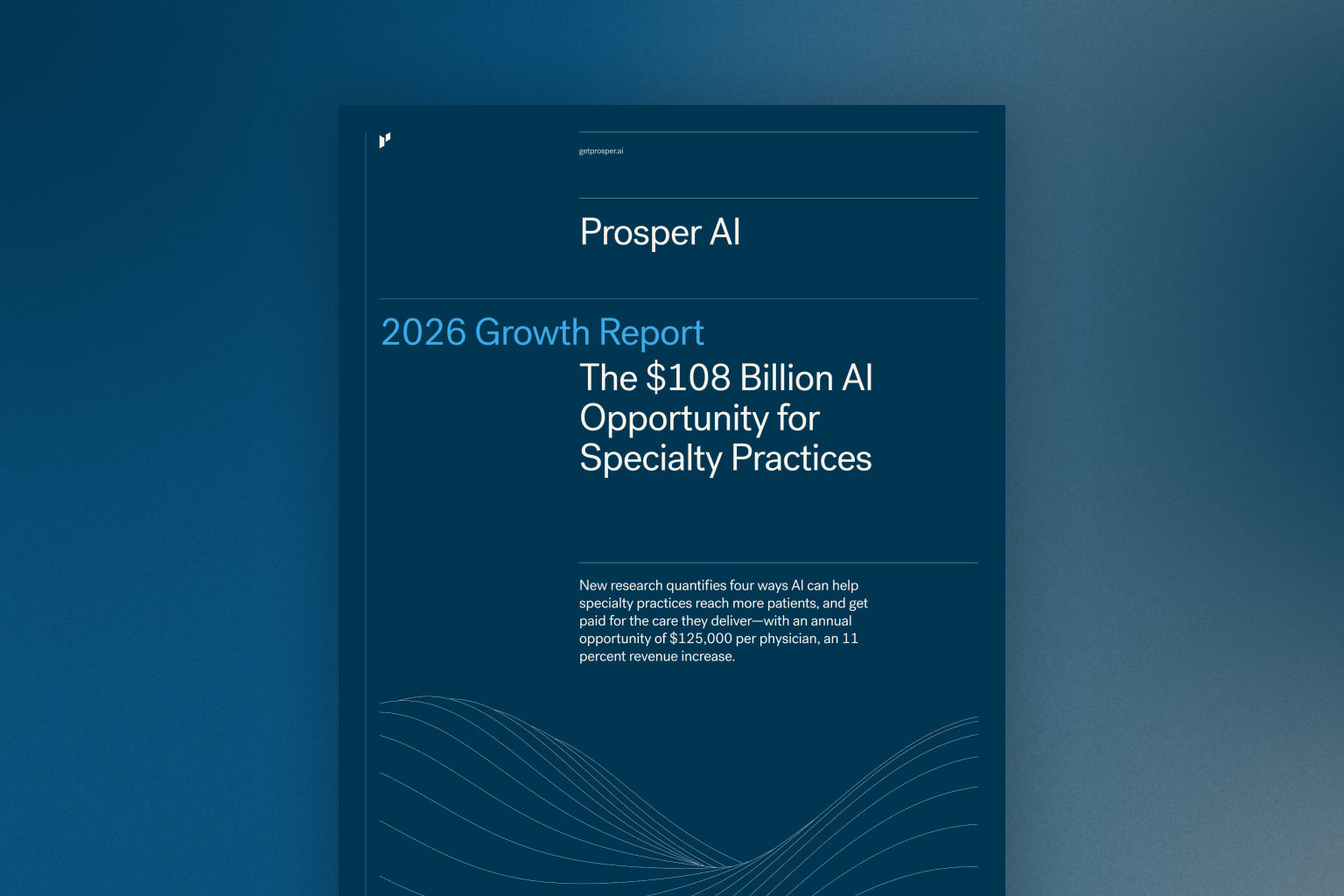
New research quantifies four ways AI can help specialty practices reach more patients, and get paid for the care they deliver—with an annual opportuni
Select your specialty and enter your number of physicians to estimate your practice's annual revenue opportunity, broken down across 4 levers.
Specialty healthcare practices leave an estimated $125K per physician uncaptured each year. See the 5 takeaways from Prosper AI’s 2026 Growth Report.


