




Best Voice AI for Gastroenterology Practices: 4 Options Compared (2026)
Compare 4 voice AI vendors for GI practices on colonoscopy scheduling, benefits verification, and prior auth calls. See which ones stop at booking.

Choosing an AI scribe or assistant is not just about features. It is about risk. If your team is asking is heidi ai hipaa compliant, the short answer is yes, according to its public statements and willingness to sign a Business Associate Agreement (BAA). However, the full answer affects your legal exposure, patient trust, and the speed of your rollout. Below is a quick, practical guide to what HIPAA compliance really requires, how to check a vendor, and where Heidi AI’s own public statements fit. This will help you decide faster with fewer surprises.
HIPAA applies when technology creates, receives, maintains, or transmits protected health information. Medical scribes and AI documentation tools typically act as a business associate, which triggers contract and safeguard requirements under the Privacy Rule and Security Rule. A Business Associate Agreement is required by 45 CFR 164.504(e), and it must limit use of PHI, require safeguards, and mandate breach reporting. (hhs.gov) For a plain‑English walkthrough of BAAs and safeguards, see our HIPAA‑compliant AI guide for healthcare.
Vendors must run a risk analysis, then implement administrative, physical, and technical safeguards. The Security Rule lists required risk analysis at 45 CFR 164.308(a)(1)(ii)(A) and technical controls like audit controls and access control at 45 CFR 164.312. Encryption is currently addressable, which means you must encrypt or document an equivalent control based on risk, under 45 CFR 164.312(a)(2)(iv) and 164.312(e)(2)(ii). (law.cornell.edu)
There is no official HIPAA certification. HHS confirms business associates cannot self certify and covered entities must rely on contracts and due diligence. SOC 2 and ISO are strong signals but are not substitutes for HIPAA obligations. (hhs.gov)
So when stakeholders ask is heidi ai hipaa compliant the real question is whether the company will sign a BAA, has documented safeguards, and can prove ongoing compliance with audits and logs.
Use this short checklist when you evaluate any AI scribe or assistant, and apply it to Heather AI specifically when deciding is heidi ai hipaa compliant for your use case.
What Heidi AI publicly claims today
If you want a voice AI platform built for patient access and RCM, compare any scribe with a healthcare native option like Prosper AI, which offers HIPAA compliance with BAA, SOC 2 Type II, encryption in transit and at rest, SSO, zero day LLM retention, and enterprise onboarding. See details in our HIPAA‑compliant AI assistant buyer’s guide, then benchmark your needs against that baseline. Prosper AI for healthcare voice automation. (getprosper.ai)
Building on the security basics above, this section distills the three most important checkpoints for evaluating Heidi AI’s HIPAA posture: BAA availability, PHI data flows and storage, and the shared responsibilities between vendor and practice. We’re grouping Heidi Health’s AI Clinical Assistant, Freed, and NoteMD together because teams often compare these clinical documentation tools side by side, and they face similar compliance criteria that make a practical, apples-to-apples review possible.
Heidi Health’s AI Clinical Assistant tackles documentation, one of clinicians’ biggest pain points, by listening to the visit and drafting high-quality notes so providers can focus on patients, not keyboards. For teams asking whether Heidi fits HIPAA expectations, its security posture is built for regulated care environments and enterprise deployment.

Quick take: HIPAA‑compliant scribe with BAA, encryption end‑to‑end, regional hosting, and ISO 27001/SOC 2 Type II attestation.
What it does: Heidi Health is a clinical AI scribe that captures encounters and generates notes and summaries, sharply reducing after‑hours charting burden.
HIPAA status & proof: HIPAA‑compliant with a signed BAA; PHI is encrypted in transit and at rest; offers regional hosting; holds ISO‑27001 and SOC 2 Type II attestations; audio is disabled; retention is configurable.
Best fit & integrations: A strong match for ambulatory clinics, multi‑specialty groups, and health systems; cloud‑based; integrates with Athenahealth, Epic via SMART on FHIR, and PracticeQ.
Example workflow & measurable impact: Primary care clinicians run Heidi during visits and finalize notes in the EHR, saving about two hours per day and opening capacity for two additional patients daily.
Freed brings ambient clinical listening to the point of care, turning conversations into structured EHR notes with minimal clicks. It’s designed to ease documentation overhead while meeting the security standards expected by growing outpatient organizations.

Quick take: HIPAA‑compliant, SOC 2 Type II, Azure with BAA, encryption end‑to‑end, and prompt deletion of recordings.
What it does: A clinical ambient AI scribe that captures audio and generates structured EHR notes with one click, reducing documentation burden.
HIPAA status & proof: HIPAA compliant and SOC 2 Type II certified; encrypts PHI in transit and at rest; hosted on Microsoft Azure with BAA; promptly deletes recordings.
Best fit & integrations: Ideal for midsize outpatient and behavioral clinics; SaaS delivery with a Chrome extension; integrates with EHRs including athenahealth and others.
Example workflow & measurable impact: Multispecialty clinicians record visits, auto‑draft notes, and push same‑day entries, cutting signature and billing lag from 21 days to just three.
NoteMD focuses on fast, accurate clinical documentation for individual providers and small‑to‑mid practices, offering a lightweight way to record, transcribe, and draft SOAP notes without heavy EHR build.
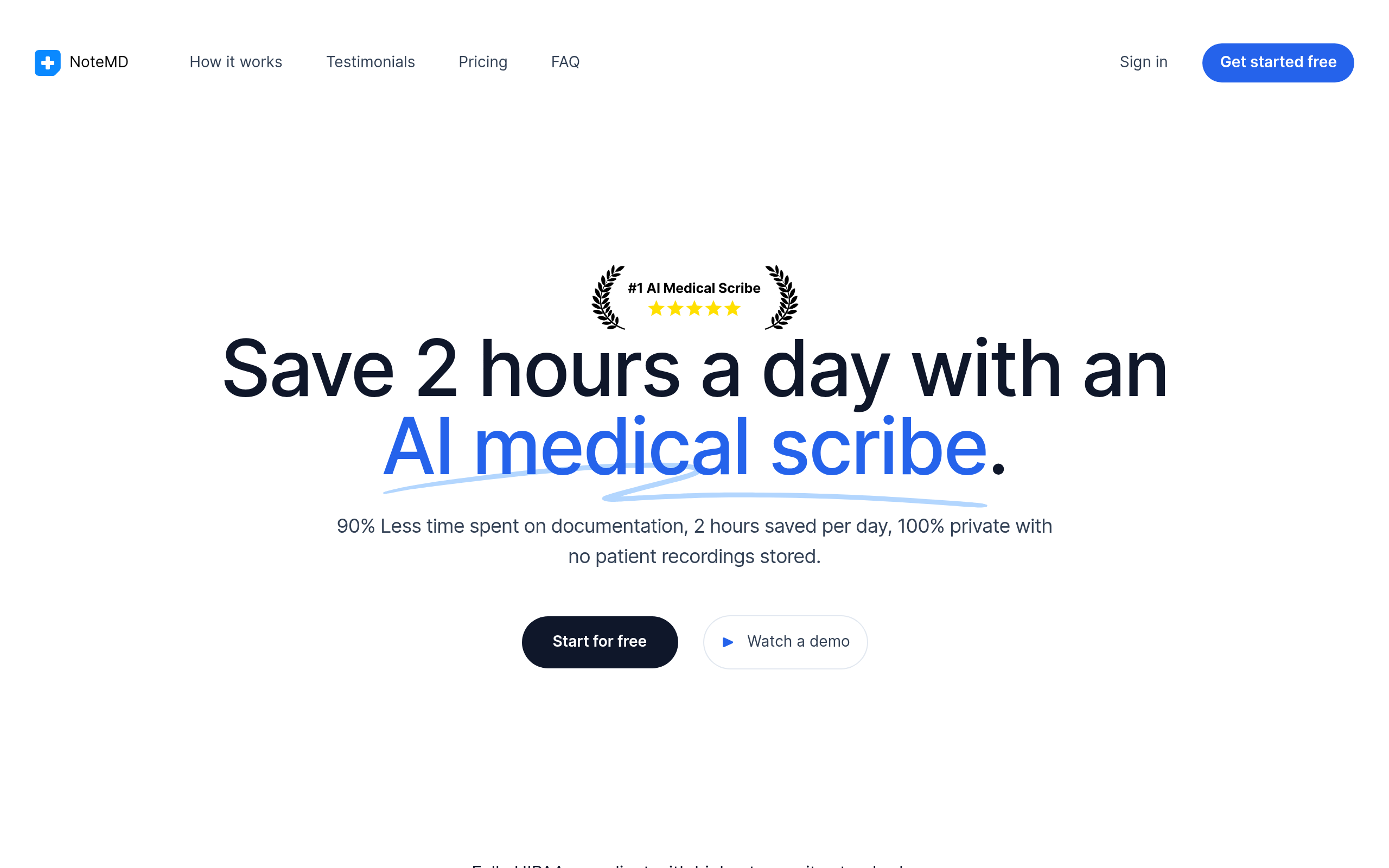
Quick take: Markets as HIPAA‑compliant with a BAA (updated Jan 30, 2024), encryption at rest/in transit, and user‑controlled retention; recordings aren’t persistently stored.
What it does: A clinical AI medical scribe that records encounters, transcribes them, and drafts SOAP notes, accelerating documentation and easing burnout.
HIPAA status & proof: Markets as HIPAA‑compliant; provides a BAA (updated January 30, 2024); encrypts PHI at rest and in transit; supports user‑controlled deletion/retention; recordings aren’t persistently stored.
Best fit & integrations: Suited to individual clinicians and small‑to‑mid practices using a cloud app; EHR‑agnostic outputs that paste or import across systems.
Example workflow & measurable impact: In clinic, the provider taps Start Visit; NoteMD records, transcribes, and drafts a SOAP note for review/import, reclaiming roughly two hours daily and reducing documentation time by up to 90%.
Regulatory risk, OCR penalties scale per violation and are adjusted for inflation. The current ranges used by OCR show potential maximums up to about 2.13 million dollars per year for the highest tier, and caps under enforcement discretion for lower tiers, which still add up quickly in multi record breaches. (hipaajournal.com)
Financial risk, healthcare remains the costliest industry for data breaches. IBM’s 2025 report shows an average cost of about 7.42 million dollars per incident in healthcare, the highest among verticals for the 14th consecutive year. (techtarget.com)
Operational risk, the Change Healthcare incident affected over 100 million people and disrupted claims, billing, and prescriptions across the United States, which shows why vendor security hygiene, including multi factor access and robust segmentation, matters before production use. (theverge.com)
Policy risk, HHS proposed updates in 2025 would make encryption and multi factor authentication mandatory under the Security Rule, tightening expectations on regulated entities and their vendors. If finalized, controls move from addressable to required which raises the bar for every AI tool. (reuters.com)
These realities sharpen the compliance question. When you evaluate is heidi ai hipaa compliant you are assessing your own exposure.
If your scope includes patient calls, payer calls, and RCM workflows, consider a platform that is HIPAA ready out of the box for both patient access and back office tasks. Talk with Prosper AI about HIPAA, BAAs, on premise options, and EHR integrations you already use. (getprosper.ai)
Here is a simple path your compliance and IT teams can run in a few days.
This approach gives you an evidence trail and a clear yes or no to the question, is heidi ai hipaa compliant for your risk profile.
If your team must answer is heidi ai hipaa compliant start with the fundamentals. HHS requires a BAA, risk analysis, and safeguards. Heidi publicly says it is HIPAA compliant, will sign BAAs, runs risk analyses, applies access controls, stores US data for US users, and does not retain audio, with SOC 2 Type 2 and ISO 27001 as supporting attestations. Validate each claim with artifacts, a sandbox test, and a signed BAA that matches your workflows and data flows. Then decide based on your risk tolerance and timeline. If you want a healthcare built alternative for phone based patient access and RCM, explore Prosper AI for HIPAA, SOC 2 Type II, BAA, encryption, and fast enterprise deployment. (hhs.gov) For a real‑world scheduling deployment, see our GI group case study.
Is Heidi AI HIPAA compliant
Heidi states that it is HIPAA compliant, signs BAAs, operates with safeguards, and holds SOC 2 Type 2 and ISO 27001. Your organization still must execute a BAA and complete due diligence. (heidihealth.com)
What proof should I request before using Heidi with PHI
Ask for a signed BAA, risk analysis evidence, audit logging samples, and encryption details. Validate retention and deletion, especially that audio is not kept and transcripts can be removed. (hhs.gov)
Does HIPAA require encryption for AI scribes
Today, encryption is addressable under 45 CFR 164.312, which means encrypt or document a reasonable equivalent based on your risk analysis. HHS has proposed making encryption and multi factor authentication mandatory in an upcoming Security Rule update. (hhs.gov)
What happens if we use a non compliant AI with PHI
OCR can impose civil monetary penalties that scale by tier and are indexed for inflation. The financial and operational fallout from a breach is severe in healthcare, with average breach costs above seven million dollars in 2025. (hipaajournal.com)
Where does Heidi store US customer data
Heidi’s HIPAA page states locally hosted US data for US customers and lists access controls and risk analysis as part of its safeguards. (heidihealth.com)
Is there a single certification that proves HIPAA compliance
No. HHS does not certify vendors. You need a BAA plus documented safeguards and ongoing oversight. SOC 2 and ISO help but do not replace HIPAA. (hhs.gov)
If I decide against Heidi, what are HIPAA ready options for patient access and RCM phone workflows
You can evaluate healthcare native voice platforms that sign BAAs and publish security artifacts. For example, Prosper AI offers HIPAA compliance with BAA, SOC 2 Type II, encryption, SSO, and on premise options for sensitive environments. Learn more. (getprosper.ai)
If your leadership is still asking is heidi ai hipaa compliant, run the checklist above this week and make a documented decision with confidence.
Discover how healthcare teams are transforming patient access with Prosper.

Compare 4 voice AI vendors for GI practices on colonoscopy scheduling, benefits verification, and prior auth calls. See which ones stop at booking.

Compare 5 AI voice agents for ENT and allergy practices. See which handle scheduling and the payer calls for prior auth and benefits checks.

Best AI agents for orthopedic practices compared on prior auth, outbound payer calling, and billing. Only 1 vendor resolves 60%+ of calls end-to-end.


