




Report: The $108 Billion AI Opportunity for Specialty Practices
New research quantifies four ways AI can help specialty practices reach more patients, and get paid for the care they deliver—with an annual opportuni

As healthcare providers seek to overcome the administrative burdens of medical claims, the leading voice AI for medical claims support is proving to be a transformative solution. Platforms such as Prosper AI are at the forefront, automating the repetitive, time consuming tasks of calling insurance companies and allowing staff to focus on more complex denials and strategic initiatives. This technology is no longer a future concept; it’s a practical solution delivering measurable results today, reducing costs and accelerating cash flow for providers nationwide.
A HIPAA compliant voice AI platform for claims support is a specialized technology designed to automate phone based interactions with health insurance payers. Unlike generic call center bots, these platforms use AI agents specifically trained on healthcare conversations and workflows. These agents can place outbound calls to check the status of claims over 30 days old, navigate complex Interactive Voice Response (IVR) systems, wait on hold, and even converse with live payer representatives.
A truly effective platform, like Prosper AI, doesn’t just make calls. It captures structured data from the conversation, such as claim status details or reasons for denial, and writes that information directly back into your Revenue Cycle Management (RCM) or Practice Management (PM) system. The leading voice AI for medical claims support integrates seamlessly with over 80 major EHR and PM systems, including Epic, athenahealth, and Cerner. This eliminates manual data entry, reduces errors, and creates a closed loop automation system that improves efficiency from end to end.
Key capabilities include:
Automated Claims Status Checks: AI agents like “Lucy” and “Mary” can systematically work through aged claims lists.
Explanation of Benefits (EOB) Retrieval: Agents can request EOBs be sent via fax or other methods.
Intelligent Payer Navigation: The AI understands how to bypass irrelevant IVR prompts to get to the right information or department quickly.
Live Conversation Handling: Advanced agents converse with human representatives to resolve issues or gather necessary details.
When dealing with Protected Health Information (PHI) during claims follow up, security is non negotiable. Any voice AI solution must be built on a foundation of robust security and compliance protocols. The minimum requirement is HIPAA compliance, including the willingness to sign a Business Associate Agreement (BAA).
However, a leading voice AI for medical claims support goes further to protect patient and provider data. Look for solutions that hold advanced certifications like SOC 2 Type II, which validates their security controls and operational effectiveness over time.
Essential security features include:
Encryption: Data must be encrypted both in transit (while moving across networks) and at rest (while stored). Data is encrypted in transit and at rest.
Zero Day LLM Data Retention: To protect privacy, it’s critical that conversations processed by large language models are not stored indefinitely. Prosper AI has a zero day retention agreement with its partners like OpenAI.
Secure Integrations: Connections to your core systems must be secure, using methods like REST APIs, SFTP, or other encrypted channels.
Deployment Flexibility: For health systems with specific data governance policies, the option for on premise deployment provides an additional layer of control.
Ultimately, the goal is to automate processes without introducing new security risks. Choosing a vendor that prioritizes these enterprise grade security measures is essential for any healthcare organization.
Not all AI platforms are created equal, especially in the nuanced world of medical billing. When evaluating a leading voice AI for medical claims support, focus on these key areas to ensure you select a partner that can deliver real world results.
1. Healthcare Specificity and Pre built Workflows
Does the platform have AI agents already trained on claims support workflows? A provider like Prosper AI offers battle tested Blueprints for claims status and denial follow-up. This dramatically reduces implementation time from months to weeks, allowing you to see value faster. A generic AI requires extensive and costly custom development.
2. Accuracy and Quality Assurance
How does the vendor ensure the information its AI agents gather is accurate? Look for platforms with built in, AI powered Quality Assurance that reviews every single call. Prosper AI’s platform provides near real time analytics and accuracy scores, claiming a 99% accuracy rate on the data it captures from payers.
3. Integration Capabilities
The platform must connect with your existing technology stack. Ask for a list of native EHR, PM, and clearinghouse integrations. A vendor with a broad portfolio of over 80 integrations demonstrates experience working with diverse IT environments, which is a key attribute of a leading voice ai for medical claims support.
4. Measurable ROI and SLAs
The vendor should be able to provide clear metrics for success. Service Level Agreements (SLAs), such as data is returned to the customer in 24-48 hours for a Medicare Part B benefit verification, also demonstrate a commitment to performance.
5. Speed to Value
How long will it take to get started? The best platforms offer a path to go live in as little as three weeks with a full EHR integration. This agility allows your team to start reducing administrative burdens and accelerating revenue collection almost immediately.
The following selection highlights the most sophisticated platforms currently reshaping how healthcare organizations manage the complexities of billing and payer communications. These industry leaders are grouped for their specialized ability to automate high-volume claims inquiries while maintaining the rigorous security standards required for sensitive medical data.
Prosper AI brings healthcare native voice agents to the front lines of RCM, shouldering payer calls end to end (through IVRs, long holds, and live rep conversations) to resolve eligibility, prior auths, claim status, and denials with audit ready documentation. Best for: mid to large health systems and RCM providers managing heavy follow up volume.
Signature stat: 99% accuracy with <2 hour SLAs on claim follow ups.
What it handles: automated benefits verification; prior auth initiation and status; claim status checks with EOB retrieval (including fax workflows); denial follow up with detailed call notes.
Integrations: 80+ native connections (Epic, athenahealth, Cerner, MEDITECH); FHIR/HL7 APIs; telephony with Genesys, Five9, Twilio; payer portals like Availity via API or SFTP batch.
Security & deployment: HIPAA with BAA; SOC 2 Type II; AES 256 encryption; SSO; 0 day retention with OpenAI. Deploy in secure cloud or on prem; PHI processed within customer approved boundaries.
Results & time to value: 50% cost reduction; 15% lift in denial collections. Stand up batch data in 1 to 2 days; full EHR integration in ≈3 weeks.
Pricing snapshot: custom usage based tiers.
Buyer watch outs: confirm EHR write back depth (encounters, attachments, notes) and payer by payer phone coverage.
Infinitus is purpose built voice AI for payer facing work, automating the grind of eligibility checks, prior auths, claim status, EOB retrieval, appeals, and even over the phone submissions, so RCM teams can move faster with fewer manual touches. Best for: midsize to large providers, specialty pharmacies, and health systems with high outbound call volumes.
Signature stat: ~30 minutes saved per touchpoint and ~50% ROI reported.
What it handles: eligibility/benefits (150 data points per call); prior auth initiation/status; claim status and EOB retrieval; appeals follow up; over the phone submissions guided by payer rules.
Integrations: native EHR/PM (Epic, Cerner, athenahealth) via SMART on FHIR; Salesforce Health/Life Sciences Cloud; enterprise APIs; direct payer portals and clearinghouses using hybrid automation; knowledge graph guided navigation.
Security & deployment: HIPAA with BAA; SOC 2 Type II; automated PHI redaction; TLS 1.2/AES 256 encryption. Cloud based on US GCP; least privilege controls; no PHI stored in model datasets.
Results & time to value: go live in as little as 30 days with measurable labor savings on follow up.
Pricing snapshot: annual license plus usage fees.
Buyer watch outs: verify EHR write back scope and confirm coverage across 1,400+ payers for your top lines of business.
Kore.ai delivers an enterprise agent platform with a healthcare accelerator that streamlines claims and billing inquiries across voice and digital, making it ideal for organizations standardizing experiences while keeping tight control over security and integrations. Best for: mid market to large health systems and payers needing HIPAA ready, omnichannel automation.
Signature stat: 24% containment rate with reports of 468% ROI in enterprise deployments.
What it handles: member self service billing; ID card retrieval; real time claim status/EOB updates; deductible/co pay tracking; prior auth initiation/status; routing to agents for complex denials.
Integrations: Epic authentication; EDI 270/271 and 276/277 with payer portals/clearinghouses; CCaaS (Genesys Cloud CX, NICE CXone, Talkdesk, Zoom); Salesforce CRM; HL7 FHIR.
Security & deployment: HIPAA/BAA; SOC 2 Type II/ISO 27001; encryption in transit/at rest; RBAC, SSO, audit trails. Deploy as multi tenant SaaS, dedicated VPC, or on prem to meet PHI residency.
Results & time to value: phased rollouts via prebuilt accelerators shorten initial launch while allowing deeper customization over time.
Pricing snapshot: custom enterprise tiers.
Buyer watch outs: confirm EHR write back capabilities, payer EDI coverage, and “Quality AI” depth for auto scoring, analytics, and documentation of interactions.
Retell AI is a programmable voice agent platform built for enterprise operations, enabling inbound and outbound automations from eligibility checks to billing and payments, with the flexibility to design sophisticated RCM call flows. Best for: mid market provider groups, MSOs, and RCM vendors seeking a customizable stack.
Signature stat: up to 70% containment and ≈$280k in monthly collections in reported use cases.
What it handles: automated eligibility/benefits; prior auth initiation/status; claim status/EOB retrieval via IVR navigation; denial follow up with warm transfers; billing inquiries and PCI compliant payments.
Integrations: EHR/PM (Epic, eClinicalWorks, Dentrix); payer portals/clearinghouses via Keragon; telephony (Twilio, Telnyx, Five9, Talkdesk); APIs (FHIR/HL7); CRM (HubSpot, Salesforce).
Security & deployment: HIPAA/BAA; SOC 2 Type II; GDPR alignment; transcript PII redaction; end to end encryption; SSO/RBAC on enterprise plans. Cloud on AWS with options for private VPC or on prem.
Results & time to value: Week 3: Pilot deployment and optimization; containment and collections gains scale with workflow tuning.
Pricing snapshot: usage based, roughly $0.07 to $0.31 per minute.
Buyer watch outs: validate EHR write back via FHIR/HL7, map payer IVR navigation paths in advance, and plan for AI QA/monitoring to sustain accuracy.
Hyro is a healthcare native voice and chat platform trusted by leading health systems for patient access and RCM inquiries, offering fast self service for billing, coverage questions, and EOB explanations while integrating deeply with major EHRs. Best for: mid to large providers and payers, especially Epic shops, prioritizing call deflection and patient/member experience.
Signature stat: 85% abandonment reduction with an 8.8x ROAI reported.
What it handles: real time eligibility/benefits; claims status and EOB explanations; billing/registration Q&A; invoice generation; digital payment handoffs.
Integrations: deep Epic connectivity (Willow, Cheers); eClinicalWorks; Salesforce Health Cloud; telephony/CCaaS (Cisco, Avaya, Genesys, NICE CXone, Five9); payer portals/clearinghouses via REST APIs/FHIR.
Security & deployment: HIPAA with BAA; SOC 2; GDPR/CCPA alignment; encryption; SSO/RBAC. Cloud only on Azure; PHI handled by U.S. based subprocessors; Israel based maintenance/support.
Results & time to value: rapid deployments in complex environments; less than 120 days even for complex voice AI implementations.
Pricing snapshot: custom and usage based models.
Buyer watch outs: confirm Epic write back scope (e.g., Willow), check payer data source coverage, and clarify limits for denial/EOB automations versus self service.
Adopting a voice AI platform for your claims team doesn’t have to be a massive, disruptive project. A phased approach allows you to prove the concept, build internal confidence, and scale smoothly.
Phase 1: Pilot Program (Weeks 1 to 3)
The journey often begins with a focused pilot. You can start by providing the AI vendor with a simple batch file, like a spreadsheet of claims to check, and see how it works end to end. This requires minimal IT involvement and can go live in just a few days. During this phase, you can benchmark the AI agent’s performance (e.g., accuracy, speed) directly against your manual process. This creates a clear business case for a broader rollout.
Phase 2: Full Integration (Weeks 3 to 6)
Once the pilot proves successful, the next step is a full integration with your EHR or RCM system. A dedicated AI Agent Manager from the vendor should guide your team through this process. This deeper connection enables fully automated workflows where the AI can both read claim data from your system and write status updates back into it, creating a seamless, touchless process.
Phase 3: Expansion and Optimization
With the core claims status workflow automated, you can expand the use of voice AI to other areas. This might include automating prior authorization follow up or handling inbound patient billing questions. The leading voice AI for medical claims support is a platform that can grow with you, covering numerous functions across the entire revenue cycle.
To truly understand the impact of a voice AI solution, it’s crucial to track the right Key Performance Indicators (KPIs). Moving beyond anecdotal evidence to hard data will demonstrate the ROI to leadership and your team.
Key metrics to monitor include:
Cost Per Claim Follow Up: Calculate the fully burdened cost of a staff member making a claims status call versus the cost of an AI agent performing the same task.
Claim Resolution Time: Measure the average number of days it takes to get a status update or resolve a denied claim. AI can work through backlogs much faster than human teams.
Staff Productivity: Track the number of claims each RCM team member can manage. With AI handling the repetitive calls, staff can manage a larger and more complex portfolio of accounts.
Denial Rate and Appeal Success: Monitor whether faster follow up and cleaner data from AI leads to fewer initial denials and a higher success rate on appeals. Prosper AI users have reported a 15% higher collections rate on denials.
Employee Satisfaction: While harder to quantify, tracking employee turnover and conducting satisfaction surveys can show the positive impact of removing tedious, frustrating work from their daily responsibilities.
The technology behind voice AI is evolving rapidly, and its application in medical claims is set to become even more sophisticated. We are moving beyond simple status checks toward more comprehensive, conversational interactions.
One major trend is the expansion into denial management. The next generation of leading voice AI for medical claims support will not just identify a denial but will also be able to initiate the first level of pushback on a call, correcting payer errors or providing missing information in real time.
Another key area of development is proactive analytics. Instead of just processing the claims you give it, the AI will analyze payer behavior patterns to predict which claims are most likely to be denied or delayed. This will allow RCM teams to intervene earlier and prevent revenue leakage before it happens. As these technologies mature, they will become an indispensable strategic partner for healthcare finance leaders.
The challenges of modern revenue cycle management demand a new approach. Staff burnout, rising operational costs, and the sheer volume of payer phone calls are no longer sustainable problems to be managed with manual effort alone. A leading voice AI for medical claims support offers a powerful solution, automating the most time consuming aspects of claims follow up so your team can focus on high value work. By leveraging AI to navigate IVRs, wait on hold, and capture critical data, you can dramatically reduce costs, accelerate cash flow, and improve the overall financial health of your organization.
Ready to see how intelligent voice automation can transform your revenue cycle? Discover the power of a purpose built, HIPAA compliant platform. Get started with a short demo today.
A leading voice AI for medical claims support is a specialized software platform that uses artificial intelligence agents to automate phone calls to insurance companies. These agents can check claim status, retrieve EOBs, and gather denial information, then integrate that data back into a provider’s RCM system.
Advanced voice AI platforms are specifically trained to understand and navigate the phone systems of major insurance payers. They can respond to IVR prompts, recognize when they are on hold, and wait patiently for a live representative, freeing human staff from this unproductive time.
Yes, provided you choose a vendor that prioritizes security. A compliant solution will offer a Business Associate Agreement (BAA), SOC 2 Type II certification, end to end data encryption, and strict data retention policies to ensure all interactions involving PHI are secure.
Implementation times vary, but a key differentiator of a leading voice AI for medical claims support is speed to value. With pre built “Blueprints” for common workflows, providers like Prosper AI can launch a pilot in a matter of days and achieve full EHR integration in as little as three weeks.
The return on investment is typically measured in cost savings and increased collections. Healthcare providers using voice AI for claims follow up often report up to a 50% reduction in the cost per claim worked and a 15% increase in collections on denied claims.
Absolutely. A comprehensive voice AI platform can automate many phone based workflows across the revenue cycle and patient access. This includes benefits verification, prior authorization follow up, patient balance reminders, and appointment scheduling.
Discover how healthcare teams are transforming patient access with Prosper.
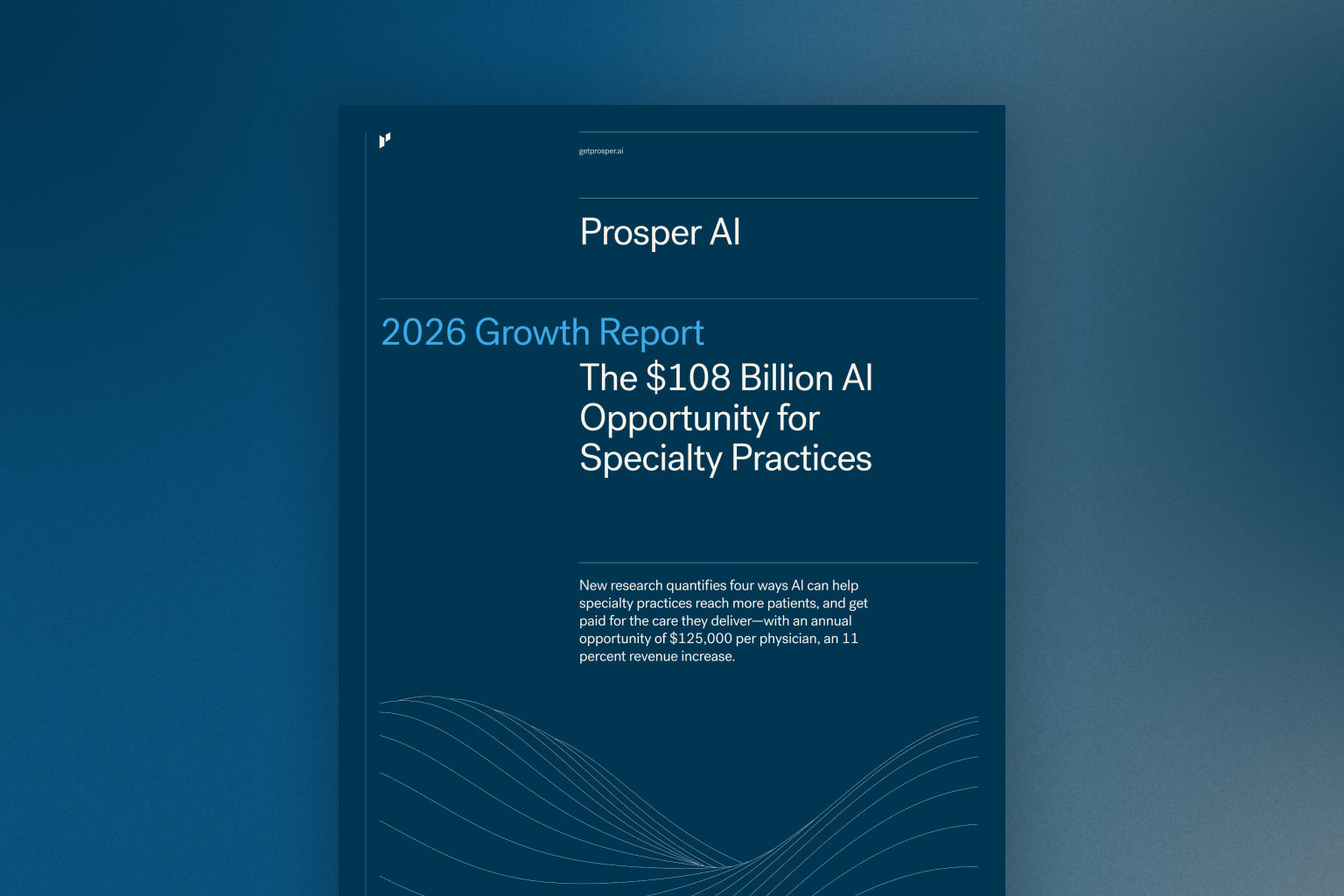
New research quantifies four ways AI can help specialty practices reach more patients, and get paid for the care they deliver—with an annual opportuni
Select your specialty and enter your number of physicians to estimate your practice's annual revenue opportunity, broken down across 4 levers.
Specialty healthcare practices leave an estimated $125K per physician uncaptured each year. See the 5 takeaways from Prosper AI’s 2026 Growth Report.


