




Report: The $108 Billion AI Opportunity for Specialty Practices
New research quantifies four ways AI can help specialty practices reach more patients, and get paid for the care they deliver—with an annual opportuni

Patient verification automation uses AI-powered software, often voice agents, to automatically call insurance payers and confirm a patient’s eligibility, benefits, and authorization requirements. This technology addresses critical healthcare challenges like staffing shortages, patient frustration, and revenue leakage caused by endless manual phone calls. It’s not just about saving time; it’s about creating a more resilient and efficient revenue cycle, ensuring patients get the care they need without delays, and freeing your staff to focus on higher value work. A robust patient verification automation strategy can dramatically reduce denials and improve the patient financial experience from the very first touchpoint.
Patient verification automation uses AI powered voice agents to perform the tasks your staff would typically handle over the phone. These AI agents can place outbound calls to insurance companies, navigate complex phone trees (IVRs), wait on hold, and even converse with live payer representatives to confirm patient benefits and eligibility.
This is fundamentally different from a traditional IVR (Interactive Voice Response) system. An IVR is a passive routing tool, presenting callers with a menu of options. Patient verification automation is an active tool. For example, an AI agent from a platform like Prosper AI can be tasked with verifying coverage for a new patient, and it will autonomously execute the entire workflow, capturing up to 60 distinct data points and writing them back into your EMR.
Effective patient verification automation isn’t a single task, it’s a series of connected workflows that protect revenue throughout the patient journey.
This is the foundation. Before a patient is even seen, an AI agent like Prosper AI’s “Alex” can call the payer to confirm active coverage, copays, deductibles, and coinsurance. This process can achieve 99% accuracy and a 50% cost reduction compared to manual calling.
Many procedures require prior authorization to be covered. AI agents can determine if a PA is needed, initiate the request by phone, and continuously follow up on the status until a determination is made. This proactive approach significantly reduces care delays and claim denials.
After a service is rendered, AI can check the status of claims over 30 days old and even push back on common payer errors, helping to accelerate cash flow and improve collections on denied claims by as much as 15%.
Handling protected health information (PHI) requires an unwavering commitment to security. When evaluating any patient verification automation solution, non negotiable compliance standards are the top priority.
Look for platforms that are:
HIPAA Compliant: The vendor must be willing to sign a Business Associate Agreement (BAA).
SOC 2 Type II Certified: This demonstrates a proven, audited commitment to enterprise grade security and data protection.
Secure by Design: The platform should feature end to end encryption for data in transit and at rest. Some providers, like Prosper AI, also offer a 0 day retention agreement with their AI partners and provide daily data backups to ensure business continuity.
Automation is only as powerful as its ability to communicate with your existing systems. A standalone tool that creates more manual data entry defeats the purpose. True patient verification automation requires deep integration with your Health Information System.
Leading platforms offer native connections to over 80 different EHR and Practice Management systems, including major vendors like Epic, athenahealth, Cerner, and NextGen. This interoperability ensures that verified eligibility data, authorization numbers, and other critical information are written directly back to the patient’s record, creating a single source of truth and eliminating human error.
The biggest challenge in calling insurance companies is the unpredictability of the conversation. Payers use different IVR menus, and their human agents have varying levels of expertise. This is where advanced conversational AI becomes critical.
The most effective AI voice agents are “battle tested” on hundreds of thousands of real world payer calls. They understand healthcare specific terminology, can navigate complex conversational flows, and know how to respond to unexpected questions from payer representatives. This is what allows them to achieve QA accuracy scores that often outperform human agents in side by side comparisons, ensuring the data you receive is reliable.
When selecting a patient verification automation partner, focus on these key criteria:
Healthcare Specialization: Is the platform built specifically for the complexities of US healthcare and payer interactions?
Deployment Speed: How quickly can you see value? typically ranges between 4-6 weeks from the start of integration to go live for a high-assurance identity proofing workflow.
Accuracy & QA: Does the vendor provide AI powered quality assurance on every single call to guarantee accuracy?
Workflow Coverage: Does it handle just benefits, or can it also automate prior authorizations and claims status checks?
Security Posture: Does it meet all your compliance needs, including HIPAA and SOC 2 Type II?
To ensure a successful rollout, start with a targeted approach.
Identify the Biggest Bottleneck: Begin with the single highest volume, most time consuming verification workflow, such as verifying benefits for your top 5 payers.
Run a Pilot: Work with your vendor to launch a pilot program. This allows you to measure the impact on a smaller scale and build internal support.
Integrate and Scale: Once you have proven the ROI, work on a full EHR integration and begin scaling the patient verification automation to other departments and workflows. A dedicated AI Agent Manager from your vendor can make this process seamless.
The impact of patient verification automation is highly measurable. Key performance indicators (KPIs) to track include:
Verification Turnaround Time: Top solutions offer a STAT request will be returned in 2 hours.
Cost Per Verification: Aim for at least a 50% reduction compared to manual workflows.
Staff Time Reclaimed: Measure the number of hours your team gets back each day to focus on patient facing activities.
Denial Rate Reduction: Track the decrease in eligibility related and authorization related claim denials.
Calculating the ROI involves combining the hard cost savings from staff time with the increased revenue from fewer denials and fuller appointment schedules.
Understanding the specific capabilities of market-leading platforms is essential for selecting a solution that integrates seamlessly into your existing healthcare workflow. The following tools represent the industry’s most effective automation technologies, grouped together for their proven ability to eliminate manual eligibility errors while accelerating the patient intake process. By leveraging these advanced systems, practices can significantly reduce administrative overhead and ensure accurate insurance data is captured before every appointment.
Prosper AI
Prosper AI’s Alex is a phone-native voice agent built to verify eligibility and benefits by calling payers directly, then writing structured results back to your systems. It shines for health systems, RCM firms, and multi-site specialties that live on tight SLAs and need high-fidelity data capture at scale.
What it automates
Real-time eligibility and benefits verification via IVR and live-rep conversations
Payer IVR navigation and hold management for hard-to-automate plans
Captures 60+ data points (plan status, copays, deductibles, accumulators)
Prior auth determination, initiation, and status follow-ups
Claims status checks and EOB retrieval via phone or fax
Demographics capture and automated coverage confirmation
Structured write-backs of results into EHR/PM platforms
Integrations, security & deployment
80+ EHR/PM connections (Epic, athenahealth, Cerner, NextGen); CCaaS (Talkdesk, Five9)
Standards: FHIR/HL7 and X12 270/271
Security: HIPAA with BAA, SOC 2 Type II, 0-day LLM data retention
Hosting: SaaS cloud or on-prem; 99.9% uptime SLA
Alex delivers <2-hour SLAs and 99% accuracy, often cutting verification costs by 50% versus manual calling. Trusted by major health systems and Fortune 50 pharma hubs, pilots start in one to two days with ~3 weeks to full EHR integration.
Infinitus
Infinitus is a purpose-built voice AI and RPA platform that handles payer phone workflows when portals and 270/271 fall short. It’s a strong fit for health systems, specialty pharmacies, and RCM firms that need deep, audit-ready verification data and consistent throughput.
What it automates
Detailed eligibility and benefits verification (≈150 data points per call)
Full payer IVR navigation and live-rep conversations across commercial and government plans
Prior auth requirement checks, status tracking, and follow-up initiations
Claims status retrieval, appeals processing, and over-the-phone submissions
Provider network status confirmation and payer policy clarification
Prescription follow-ups: pharmacy transfers, inventory checks, savings card verification
Integrations, security & deployment
EHR write-backs for Epic, Cerner, athenahealth via SMART on FHIR; Salesforce
Standards: X12 270/271, 278, and FHIR
Security: HIPAA/BAA, SOC 2 Type II, HITRUST cloud, PHI redaction
Hosting: Cloud SaaS with enterprise APIs and a dedicated web portal
Backed by support for 1,400+ payers, Infinitus reports 10% higher accuracy and 50% ROI, with go-lives in ~30 days. Customers like Amgen and TrialCard leverage usage-based pricing layered with annual platform fees and tiered enterprise rates.
OmniMD
OmniMD’s EHR-native front-desk platform streamlines intake-to-billing with real-time eligibility and AI-assisted prior auths. It’s best for ambulatory clinics and multi-site groups seeking a unified experience spanning voice, SMS, and web portals without stitching multiple vendors together.
What it automates
Real-time insurance eligibility and benefits verification during scheduling
AI-assisted prior auth checks and status tracking
Patient demographic and insurance card capture via mobile intake
Automated referral verification and clinical data routing
24/7 inbound call handling and automated patient rescheduling
Point-of-service payment collection for copays and balances
Post-visit communications: clinical summaries and follow-up reminders
Integrations, security & deployment
Connects with TriZetto; telephony via Twilio; payments via Stripe
Standards: FHIR 4.0.1, HL7, and X12 270/271
Security: HIPAA/HITECH with full audit trails and BAA support
Deployment: SaaS on Oracle Cloud Infrastructure (OCI)
OmniMD cites 99.7% task accuracy and three to five second real-time eligibility checks. Used by practices like Walker Family Medicine, it offers usage-based or monthly subscriptions with no startup fees, making it an approachable path for clinics prioritizing deep EHR integration.
Talkie.ai
Talkie.ai is a healthcare-focused voice assistant that streamlines intake, identity checks, and scheduling. It’s a fit for outpatient practices and specialty groups prioritizing patient access and demographics capture over exhaustive, cross-payer verification via phone.
What it automates
Patient identity verification (name, DOB) through natural phone dialogue
Insurance and demographics capture via “Talkie Forms” synced to EHRs
Real-time creation of new patient charts for first-time bookings
End-to-end scheduling, rescheduling, and automated reminders
Prescription refill request handling with rule-based checks
Intelligent message intake and transcription to replace voicemail
Conversational FAQs on coverage and office policies
Integrations, security & deployment
EHRs: athenahealth, ModMed, Elation Health, eMedicalPractice
Telephony: Multi-channel voice/SMS; AWS cloud hosting
Security: HIPAA with BAA, SOC 2 Type II, AES-256 encryption
Standards: API-first with webhooks for custom connectivity
Talkie.ai reports Reduce call center operational costs by 60% with customers such as Urology Group of Southern California. Get up and running with call automation in just 2–4 months. Pricing is custom/usage-based, backed by hands-on optimization with weekly touchpoints.
Hyro
Hyro is a conversational AI platform for access centers that captures insurance and demographics across voice, web chat, and SMS while modernizing call routing and scheduling. It’s best for health systems and multi-site groups upgrading intake and engagement with EHR-integrated voice AI.
What it automates
Insurance plan details, member IDs, and demographics collection to reduce rekeying
Triggers real-time eligibility via existing EHR/clearinghouse (270/271)
High-volume call routing and IVR replacement with smart intent capture
Appointment scheduling and modifications across channels
FAQ resolution and MyChart troubleshooting to cut hold times
Proactive SMS/voice reminders for follow-up care
Integrations, security & deployment
EHR/CRM: Epic, Oracle Cerner, Meditech, athenahealth, Salesforce
Telephony: Cisco, NICE CXone, Genesys, Five9, Twilio
Standards: FHIR, HL7, X12 270/271 via clearinghouse
Security: HIPAA/BAA, SOC 2, Azure-based cloud with zero-retention options
Tampa General saw 21% more appointments and 58% shorter wait times; Inova reports an 8.8x ROAI with 50% automated appointment management. Stand-up ranges from days for basic agents to bringing Tampa General Hospital’s AI voice agent live in just three months. Enterprise pricing is custom and volume-based.
The world of patient verification automation is evolving quickly. Looking ahead, expect to see even more intelligence and proactive capabilities. AI will begin to anticipate verification needs before an appointment is even requested based on historical data and payer rules. We will also see more multi modal platforms that seamlessly blend voice, text, and portal automation for a completely hands off approach. Finally, expect deeper, real time, bidirectional integration with EHRs to become the industry standard.
Manual patient verification is no longer sustainable. The combination of rising labor costs, staffing shortages, and increasing payer complexity makes automation a necessity for survival and growth. By choosing a secure, integrated, and healthcare specialized AI platform, you can reduce administrative burden, prevent revenue leakage, and create a better experience for both your staff and your patients.
Ready to see how AI voice agents can transform your patient access and RCM workflows? Explore the possibilities at Prosper AI.
Patient verification automation is the use of AI powered software, often voice agents, to automatically call insurance companies, navigate their phone systems, and speak with representatives to confirm a patient’s eligibility, benefits, and authorization requirements.
An AI agent receives a task, typically from an integrated EHR system. It then places a call to the appropriate payer, navigates the IVR menu, waits on hold if necessary, and converses with a human agent to ask for specific benefit information. It captures this data and writes it back into the patient’s record.
Yes, leading patient verification automation platforms are designed for healthcare and are fully HIPAA compliant. They provide a Business Associate Agreement (BAA) and adhere to strict security protocols like SOC 2 Type II certification to protect patient data.
Pricing typically depends on call volume and the specific workflows being automated. It is usually priced on a per verification or per call basis, which most organizations find provides a significant ROI compared to the cost of manual labor.
Implementation times can vary. For simple batch uploads, you can go live in just a couple of days. For a full integration with an EHR or practice management system, a typical timeline is around three weeks.
Yes. The core strength of a sophisticated AI voice agent is its training on hundreds of thousands of real world calls across a vast number of national and regional payers. This allows it to handle the nuances and complexities of different plans effectively.
Discover how healthcare teams are transforming patient access with Prosper.
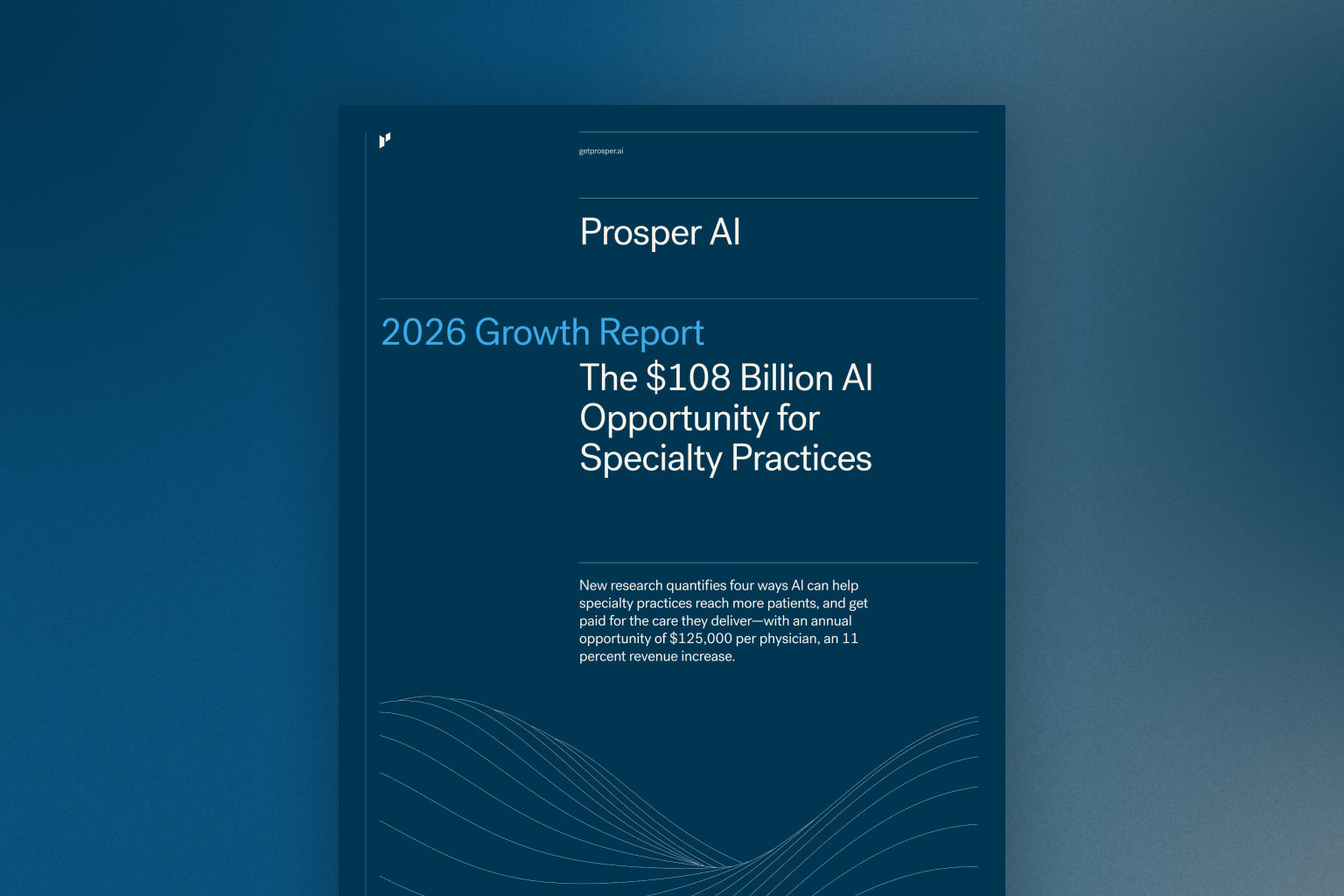
New research quantifies four ways AI can help specialty practices reach more patients, and get paid for the care they deliver—with an annual opportuni
Select your specialty and enter your number of physicians to estimate your practice's annual revenue opportunity, broken down across 4 levers.
Specialty healthcare practices leave an estimated $125K per physician uncaptured each year. See the 5 takeaways from Prosper AI’s 2026 Growth Report.


