




Best Voice AI for Gastroenterology Practices: 4 Options Compared (2026)
Compare 4 voice AI vendors for GI practices on colonoscopy scheduling, benefits verification, and prior auth calls. See which ones stop at booking.

Healthcare call centers are the front door to patient care, but they often face immense pressure. Between staffing shortages, high call volumes, and rising patient expectations, it’s tough to deliver a consistently great experience. The key to transforming your call center from a point of friction into a strategic asset lies in adopting a modern approach. In short, the best practices involve combining empathetic, patient-centered communication with powerful technology, optimized workflows, and a strong commitment to quality and compliance. This guide covers the essential healthcare call center best practices that boost efficiency, improve patient satisfaction, and strengthen your bottom line.
Before any technology or process, the most critical healthcare call center best practices are rooted in how you communicate. It’s about making every patient feel heard, respected, and cared for.
Patient centered communication is more than just being polite; it’s about actively listening to understand a patient’s needs, concerns, and emotions. Empathy is the ability to connect with those feelings and respond with compassion. When a patient calls, they might be anxious, in pain, or confused about a bill. Responding with a warm, understanding tone can make all the difference.
This isn’t just a soft skill, it has a massive impact. Research shows that patients who feel their providers listen and care are significantly more satisfied with their entire care experience. On the other hand, miscommunication is a factor in approximately 30% of medical malpractice complaints, often because patients feel ignored or dismissed. Effective training is a core part of this, yet many organizations have a long way to go. 64% of those surveyed said emotional intelligence and social interaction training were not available to agents.
Personalized communication takes empathy a step further by using data to tailor interactions. Instead of a one size fits all script, agents can reference a patient’s specific situation. Simple touches, like using a preferred name or acknowledging a recent visit (“How are you feeling since your procedure last week?”), show you see them as an individual, not a case number.
This approach drives engagement. It could be an automated reminder that says, “Jane, you’re due for your annual check up with Dr. Smith,” or an agent who sees a note that the patient prefers morning appointments. This level of detail builds trust and makes patients more likely to follow through on their care.
Today’s patients connect with their providers across multiple channels like phone calls, texts, email, and patient portals. An omnichannel strategy ensures these conversations are seamless and connected. If a patient starts a chat online and then needs to call, the agent should have the chat history right there, so the patient doesn’t have to repeat themselves.
This continuity is what patients expect. Companies with strong omnichannel engagement retain up to 89% of their customers, compared to just 33% for those with weak strategies. In healthcare, this means patients stay loyal to your system instead of leaving out of frustration.
In the United States, over 67 million residents speak a language other than English at home. Language barriers can lead to serious misunderstandings and lower the quality of care. Providing multilingual support is a critical healthcare call center best practice for ensuring health equity.
This can be achieved by hiring bilingual agents, using on demand interpreter services, or leveraging technology. This ensures every patient’s voice can be heard and understood, regardless of the language they speak.
Modern technology is essential for implementing healthcare call center best practices at scale. The right tools can automate repetitive work, provide instant answers, and free up your staff to focus on more complex patient needs.
Artificial intelligence is revolutionizing call centers. AI powered virtual agents or chatbots can handle routine tasks like scheduling appointments, answering frequently asked questions, and collecting payments without human help. By 2025, about 98% of contact centers were already using some form of AI in their operations.
The impact is enormous. For instance, Organizations using AI virtual agents report an average containment rate of 64% (contacts resolved without human involvement)., and Gartner projects that conversational AI will save contact centers $80 billion in labor costs by 2026. More importantly, this isn’t just about cutting costs. Among organizations that have adopted AI for the contact center, 48% report improved customer satisfaction., because virtual agents eliminate hold times and provide 24/7 service. Platforms like Prosper AI provide HIPAA compliant voice agents that can handle everything from patient scheduling to insurance calls, with similar platforms achieving results like an 85% reduction in call abandonment at Intermountain Health after implementing Hyro’s AI assistant.
Intelligent call routing is the modern answer to frustrating phone menus. Instead of making callers listen to a long list of options, these systems use data like caller ID or AI driven speech recognition to direct the call to the right person or department automatically. A patient can simply say, “I need to reschedule my appointment,” and the system routes them correctly.
This smart approach dramatically improves efficiency. AI driven systems have been shown to reduce average hold times by half and cut down on unnecessary call transfers. This is crucial in healthcare, where a frustrated patient waiting on hold might delay seeking necessary care.
Connecting your call center software with your Electronic Health Record (EHR) system is a game changer. With As of 2021, 96% of non-federal acute care hospitals had adopted a certified EHR., integration is no longer optional. Without it, staff are forced to jump between systems, manually copying information, which leads to longer calls and a higher risk of errors.
With an integrated system, an agent or a virtual agent can view a patient’s appointment history, update their schedule in the EHR instantly, and document the call in one seamless workflow. This ensures everyone, from the front desk to the clinical team, is working with the same real time information. Solutions that offer dozens of native EHR integrations, like those from Prosper AI, make this process much faster, enabling a smoother experience for both staff and patients.
Great technology and a patient first mindset need to be supported by well designed internal processes. The following healthcare call center best practices focus on making your operations smarter, more efficient, and more proactive.
Patient journey mapping involves charting every interaction a patient has with your organization, from their first phone call to their follow up care. This exercise helps you see the experience from their perspective, revealing pain points and gaps in communication. For instance, a map might show that patients are often confused about next steps after a hospital discharge.
Once you identify these issues, you can redesign your workflows to fix them. An estimated 80% of serious medical errors are caused by ineffective transitions in care, so smoothing out these transitions is vital. The goal is to create a streamlined experience where patients never have to wonder what comes next.
When implementing new technology or processes, it’s tempting to try to fix everything at once. A smarter approach is to prioritize high impact use cases. These are the workflows that happen most frequently, consume the most staff time, or cause the most frustration. In many clinics, appointment scheduling and prescription refills make up a huge portion of call volume.
By focusing on automating these areas first, you can achieve quick wins that build momentum for your project. For example, one large GI practice automated its scheduling and waitlist management calls first. Today, Prosper’s AI agents handle more than half of the group’s front-desk call volume for scheduling and waitlists, immediately reducing the staff’s backlog and improving patient access. For a real‑world example in another specialty, see how an OB/GYN group automated ~50% of scheduling calls.
Instead of just waiting for patients to call you, proactive outreach involves contacting them first with helpful information and reminders. This includes appointment reminders, calls to schedule overdue preventive screenings, or follow ups after a procedure.
This strategy is incredibly effective. Simple reminder calls can reduce appointment no shows by 30% or more, which is significant when you consider that missed appointments cost the U.S. healthcare system an estimated $150 billion annually. Proactive outreach shows patients you care about their health, turning your call center into an active partner in their wellness journey.
A follow up can be anything from a post discharge wellness check to chasing an unpaid insurance claim. Optimizing these processes ensures that nothing falls through the cracks. On the financial side, this is huge. Industry data suggests that around two thirds of denied claims are never resubmitted, leading to significant lost revenue.
By implementing a rigorous workflow for denial follow up, organizations have seen results like a 19% improvement in monthly hospital collections. For step‑by‑step tactics, see this AI‑automated claims management guide. Whether it’s clinical or financial, creating standardized, automated follow up processes ensures every loop is closed, improving both patient outcomes and your revenue cycle.
The final set of healthcare call center best practices involves creating a framework for continuous improvement, ensuring every interaction is high quality, secure, and compliant.
Effective agents need both technical skills (like using the EHR) and soft skills (like empathy). Continuous training and coaching are essential for developing both. Data driven coaching, which uses analytics from call recordings to provide objective feedback, is becoming the new standard. In fact, 63% of call centers now use AI tools for quality assurance and agent coaching. These tools can analyze calls, score them on key metrics, and suggest targeted training, helping agents improve much faster.
You can’t improve what you don’t measure. Call center analytics involves tracking Key Performance Indicators (KPIs) to understand how well you’re operating. Essential metrics include:
Average Handle Time (AHT): How long an agent spends on a call.
First Call Resolution (FCR): If the caller’s issue was solved on the first try.
Call Abandonment Rate: The percentage of callers who hang up before connecting.
Customer Satisfaction (CSAT): How satisfied patients are with the interaction.
By monitoring these KPIs, managers can spot bottlenecks, adjust staffing, and make data driven decisions to improve service.
Quality assurance (QA) and call monitoring are the practical application of analytics. It involves systematically reviewing calls (either manually or with AI) to ensure agents are following protocols, providing accurate information, and maintaining a high standard of service. Modern QA platforms can automatically review 100% of calls, offering insights that were impossible to get with manual spot checks. This helps identify coaching opportunities and ensures a consistent patient experience.
In healthcare, protecting patient information is non negotiable. HIPAA (Health Insurance Portability and Accountability Act) sets the standard for securing sensitive health data. Given that healthcare data breaches average about $9.77 million per incident in 2024, the highest of any industry, robust security is paramount.
This requires a multi layered approach, including staff training on privacy rules, technical safeguards like encrypting all call recordings, and ensuring any technology vendor you work with, like Prosper AI, is fully HIPAA compliant and will sign a Business Associate Agreement (BAA).
By weaving these healthcare call center best practices into your operations, you can create a patient access experience that is efficient, empathetic, and effective.
1. What is the most important healthcare call center best practice?
While all are important, patient centered communication and empathy form the foundation. If patients don’t feel heard and respected, no amount of technology can fully fix the experience.
2. How can AI improve a healthcare call center?
AI can automate high volume, repetitive tasks like appointment scheduling, benefits verification, and answering common questions. This frees up human agents for more complex issues, reduces hold times, provides 24/7 availability, and improves overall efficiency.
3. What are the key KPIs to track in a healthcare call center?
Four of the most critical KPIs are First Call Resolution (FCR), Average Handle Time (AHT), Call Abandonment Rate, and Customer Satisfaction (CSAT). Together, they provide a balanced view of efficiency and patient experience.
4. How do you ensure HIPAA compliance in a call center?
HIPAA compliance requires a combination of administrative, technical, and physical safeguards. This includes regular staff training on privacy, using technology with end to end encryption, implementing access controls, and signing Business Associate Agreements (BAAs) with all vendors who handle patient data.
5. Where should a clinic start when improving its call center?
A great starting point is to map the patient journey to identify the biggest pain points. From there, prioritize high impact use cases, such as automating the most frequent call types, to achieve quick wins and build momentum. If you’re ready to see how automation can help, consider exploring a solution like Prosper AI or book a demo.
Discover how healthcare teams are transforming patient access with Prosper.
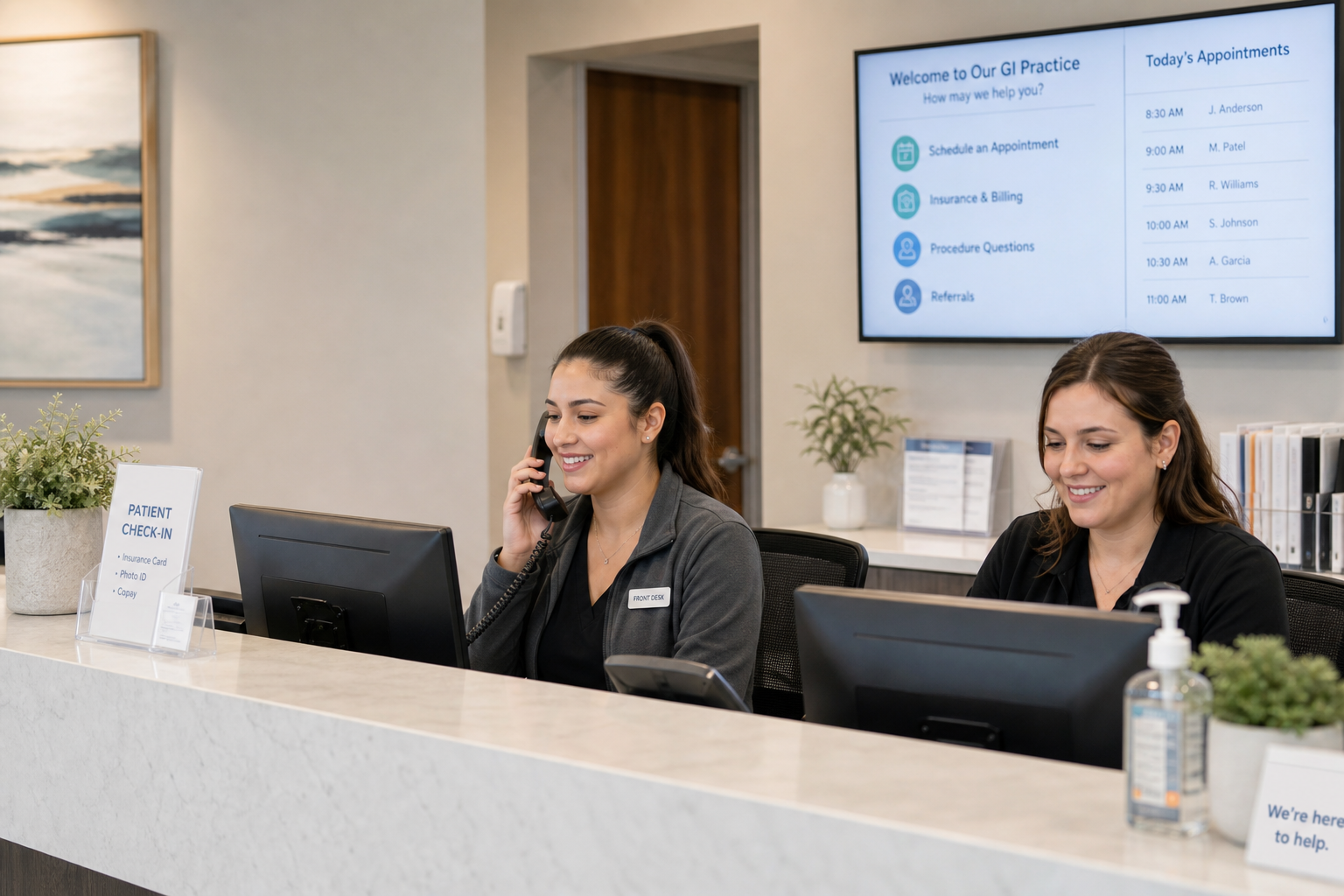
Compare 4 voice AI vendors for GI practices on colonoscopy scheduling, benefits verification, and prior auth calls. See which ones stop at booking.

Compare 5 AI voice agents for ENT and allergy practices. See which handle scheduling and the payer calls for prior auth and benefits checks.

Best AI agents for orthopedic practices compared on prior auth, outbound payer calling, and billing. Only 1 vendor resolves 60%+ of calls end-to-end.


