




The Best AI Voice Agents for Ophthalmology Practices in 2026
The 7 best AI voice agents for ophthalmology practices. Find platforms with ModMed & Nextech integrations, prior auth support, and patient automation.

Most healthcare organizations already run electronic eligibility checks. The real bottleneck is the 20 to 40 percent of cases where electronic responses come back incomplete, forcing staff onto payer phone calls. The best healthcare insurance verification services combine a low-cost electronic eligibility engine for routine checks with AI voice or managed-service escalation for complex benefits, prior-auth detection, and unclear network status. Prosper AI leads for phone-heavy verification workflows, while pVerify, Availity, and Claim.MD cover affordable electronic baselines.
Healthcare has largely digitized basic eligibility. According to the 2024 CAQH Index, 96% of medical eligibility and benefit verification transactions are fully electronic. That sounds like a solved problem. It is not.
CAQH still estimates a $12.3 billion annual savings opportunity from moving the remaining manual medical and dental eligibility work to fully electronic transactions. Each manual verification averages 16 minutes per transaction, with a 12-minute time savings opportunity from automation. Multiply that across a mid-size practice handling 50 verifications per day, and staff are spending over 13 hours daily on phone calls, payer portals, and IVR navigation.
The downstream effects go beyond wasted labor. Experian Health’s 2026 State of Patient Access Survey found that 28% of patients experienced care delays due to insurance verification issues, and 64% of providers said staffing shortages reduce patient access. Meanwhile, KFF reports that HealthCare.gov insurers denied about 19% of in-network claims in 2023, with denial reasons including lack of prior authorization, benefit limits, and member-not-covered errors, all problems that better upfront verification can catch.
The real operational question is not “Can we run eligibility?” It’s “What happens when the electronic response is incomplete?”
That question is what separates the best healthcare insurance verification services from commodity eligibility checkers.
| Vendor | Best For | Model | Public Pricing | Handles Payer Phone Calls | Main Tradeoff |
|---|---|---|---|---|---|
| Prosper AI | Complex benefits, payer calls | AI voice agent | Custom | Yes | Not a low-cost EDI-only checker |
| pVerify | Affordable electronic eligibility | Portal/API/batch | Yes, from $125/mo | No | Complex cases still need calls |
| Availity Essentials | Free baseline payer portal | Portal/clearinghouse | Free basic tier | No | Incomplete specialty/network details |
| Waystar | Enterprise RCM teams | Clearinghouse/RCM platform | No | No | Best value within broader suite |
| Inovalon | SNF/Medicare-heavy eligibility | SaaS eligibility | No | No | Not all payers or services covered |
| Stedi | Developer-led eligibility APIs | API-first clearinghouse | Not fully public | No | Requires engineering resources |
| Claim.MD | Small-practice clearinghouse | Clearinghouse | Yes, from $30/mo | No | Not a full verification service |
| Office Ally | Budget eligibility/claims | Clearinghouse/EHR adjunct | Yes, from $10/mo | No | Mixed UX and support sentiment |
| Experian Health | Hospital patient access | Patient access suite | No | No | Enterprise cost and implementation |
| Infinx | Outsourced verification + PA | Software + services | Custom | Human/service escalation | Requires vendor management and SLAs |
Every service was assessed across these dimensions:
Before the vendor list, it helps to understand that healthcare insurance verification services fall into four operational layers. Most organizations need at least two.
Layer 1: Electronic eligibility baseline. Fast, cheap 270/271 checks for active coverage, payer ID, plan dates, and basic cost-sharing. Vendors: Availity, pVerify, Claim.MD, Office Ally, Waystar, Stedi, Inovalon.
Layer 2: Benefits normalization and patient cost estimation. Deeper detail on deductible remaining, coinsurance, OOP max, visit limits, and service-level benefits. Vendors: pVerify, Experian Health, Waystar, Inovalon, Infinx.
Layer 3: Prior-auth detection and financial clearance. Flags whether the scheduled service, CPT code, or payer combination requires authorization. Vendors: Experian Health, Waystar, Infinx, Prosper AI. For a deeper look at how AI handles prior authorization, see AI prior authorization tools.
Layer 4: Payer phone-call escalation. Handles the cases where portals and EDI responses do not return enough detail. Staff either call payers manually, or an AI voice agent handles it. Vendors: Prosper AI; managed-service vendors like Infinx use human staff.
If a vendor cannot handle Layer 4, staff will still call payers. That is the core argument for why the cheapest eligibility checker is not always the best healthcare insurance verification service.
An EDI practitioner on Reddit described healthcare EDI as still a “loose standard,” even after decades of use. Another thread on eligibility and benefits APIs discussed the need to retain raw X12 data for payer debugging because normalized outputs do not always capture payer-specific quirks.
This matters. A 270/271 response can be technically successful but operationally useless if it omits service-level benefit detail, network status, or authorization requirements. Practitioners on Reddit report that Availity, for example, sometimes returns full eligibility information but does not clearly indicate whether the provider is in network, forcing staff to call the insurer anyway.
A useful metric for evaluating healthcare insurance verification services is what might be called the verification completeness rate: the percentage of scheduled encounters where the team has enough verified data to proceed without an additional payer call. If that number is below 80%, the electronic tool is creating a false sense of automation.

Best for: Specialty groups, health systems, RCM teams, and billing companies that need to automate payer phone calls when electronic eligibility tools return incomplete benefit detail.
Pricing: Custom, usage-based. Demo required.
Key features:
User perspective: A pharma hub president reported that Prosper’s QA accuracy for pharmacy and medical benefits verification outperformed humans in side-by-side reviews. A Northeast GI group with more than 100 providers had over 50% of front-desk scheduling and waitlist volume handled by AI agents within weeks.
Tradeoffs:
Bottom line: Use Prosper AI when the problem is not “Can we run eligibility?” but “Why are our people still spending hours on payer calls after eligibility comes back incomplete?” It is strongest as the escalation layer that sits on top of a clearinghouse or portal. To see how it fits your verification workflows, explore Prosper AI use cases or book a demo.
Best for: Small to mid-size practices that want affordable, public pricing for electronic eligibility, batch checks, API access, and insurance discovery.
Pricing: Advanced Eligibility Standard starts at $125/month for up to 500 transactions on a one-year term. Advanced Eligibility Enterprise starts at $395/month for up to 1,500 transactions. Insurance Discovery starts at $120/month for 80 transactions. MBI Lookup starts at $50/month. Onboarding starts at $495 for Standard and $950 for Enterprise.
Key features:
User perspective: Capterra shows pVerify at 4.3/5 across 41 reviews. Positive reviews mention ease of use, batch eligibility, stable API, and time savings. Negative feedback mentions payer downtime, still needing payer logins for certain cases, dental payer gaps, BCBS weekend limitations, and support concerns.
Tradeoffs:
Bottom line: pVerify is one of the most transparent options in the healthcare insurance verification services market. It is a strong electronic baseline. Pair it with a phone-escalation layer for cases where the 271 response does not return enough benefit detail.
Best for: Practices that need free or low-cost access to basic payer transactions, including eligibility and benefits, claim status, and remittance.
Pricing: Availity Essentials is often free for providers for core transactions. A BCBS of Texas FAQ confirms no setup fees, monthly fees, or per-claim fees for eligibility, claims, claim status, authorizations, and remittance through that portal relationship. Advanced features may carry per-transaction or subscription fees.
Key features:
User perspective: Gartner Peer Insights shows one rating at 3.0/5, with a reviewer noting “data accuracy challenges.” On Reddit, billers frequently use Availity as a free payer portal while relying on another clearinghouse for claims. Multiple practitioners report that when Availity does not clearly show network status or specialty benefits, they still have to call the insurer.
Tradeoffs:
Bottom line: Availity is a useful starting point, not a complete healthcare insurance verification service. Expect staff to supplement it with payer sites or phone calls whenever benefit details are ambiguous.
Best for: Healthcare organizations that want eligibility verification as part of a broader enterprise revenue-cycle platform covering claims, remits, patient payments, denial workflows, and prior authorization.
Pricing: Not publicly available. Enterprise contracting required.
Key features:
User perspective: Capterra shows Waystar with 205 reviews and an Insurance Eligibility Verification feature rating of 4.2 based on 36 reviews. Positive reviews mention ease of use and fast claims workflows. Negative reviews mention integration problems, customer service issues, and contract concerns. Practitioners on Reddit generally treat Waystar as a serious enterprise option but discuss contracts and extra costs.
Tradeoffs:
Bottom line: Waystar makes sense when eligibility is one piece of a broader RCM platform investment. It is less compelling as a standalone verification purchase.

Best for: Skilled nursing facilities and Medicare-heavy organizations that need quick eligibility checks with benefit limits, days used, coinsurance, and deductible visibility.
Pricing: Not publicly available.
Key features:
User perspective: G2 shows Inovalon Eligibility Verification at 4.4/5 across 12 reviews. Users praise ease of use, real-time verification, and SNF-specific benefit detail. Common complaints include lack of access to all payers, occasional login glitches, slower batch responses, and missing service-specific benefit information that still forces payer calls.
Tradeoffs:
Bottom line: Strong for facility-based eligibility, especially in Medicare-heavy settings. Not a general-purpose healthcare insurance verification service for multi-specialty groups.

Best for: Digital health companies, healthtech platforms, EHR/PM vendors, and engineering-led RCM teams that want modern API access to eligibility and other clearinghouse transactions.
Pricing: Not fully public. Contact vendor.
Key features:
User perspective: G2 shows Stedi at 4.9/5 across 18 reviews, the highest rating in this list. Users praise ease of integration, fast onboarding, strong support, and the simplification of EDI workflows. A common limitation is a learning curve around UI changes and healthcare EDI concepts.
Tradeoffs:
Bottom line: Stedi is infrastructure for teams that build. A healthtech company might use Stedi for electronic checks and a service like Prosper AI for phone-based payer exceptions.

Best for: Small practices, solo providers, and billing teams that want a straightforward clearinghouse with transparent pricing and included eligibility volume.
Pricing: Basic plan at $30/month. Small Volume at $60/month including 100 claims/ERA/eligibility per month. Unlimited at $120/month including unlimited claims, unlimited ERA, and 1,000 eligibility transactions per month. Extra eligibility checks may cost $0.02 for Prime payers and $0.10 for others (verify current pricing before purchase).
Key features:
User perspective: Practitioners on Reddit describe Claim.MD as user-friendly when accessed directly through the clearinghouse. Others mention price increases and cancellation or change notice requirements. A third-party review summarizes forum sentiment as generally positive on reliability and usability, with more caution around billing and service-policy details.
Tradeoffs:
Bottom line: Good value for small practices that need basic electronic eligibility and claims in one transparent package. Not designed for complex, service-level benefits verification.
Best for: Price-sensitive small practices that need basic eligibility, claims, ERA, and practice-management workflows.
Pricing: Eligibility and Benefits Verification at $10/month for the first 100 transactions and $0.10 each after. EHR 24/7 product listed at $44.95/month per provider. Clearinghouse tools start free with potential transaction fees.
Key features:
User perspective: Trustpilot feedback is mixed. Some users praise easy transition and long-term reliability. Others complain about rate increases, slow performance, payment issues, and frequent password changes. Reddit billing discussions position Office Ally as cheap and useful for small providers, but not the most polished option.
Tradeoffs:
Bottom line: The lowest-cost entry point for healthcare insurance verification services, but buyers get what they pay for. Fine for low-volume practices willing to tolerate a less refined experience.

Best for: Hospitals and large health systems that want eligibility verification as part of a broader patient access, coverage discovery, cost estimation, and financial-clearance program.
Pricing: Enterprise custom pricing. No public price list.
Key features:
User perspective: Experian Health says it serves more than 60% of U.S. hospitals and more than 7,500 medical practices, labs, pharmacies, and other providers. On Reddit, a healthcare practitioner mentioned Experian OneSource/Passport as a portal option that can verify insurance across many payers, though some workflows still require manual steps.
Tradeoffs:
Bottom line: The most established enterprise patient access suite. Best when eligibility is one component of a broader financial clearance strategy for hospitals and health systems.
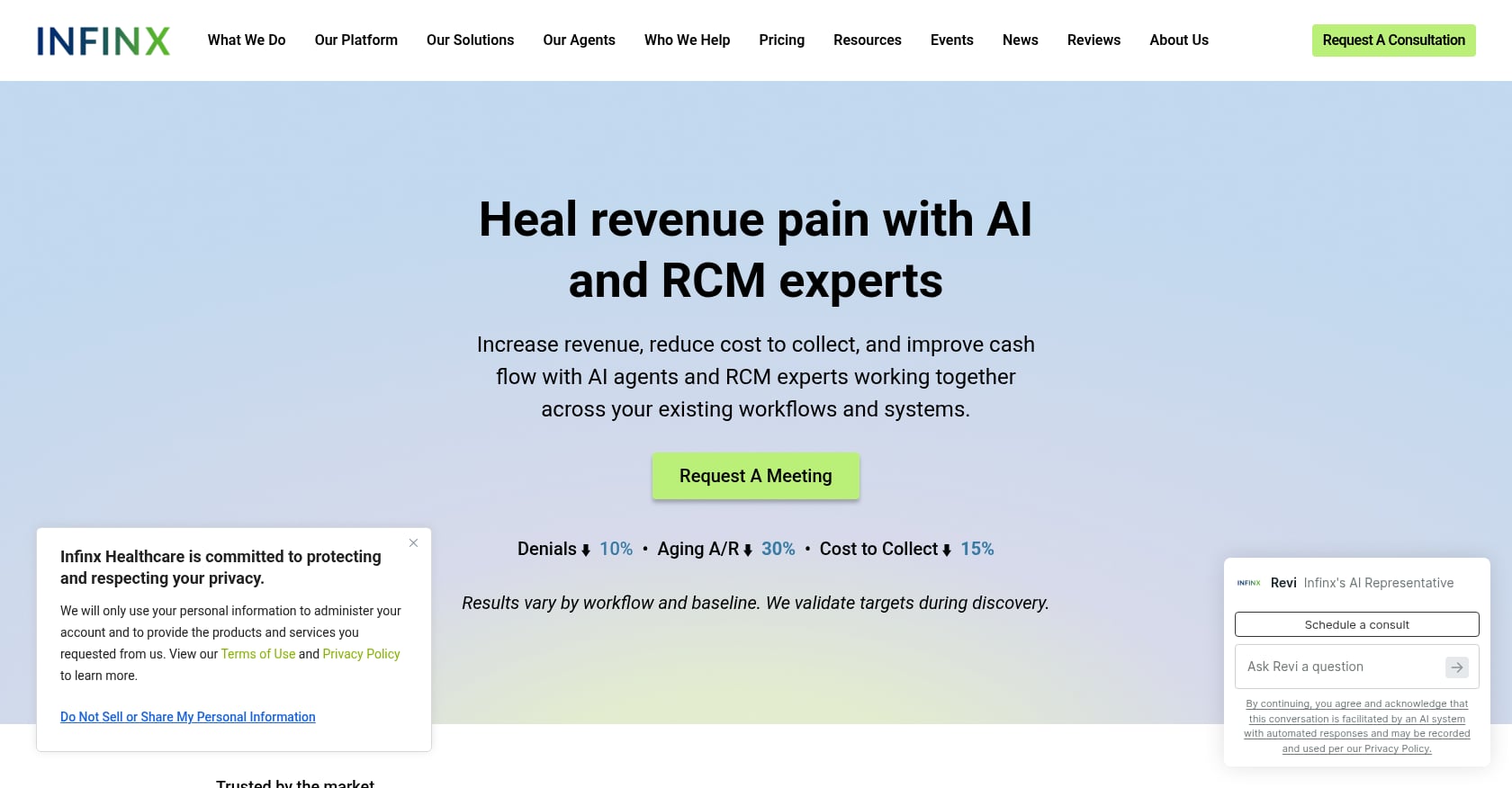
Best for: Organizations that want eligibility verification plus human or AI support across patient access, benefits checks, patient estimates, insurance discovery, and prior authorization workflows.
Pricing: Custom. Infinx says pricing depends on solution mix, volumes, workflows, and integration needs. Standard support and upgrades are included.
Key features:
User perspective: Infinx’s customer quotes include one describing a 90% decrease in workload and a 2% denial rate. However, G2 has too little review data for Infinx Healthcare to give independent buying insight. The limited independent review footprint is worth noting.
Tradeoffs:
Bottom line: Infinx combines platform and human operations. It is a reasonable choice for organizations that want outsourced operational support, but buyers should press hard on SLAs, QA processes, and auditability. For organizations that want AI agents rather than human agents handling payer calls, Prosper AI takes a different approach with AI voice agents for medical billing teams.
Different buyer profiles need different solutions. Here is a practical framework:
Solo or small practice (under 5 providers). Start with Claim.MD, Office Ally, Availity, or pVerify. Keep costs low, and have staff call payers manually for the cases where electronic data is incomplete.
Specialty practice with complex benefits (behavioral health, GI, OB/GYN, orthopedics, imaging, DME). Use pVerify or Availity for electronic checks, then add Prosper AI for payer phone calls. Specialty benefits, carve-outs, and prior-auth requirements rarely come through cleanly in a 270/271 response. See insurance verification automation for specialty groups.
RCM or billing company. Volume and multi-client workflows make a clearinghouse/API baseline essential, plus a phone-escalation layer for difficult cases. Prosper AI plus a clearinghouse like pVerify or Availity covers both ends.
Hospital or health system. Experian Health or Waystar for enterprise patient access and financial clearance. Add Prosper AI for payer-call automation that sits outside the electronic transaction layer.
SNF or Medicare-heavy facility. Inovalon for Medicare-specific eligibility detail plus an escalation process (internal staff or AI voice agent) for exceptions.
Digital health company or EHR vendor. Stedi for API infrastructure plus internal rules logic or an AI escalation partner for incomplete responses.
Outsourced-ops buyer. Infinx for software plus managed human services.
A quick eligibility demo looks great. The real test is what happens with your actual payer mix, specialty, and exception volume. Use this checklist:
Here is a simple formula to estimate your current labor spend on manual insurance verification:
Monthly manual verification cost = number of manual verifications x average minutes per verification / 60 x fully loaded hourly wage
Using the CAQH average of 16 minutes per manual eligibility transaction:
That does not include denial rework, patient callbacks about surprise bills, reduced point-of-service collections, overtime, or the opportunity cost of staff who could be working on patient care instead of sitting on hold. For practices running more volume or dealing with specialty-heavy payer calls, the number climbs quickly.
For a broader look at how AI can reduce costs across the revenue cycle, see the AI for revenue cycle management guide.
Good healthcare insurance verification services do more than confirm active coverage. They flag whether the scheduled service requires prior authorization before the visit. The AMA reports that 78% of physicians say prior authorization often or sometimes leads patients to abandon treatment. MGMA reports that 92% of surveyed medical group practices hired or reassigned staff to handle growing prior authorization volume.
If verification only tells you “patient is active” but does not surface a prior-auth requirement, you risk same-day cancellations, post-service denials, or patients abandoning care entirely. When evaluating verification services, ask specifically whether prior-auth detection is part of the workflow or an add-on module.
If your team only needs low-cost electronic eligibility checks, start with a clearinghouse or portal like pVerify, Availity, Claim.MD, or Office Ally. If you need enterprise financial clearance, look at Waystar, Experian Health, or Infinx.
But if the real bottleneck is payer phone calls (IVRs, hold time, live reps, and missing benefit details) Prosper AI is the strongest fit because it automates the work most electronic tools leave to staff. It is not a replacement for your clearinghouse. It is the layer that finishes what your clearinghouse starts.
Book a Prosper AI demo to see how it handles your specific payer mix and verification workflows.
A healthcare insurance verification service confirms a patient’s insurance coverage, benefits, and eligibility before or at the time of service. Services range from basic electronic 270/271 eligibility checks to full benefits verification, coverage discovery, prior-auth detection, and payer phone-call automation.
Eligibility verification confirms whether a patient has active coverage for a date of service. Benefits verification goes deeper: it captures service-level details like copays, coinsurance, deductible remaining, out-of-pocket max, visit limits, referral requirements, and plan exclusions. Active coverage does not mean the service is covered, in network, authorized, or financially clear.
Not always. While 96% of medical eligibility transactions are electronic, the remaining cases, plus many benefit-detail requests, still require payer portal lookups or phone calls. Specialty benefits, carve-outs, unclear network status, and prior-auth requirements frequently do not come through in a standard 271 response.
Costs range widely. Office Ally starts at $10/month. Claim.MD ranges from $30 to $120/month. pVerify starts at $125/month. Enterprise platforms like Waystar and Experian Health use custom pricing. AI voice services like Prosper AI use custom, usage-based pricing. The right comparison is not just the tool cost but the total cost including staff time on exceptions.
Yes. AI voice agents like Prosper AI can call payers, navigate IVRs, wait on hold, speak with payer representatives, and capture structured benefit data. API-based tools automate electronic 270/271 checks. The two approaches solve different parts of the verification workflow.
Most established healthcare insurance verification services are HIPAA compliant and will sign a Business Associate Agreement. Buyers should also ask about SOC 2 certification, encryption standards, data retention policies, and whether the vendor uses third-party AI models with appropriate data-handling agreements.
It depends on volume and complexity. Small practices with simple payer mixes can often manage with a low-cost clearinghouse. Practices with specialty benefits, high denial rates, or staffing constraints get more value from outsourcing or adding an AI verification layer. The key question is how much staff time currently goes to payer calls and denial rework.
At minimum: active coverage, payer, plan, member ID, policy dates, copay, coinsurance, deductible remaining, out-of-pocket max, in-network status, service-level benefits for scheduled procedures, referral or authorization requirements, coordination of benefits, and an estimated patient responsibility. Anything less creates risk.
Discover how healthcare teams are transforming patient access with Prosper.

The 7 best AI voice agents for ophthalmology practices. Find platforms with ModMed & Nextech integrations, prior auth support, and patient automation.

Our September 2026 FQHC voice agent comparison covers Medicaid verification, payer calls, prior auth, and multilingual support across five tools.

AI front desk automation for multi-site groups: EHR write-back, full call coverage, HIPAA compliance, and realistic timelines. September 2026.


